





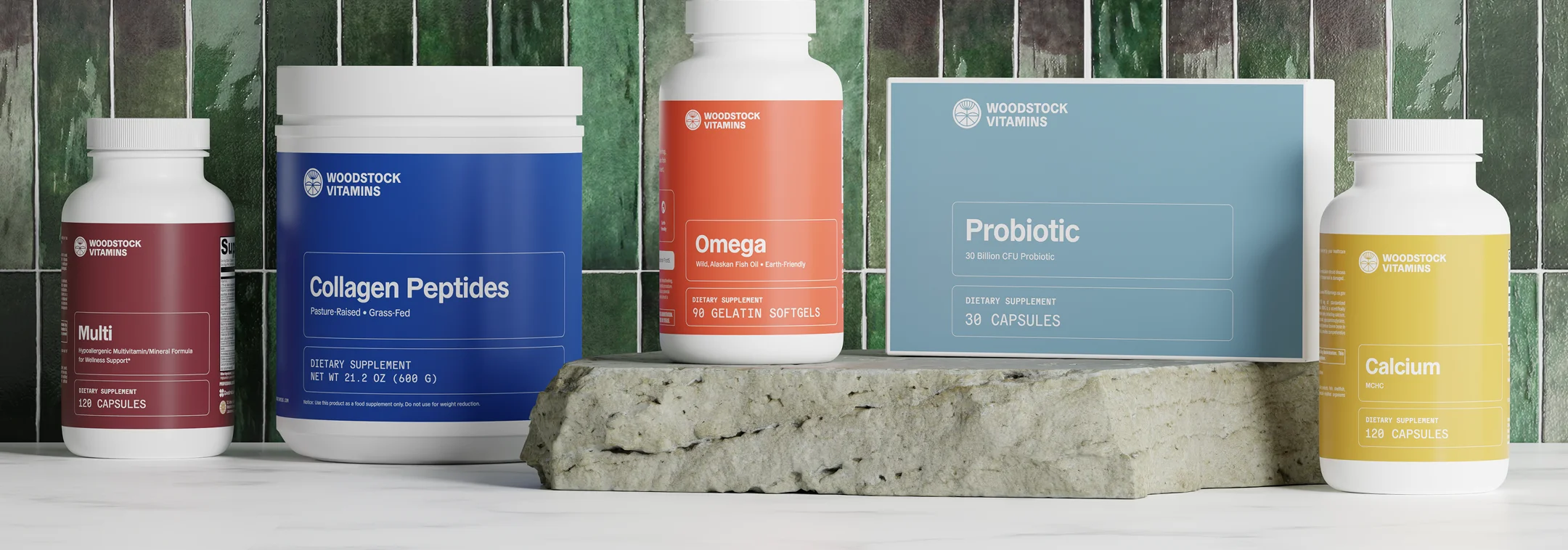


Everyone says more is more when it comes to supplements. But is it? When a concern comes up, the instinct is to buy something new for it. Low energy? Add B vitamins to cart. Poor sleep? Grab magnesium. Joint discomfort? Try Collagen. Immune support? More vitamin C and zinc are needed. When you repeat that process enough times, the cabinet fills with bottles that each seem reasonable on their own. Months later, the routine is more complicated, more expensive, and often no more effective than when it started. This isn’t a willpower problem or a discipline problem. It’s a structural one. Adding supplements on top of a missing foundation doesn’t compound. It stalls your progress. Here’s why more isn’t more and what you should do instead.
The Assumption That Doesn’t Hold Up
The logic behind “more” feels sound on the surface: more nutrients, more coverage, more bases covered. But the body isn’t a checklist. Nutrients don’t work in isolation, nor in a vacuum. They depend on a baseline of foundational nutrients that impact nearly every body system and fill the gaps diet leaves behind.
When that nutritional baseline is missing, a newly added, more targeted product isn’t going to build upon your health goals. It’s operating without the groundwork that gives it a system to work within. The result is a routine that looks thorough on paper and doesn’t move the needle in practice.
Why Foundations Matter
A nutritional foundation isn’t about finding the “perfect” supplement. It’s about ensuring that the nutrients with the broadest impact—the ones many people don’t consistently get enough of through diet alone—are adequately covered before moving on to more targeted goals.
Foundational nutrients support processes that happen every day:
- Energy production
- Muscle function
- Bone health
- Immune function
- Nervous system signaling
- Cellular repair
- Protein synthesis
- Hormone production
When those systems are well supported, the body is generally in a better position to respond to more specific interventions. That doesn’t mean every targeted supplement suddenly becomes dramatically more effective. It means they’re no longer trying to compensate for a more basic nutritional gap.
What Happens Without a Foundation
Here’s how routines typically drift away from what’s actually useful.
Redundancy Without Coverage
One of the most common patterns is overlap. A multivitamin, greens powder, immune blend, and recovery formula may all contain some of the same vitamins and minerals, while still leaving genuinely under-consumed nutrients insufficient. In other words, you can end up taking multiple products that all emphasize similar ingredients while missing the nutrients that actually deserve priority. The cabinet looks complete. The nutritional foundation isn’t.
Chasing Symptoms Instead of Systems
Many supplements are marketed around individual concerns. One product promises better focus. Another promises better sleep. Another promises joint comfort. Another immunity. Each addresses a single outcome. But those outcomes don’t exist independently. Sleep influences recovery. Recovery influences exercise performance. Exercise affects energy. Energy affects cognitive function. Nutrition supports every one of those systems simultaneously. When the foundation isn’t covered, it’s easy to spend months treating individual symptoms without improving the broader physiological environment that supports them all.
Less Clarity on What Moved the Needle
The more products that enter a routine without a clear purpose, the harder it becomes to evaluate what’s actually helping. If energy improves, was it the new magnesium? Better sleep? More consistent vitamin D? The extra protein? Something unrelated entirely? Likewise, if nothing changes, it’s impossible to know whether the routine needs more time, fewer products, or a completely different approach. Every unnecessary addition makes the reasoning weaker. Simple routines create clearer feedback.
Cost Without Better Results
Supplement spending often grows much faster than benefit. It’s easy to spend hundreds of dollars each month assembling products aimed at increasingly narrow goals while overlooking the nutrients with the strongest evidence for broad, everyday health. A foundation-first approach does the opposite. It prioritizes nutrients that support multiple body systems, have substantial research behind them, and are commonly under-consumed. Only after that foundation is established does it make sense to ask whether something more specialized is likely to provide additional value.
Abandoning Supplements Too Early
Complex routines don’t usually fail because they’re ineffective. They fail because they’re difficult to maintain. You’ve got morning pills, evening pills, products that need food, products that need an empty stomach, products before workouts, products after workouts, and the list goes on. Even the most motivated people eventually miss days, then weeks, then stop altogether. Consistency matters more than complexity. A routine that someone follows for years will almost always outperform a theoretically perfect routine that lasts six weeks.
The Hidden Cost of Constantly Adding
There’s another downside that often goes unnoticed. Every new supplement changes expectations. Instead of asking, “Am I covering the basics?” people begin asking, “What’s the next thing I should add?” The routine gradually becomes centered around accumulation rather than evaluation. More bottles become a substitute for better decision-making. This creates an endless cycle of optimization without much actual progress. Sometimes the best next step isn’t another supplement. It’s simplifying the routine enough to identify what’s actually providing value.
The Case for Foundation-First
The nutrients that belong in a foundation share several characteristics. They’re commonly under-consumed, even among people who generally eat well. They support multiple physiological systems rather than one narrow function. They’ve been studied extensively and have evidence supporting long-term, daily use when intake is inadequate.
And they’re relevant to a broad portion of the population—not because everyone is deficient, but because dietary intake often falls short of recommended levels. That combination is what makes them worth prioritizing before anything else. Not because targeted supplements don’t have a place. Not because personalization doesn’t matter. But because specialization only makes sense once the fundamentals are in place.
Consistency Beats Constant Optimization
It’s tempting to think better results come from finding increasingly specialized solutions. In reality, many of the biggest gains come from consistently doing the basics well. A routine built on a solid nutritional foundation—and followed day after day—is usually more valuable than a larger collection of products taken inconsistently.
This isn’t the least ambitious approach. It’s the one most aligned with how long-term health behaviors actually succeed. Foundations aren’t meant to be exciting. They’re meant to be effective.
Where This Leaves You
None of this means additional, more targeted supplements are the wrong idea. For the right person, with the right goal, at the right time, they can absolutely make sense. But they’re rarely the right first step. Start with the nutrients that provide the broadest support, establish consistency, and then evaluate whether there’s a clear reason to add something more specific.
Foundation first. Everything else second. Not because more is inherently bad, but because more without a foundation underneath it rarely produces the results people are actually looking for. If you’re not sure whether your own routine has that foundation in place, start with the quiz. It’s the fastest way to identify what’s actually missing before adding anything else.
There’s a moment almost everyone hits eventually: nothing feels like it’s working, so you add something. A new bottle. A new blend. Something with a bolder label than the last one. It feels like progress, but it rarely is. “More” is the industry’s default answer to almost every problem. It’s also, most of the time, the wrong one. Let us explain.
The “More” Reflex and Why It Doesn’t Compound
Adding a product on top of a shaky nutritional foundation doesn’t create momentum or lead to good results. It creates noise. If your baseline nutrient gaps are still open, a new supplement or product isn’t building on anything. Your progress ends up being imaginary.
This is the quiet failure behind most crowded supplement cabinets. It’s not laziness or a lack of effort. It’s a structural mistake. It’s treating supplementation like a collection to have instead of a foundation to build up. Ten half-used bottles rarely outperform two or three thoughtfully taken ones with consistency. That’s because the ten were never really working together in the first place. They were working around each other. Remember, results don’t compound when the thing underneath them keeps shifting.
What Compounding Actually Looks Like
Compounding requires two things: the right starting points and time spent not disrupting them.
In nutrition, that means closing the gaps that are broadly under-consumed and are foundational to total body health. These are the nutrients most diets miss regardless of how careful someone is, and then giving the body a consistent baseline to work from. Omega-3s help support brain and cardiovascular health. Calcium and Vitamin D help support bone strength and density over time. A balanced gut microbiome, supported by the right probiotic strains, plays a role in digestion and broader system function. None of that shows up as a single dramatic before-and-after. It shows up as a baseline that holds month after month, instead of resetting every time a routine changes.
That’s the part the industry rarely tells you: benefits compound. They don’t spike and then crash. A formula that promises a fast, singular turnaround is, by definition, promising something a nutrient can’t deliver on its own. The honest version is slower and less exciting to put on a label — and it’s the one that actually holds up over time.
Why the Foundation Has to Come First
This is the reasoning behind the First5: five nutrients that are broadly under-consumed even in strong diets, backed by a meaningful body of evidence, relevant across multiple body systems, and appropriate for long-term daily use. Everything else — however well-formulated and interesting from a research perspective — is secondary until that baseline is in place.
Layering something promising on top of an open gap doesn’t get you further ahead. It just means you’re optimizing on top of a hole. Foundation first isn’t a slogan. It’s the only sequence that lets anything after it actually work.
Restraint Is Part of the Strategy
We say no to more products more often than we say yes to them — on purpose. A well-marketed add-on that isn’t yet earned doesn’t belong in a starting recommendation, no matter how good the story behind it sounds. Situational supplements have a place, but only after consistency with the foundation is already established. Not before. Not instead of.
This is a different posture than most of the category takes, and it’s a deliberate one. A crowded cabinet isn’t a sign of a serious wellness practice. A short list, taken consistently, usually is.
What This Looks Like in Practice
Start with the foundation, not the newest thing on the shelf. If you’re not sure where your own gaps are, Find Your Foundation walks you through it. It’s built to identify which of the First5 belong in your starting point, not to hand you a shopping list. From there, the work is mostly about showing up: the same handful of things, taken the same way, for long enough that they can actually do what they’re formulated to do.
This is what turns supplementation from a stack of purchases into an actual practice — one you commit to because the foundation is right, not because you found one more thing to add to the pile. Fewer supplements. Better decisions. Results that build instead of fade.
Most supplement labels are written to be glanced at, not read. The front of the bottle is nothing but bold claims, a clean font, a word like “premium” doing a lot of heavy lifting. The back is where the actual information lives, and almost nobody reads it the way it deserves to be read.
Dr. Neal Smoller does. Pharmacist training doesn’t go away just because the product in front of him is a supplement instead of a prescription. The same questions apply: What’s actually in here? In what amount? In what form? And does any of that match what the front of the bottle is implying?
Here’s that lens, broken down into something you can use the next time you’re standing in an aisle or scrolling a supplement’s shop page.
Start With the Serving Size — Not the Numbers Below It
Before you look at a single nutrient amount, check two things at the top of the panel: serving size and servings per container.
This is the most common place labels create an impression that isn’t quite true. A bottle might list an impressive dose of an ingredient. But if that dose requires three capsules, and the “serving size” is three capsules, a 90-capsule bottle is actually a 30-day supply, not the 90-day supply the price made you assume. Worse, some labels list the per-serving amount in a way that makes a two-capsule product look like it delivers the dose of one capsule.
This framing means every other number on the label has to be read in the context of “per how many capsules, how often.”
What to check: Does the serving size match how the product is actually meant to be taken — once a day, as a foundational supplement — or does it require stacking multiple capsules to hit the dose mentioned on the front of the bottle?
The Ingredient List: Order, Form, and Amount
Ingredients on a Supplement Facts panel are typically listed in descending order by weight. That’s useful, but the more important question is the form, not just the presence, of an ingredient.
Two products can list “calcium” and mean very different things. Calcium carbonate is cheap and common, but it depends on stomach acid for absorption and can cause digestive discomfort. Calcium hydroxyapatite behaves differently in the body and is absorbed more consistently. Same nutrient, same word on the label — different outcome.
This pattern repeats across nearly every category:
- Omega-3: ethyl ester vs. triglyceride form changes how much of it your body actually absorbs.
- Minerals: chelated forms (bound to an amino acid) are typically absorbed more efficiently than non-chelated forms.
- B vitamins: activated, methylated forms (like methylcobalamin) don’t require your body to do an extra conversion step that some people are genetically less efficient at.
A label that just says “Vitamin B12” without specifying the form is telling you less than it appears to.
What to check: Does the label name the specific form of each nutrient, not just the nutrient itself? If it doesn’t, that’s a gap worth noticing — not necessarily a dealbreaker, but a sign to look closer.
Proprietary Blends: The Single Biggest Red Flag on the Shelf
If you only take one habit from this article, take this one: be skeptical of any “proprietary blend,” “complex,” or “matrix” that lists a group of ingredients followed by a single combined amount.
A proprietary blend might say “Energy Complex: 500mg” and then list eight ingredients underneath it. What you don’t get is how much of each individual ingredient is in that 500mg. It could be one dominant cheap ingredient padded out with trace amounts of the expensive, well-studied ones — and you have no way to know, because the label isn’t required to tell you.
This matters because dose is the whole game. An ingredient with strong research behind it is only meaningful at the dose that research actually used. Hidden behind a blend, you can’t tell whether you’re getting a real dose or a token amount that exists mostly so the ingredient can appear on the front of the bottle.
What to check: Are individual ingredients and their individual amounts listed — or are they buried inside a named blend with one combined number?
Daily Value vs. Studied Dose
You’ll often see a “% Daily Value” (%DV) next to a nutrient. That percentage is based on general nutritional adequacy — the amount needed to prevent classic deficiency. It is not the same as the dose used in the research behind a specific benefit.
For some nutrients, 100% DV is a reasonable, sufficient target — this is generally true for a well-formulated multivitamin, where the goal is filling baseline gaps, not chasing a therapeutic dose. For others, the dose that shows up consistently in research is meaningfully higher than 100% DV, and a product dosed only to hit the DV number is, functionally, underdosed for the result implied on the bottle.
What to check: Is this a “fill the gap” nutrient, where 100% DV is the right target — or a “this is the dose the research actually used” nutrient, where the DV number isn’t the relevant one? Knowing the difference is most of the battle.
The Words That Are Doing No Work at All
Certain words exist almost entirely to create a feeling, not to convey information. None of them are regulated in any way that requires the brand to prove anything:
- “Natural” has no enforced definition for supplements.
- “Pure” and “Clean” are vague quality claims with nothing standardized behind them.
- “Premium” describes a price point, not a formulation.
- “Doctor recommended” or “clinically proven” imply a level of substantiation that’s rarely specific to the actual product in your hand — research on an ingredient is not the same as research on this formula, at this dose, made this way.
None of these words are illegal. They’re just noise. A well-formulated product doesn’t need them, because it can point to something specific instead: an exact dose, a named form, a sourcing standard, a testing certification. If a label leans on feeling-words instead of specifics, that’s information too.
What to check: For every claim-word on the front of the bottle, ask: what specific fact on the back of the bottle backs this up? If there isn’t one, the word is decoration.
Third-Party Testing: The Seal That Actually Means Something
Supplements are not reviewed by the FDA before they go to market the way medications are. That makes third-party testing one of the only real verification layers in the category — and one of the most overlooked things on a label.
Look for an actual certification mark from an independent testing body (such as USP, NSF, or a named third-party lab), not just the phrase “tested for purity” with nothing to back it. A brand stating that it tests its products is not the same as a brand submitting to outside verification it doesn’t control.
What to check: Is there a real, named third-party certification or just a sentence claiming quality with no outside party attached to it?
Inactive Ingredients Count, Too
It’s easy to scan past the bottom of the label — fillers, binders, coatings, flow agents — because they’re not the “point” of the product. They should still get a look. If a capsule contains unnecessary artificial colors, excessive fillers, or coatings with no functional purpose, that’s a formulation choice, and it tells you something about how carefully the rest of the product was put together. If it’s in the capsule, it has to belong there.
What to check: Are the inactive ingredients minimal and purposeful, or is there a long list of things with no clear reason to be there?
The Disclaimer Isn’t a Red Flag — It’s the Opposite
A lot of people see this sentence on a label and read it as a hedge, or even a confession that the product doesn’t work:
“These statements have not been evaluated by the Food and Drug Administration. This product is not intended to diagnose, treat, cure, or prevent any disease.”
It’s actually the opposite. That disclaimer is required by law on legitimate structure/function claims — statements about how a nutrient supports normal body function. Its presence means a brand is making the kind of claim it’s legally allowed to make. What should concern you more is a brand making claims that sound like they treat or cure something specific, with or without a disclaimer attached, because no supplement is allowed to make that claim, disclaimer or not.
What to check: Is the disclaimer present on a product making structure/function claims? Good, that’s the system working as intended. Is a product implying it treats a specific condition? That’s the actual problem, regardless of what disclaimer is or isn’t nearby.
A Two-Minute Label Checklist
Next time you’re evaluating a product — ours or anyone else’s — run it through this list:
- Serving size: Does it match how the product is actually meant to be taken?
- Form: Is the specific form of each nutrient named, not just the nutrient?
- Blends: Are individual amounts listed, or hidden inside a combined “complex”?
- Dose: Is this a fill-the-gap nutrient (where %DV is the right target) or a research-dose nutrient (where %DV likely isn’t enough)?
- Claim words: Does every feeling-word on the front have a specific fact backing it up on the back?
- Testing: Is there a real, named third-party certification?
- Inactives: Are fillers and binders minimal and purposeful?
None of this requires a science degree. It requires slowing down for about two minutes and reading the label the way it’s actually meant to be read — as the most honest part of the package, once you know what you’re looking at.
This is the same lens behind every product Woodstock Vitamins makes. If you want the longer version of where it comes from, read What It Means to Have Neal in Your Corner. If you’d rather skip ahead to where your own foundation should start, find your foundation.
Foundational supplements work best when taken consistently over time, but if a product isn’t the right fit, our team is here to help you adjust your plan. Our goal isn’t to sell more products — it’s to help you build a routine that actually supports your health.
We offer several shipping options within the U.S., including free shipping on orders over $60. Orders placed before 4 PM EST, Monday through Friday, ship the same day. You can find more details at woodstockvitamins.com/shipping.
To redeem your points, click the green Rewards Program button at the bottom of your screen. Under the Redeem section, select either the $3-off (100 points) or $12-off (400 points) coupon and click Redeem to generate your code. At checkout, enter the code in the discount code field. You can use one coupon code per transaction. If you don’t use the code right away, it never expires — just contact us if you need it looked up.
We will gladly accept any unopened item purchased from Woodstock Vitamins for any reason within thirty (30) days of purchase. Refunds are issued promptly upon receipt of unopened items to the original payment method. Shipping and handling charges are non-refundable. To start a return, contact us via email, phone, or chat. If you’re local to Woodstock, NY, you can bring your purchase to our store at 79 Tinker Street for an immediate refund. Full policy: https://www.woodstockvitamins.com/returns
Enrolling in Woodstock Rewards is automatic — once you create an account, you’re in. You’ll earn 1 point for every dollar you spend on our website, plus extra points for things like referring friends, subscribing to our newsletter, and reviewing products. You can start redeeming once you have at least 100 available points.
Your shipment should arrive within 2–6 business days from the date you placed the order. Orders placed before 4 PM EST, Monday through Friday, ship the same day. Once your order ships, we’ll send a confirmation email with your tracking number.
Dr. Neal Smoller, PharmD, is a holistic pharmacist, supplement strategist, and the founder of Woodstock Vitamins. His mission is to challenge the natural products industry by redefining holistic care and setting the standard for supplement quality. His methods and products are backed by real science, and with them, he builds and supports his customers’ lifelong wellness strategies. You can learn more about Dr. Neal at https://drnealsmoller.com.
Woodstock Vitamins products are made in several US facilities, hand-selected and vetted by our founder, Dr. Neal Smoller, PharmD. All products are manufactured in the United States in cGMP-compliant facilities. We use a variety of contract manufacturers to ensure each product is made by the specialists best equipped for that product type. Our high-quality ingredients are sourced from around the world, depending on the best location to grow, harvest, and process them.
Yes. All of our products are third-party tested for heavy metals like lead, cadmium, and mercury, as well as contaminants like E. coli, Salmonella, yeast, and mold. Every product we recommend must meet the Supplement Quality Standard — our internal benchmark for quality, manufacturing compliance, sourcing, and value. If a product fails any part of it, we don’t sell it.
At some point, almost everyone who starts thinking seriously about supplements asks the same question: what’s the best brand?
It feels like a reasonable place to start. Brands are how we navigate most consumer categories. You find one you trust, you buy from it, you don’t have to think too hard about the rest. The problem is that supplements don’t work like most consumer categories — and starting with brand leads almost everyone to the same place: a cabinet full of things they’re not sure about, a routine they can’t sustain, and results that are hard to measure and easy to doubt.
The question isn’t wrong because brands don’t matter. They do. The question is wrong because it skips the step that actually determines whether a supplement is worth taking at all.
The Wrong Question
Brand-first thinking puts marketing in charge of your supplement decisions. And supplement marketing is very good at one thing: making you feel like whatever you’re currently taking isn’t quite enough.
There’s always a new ingredient. A new delivery mechanism. A new study — usually preliminary — that generates a wave of products and claims before the research has had time to replicate. The brand-first approach means you’re navigating that noise without a filter. You’re comparing labels, reading reviews, trying to parse the difference between “clinically studied” and “clinically effective,” wondering whether the 47-ingredient formula is better than the 12-ingredient one, and whether the one your friend takes is actually doing anything.
This isn’t a consumer failure. It’s what the industry is designed to produce. Confusion is profitable. A person who has a clear sense of what they need and why is a much harder sell than a perpetually uncertain person.
The same dynamic drives trend-first supplement thinking. When something trends — collagen a few years ago, lion’s mane more recently, whatever comes next — the question it generates is “should I be taking this?” That question assumes the trend is the starting point. It isn’t. The trend is a marketing event. Whether the ingredient deserves a place in your routine is a completely separate question, and one that requires a different kind of answer.
The Right Question
The question that actually produces useful answers is this: which nutrients do most people need and aren’t getting?
That’s it. When you start there, the noise drops out immediately. You’re no longer evaluating brands or trends. You’re evaluating nutrients — what they do in the body, what the evidence shows, how common deficiency or insufficiency actually is, and whether a person can realistically get enough from food alone.
When Neal started asking that question — applying a pharmacist’s evidence standard to the supplement category — a pattern emerged that he couldn’t ignore. Across the population, the same nutrients kept showing up as undersupplied. The same gaps kept appearing in the same people. And the science supporting supplementation for those specific nutrients was far stronger and more consistent than the science supporting most of what fills supplement shelves.
The answer to the right question isn’t a brand. It’s five nutrients. Every time.

The First5 and Why
The First5 aren’t a product bundle. They’re the answer to a nutrient question, and they’re there because they each cleared the same bar: broadly under-consumed in modern diets, supported by strong and consistent evidence, relevant to multiple body systems, and safe for long-term daily use.
Omega-3s. EPA and DHA — the long-chain omega-3s found in fatty fish — are the building blocks of cell membranes throughout the body, including in the brain and cardiovascular system. Modern diets, even reasonably healthy ones, rarely deliver the amounts the research associates with meaningful benefit. Plant-based omega-3 sources provide ALA, which the body converts to EPA and DHA inefficiently. Most people are running low on the forms that actually matter, and the downstream effects influence your natural inflammatory response, cognitive function, joint health, and cardiovascular health — which is what it looks like when a nutrient is relevant across multiple systems.
Probiotics. The gut microbiome — the ecosystem of bacteria that lives in the digestive system — is involved in far more than digestion. It influences immune function, mood, and nutrient absorption. Modern life is systematically hard on that ecosystem: processed food, antibiotic use, chronic stress, and environmental factors all disrupt it. A well-formulated probiotic, chosen for strain specificity rather than CFU count, supports the gut environment that everything else depends on.
Calcium and Vitamin D. Calcium is the structural mineral of bone. Vitamin D is the mechanism by which the body absorbs and uses it. The two are inseparable — calcium without adequate D doesn’t behave the same way in the body — and insufficiency in both is common across the population, not just in the groups that typically get warned about it. Low sun exposure, limited dairy, and the gradual decline in bone density that begins earlier than most people expect make this a foundation piece for most adults.
Collagen Peptides. Collagen is the most abundant protein in the human body — the structural material of skin, joints, bones, connective tissue, and the gut lining. The body produces it, but production declines with age, and modern diets have almost entirely eliminated the collagen-rich foods — bone broth, skin-on cuts, organ meats — that used to supply it. This isn’t a general protein gap. It’s a specific structural gap that no other protein source closes, and the research on hydrolyzed collagen peptides shows meaningful support for the systems that depend on it.
Multivitamin. Not the multi-as-everything solution that decades of marketing has promised — but a well-formulated multivitamin as a genuine gap-closer. Modern food supply, dietary patterns, and individual variation leave most people consistently short on specific vitamins and minerals: B vitamins, magnesium, vitamin D, iron. A multivitamin built with the right forms at clinically relevant doses addresses those gaps without requiring a person to figure out and manage each one individually.
These five are in the First5 because the evidence put them there. They’re not the most exciting category. They’re not trending. They’re the nutrients that most people are missing and that the science most consistently supports — and that combination, it turns out, is both rare and worth paying attention to.
The Execution Gap
Here’s where things get complicated. Most people who take at least some of these nutrients aren’t taking them correctly — and in supplements, how you take something is often as important as what you take.
Form is the clearest example. Many multivitamins use synthetic B vitamins that a meaningful portion of the population can’t properly convert into usable forms. Many calcium supplements use calcium carbonate, which has lower bioavailability than other forms and requires stomach acid to absorb — an issue for anyone whose stomach acid is reduced, which includes a large number of older adults. Many fish oils deliver far less active EPA and DHA than their label implies, because the label counts total omega-3 rather than the fractions that the research actually studied. Many probiotics lead with CFU count — billions of bacteria — when strain specificity is what determines whether a probiotic does anything relevant to your health.
Dose matters for the same reason. An ingredient at half the dose used in the research that supports its claims is not half as effective. It may be effectively ineffective, depending on the nutrient and the outcome. This is not a minor distinction. It’s the difference between a supplement routine that produces results and one that produces expensive urine.
Getting the right nutrients matters. Getting them right matters more.
What Changes When You Get This Right
The most common thing people report when they’ve been consistent with the First5 for a few months isn’t a dramatic transformation. It’s the absence of certain things — the midday energy collapse that had become normal, the joint stiffness that seemed like an inevitable part of aging, the digestive inconsistency that was easy to attribute to stress or diet but never quite resolved.
This is what foundational nutrition looks like. It doesn’t announce itself. It supports systems that are supposed to work quietly in the background, and when those systems are better supported, daily life feels different in ways that are hard to attribute to any single thing — which is exactly what you’d expect if the foundation was doing its job.
People who get the First5 right also stop chasing the next thing. Not because they’ve decided to ignore the supplement category, but because they’re not operating from the anxiety that drives most supplement decisions. When you have a clear foundation, and you understand why it’s there, the next trending ingredient is just an ingredient — something to evaluate on its merits, not something to feel behind on.
This is what supplements as a wellness practice actually look like. Not a cabinet full of uncertainty. A small number of things taken consistently, for good reasons, with realistic expectations and real results over time.
Start Here
Not everyone needs all five. The goal of the First5 isn’t to add five products to your routine — it’s to identify which gaps exist in yours and close them. You can find which gaps you need to fill by taking our two-minute quiz.
Some people have the omega piece handled. Some have been consistent with a quality probiotic for years. Some have dietary patterns that partially address specific needs. The quiz exists to help you figure out where your actual gaps are, so you start with what matters most for you rather than working through the full five on the assumption that more is better.
More is rarely better. The right things, taken correctly, consistently — that’s what produces results that last.
You’ve heard of the phrase “pharmacist-formulated” before, right? It’s written on a lot of supplement bottles. It implies rigor, quality, and trust. But if you’ve spent any time in the supplement aisle — or scrolling through the endless parade of wellness products online — you know that words on labels rarely tell the full story. Pharmacist-formulated is a keyword we use to describe the immense value Dr. Neal brings to Woodstock Vitamins formulations. But there’s more to the phrase. It’s a key reason why our supplements are different than others out there.
The Supplement Space Needs an Honest Voice
Most supplement guidance comes from one of three places: the brands selling the products, the influencers paid to promote them, or generalists advising you on a category that they don’t deeply understand. None of those sources have a particular incentive to tell you that you’re probably taking too many supplements. None of them benefit from recommending less. None of them are accountable to your results.
The industry is built around novelty and complexity. New ingredients, new formulations, new reasons to add something to your routine. That cycle is profitable — for everyone except the person trying to figure out what actually works. Dr. Neal Smoller is none of those voices. He’s a 20+ year pharmacist and a Supplement Strategist — and what that means in practice is a perspective that the supplement industry rarely encounters: one with fewer incentives to lead you astray. But one simple goal: to help you simplify your supplements without the fluff.
The Pharmacist Lens
Pharmacists are trained differently than most healthcare practitioners. Their default orientation is skepticism. When a new medication or therapy is proposed, the first question isn’t “could this work?” — it’s “what is the evidence? What are the risks? What interactions haven’t been accounted for? What’s already being taken that might make this unnecessary or counterproductive?”
That lens doesn’t turn off when you leave the pharmacy. Neal applied it to supplements from the beginning, at a time when the supplement category had decided that the rules of evidence didn’t quite apply to it.
That meant reading the actual research — not cherry-picked summaries, not the studies manufacturers paid for, but the weight of evidence. It meant questioning formulations: why this dose? Why this form of the nutrient? Does bioavailability data support this delivery method, or is it just cheaper to manufacture? It meant evaluating what a supplement would need to do in real life — not in an ideal study population, but for a real person with an actual schedule and a medicine cabinet full of other things.
The pharmacist lens asks one question above all others: Should this even be here? Not “could someone believe this works?” Not “is there a study somewhere that supports this?” The question is whether the ingredient, at that dose, in that form, belongs in a formula for a person who wants real results over the long term.
That’s the standard. It’s more demanding than most of the industry is comfortable with. It’s also why the products that come out of it are different from what’s on most shelves.
The Woodstock Context
There’s a version of this story where Neal is just a pharmacist who got into supplements. That version is incomplete.
Neal has been part of the Woodstock, New York community for decades. That matters because Woodstock isn’t a lab. It’s a place with real people — people who came to him with real questions, who tried things and reported back, who returned months later with a verdict on what held up and what didn’t.
Clinical trials are valuable. They’re also conducted under controlled conditions, on defined populations, over specific time windows. What they can’t capture is what happens when someone has to take something every day for years — while managing their actual life, their stress, their imperfect diet, their medications, their age.
That long-term community visibility is something no study captures. Neal has it. After decades of watching what helps people stick with their routines, what produces results they can notice, and what gets abandoned by month three, he has a feedback loop that clinical researchers rarely have access to.
The Woodstock community didn’t ask for impressive regimens. They asked for what works. That’s a different question than what the supplement industry is usually trying to answer.
What Dr. Neal Actually Evaluates
When Neal evaluates a supplement, the process isn’t simple. But the questions are.
Does the evidence support this ingredient at this dose? Not “is there a study?” but “what does the evidence actually show, at what dose, and what is the realistic outcome for most people?” Most supplement marketing leans on research that either used far higher doses than what’s in the product, or that studied a specific population that doesn’t match the person buying it. Neal reads what the studies actually say.
Is the form right? This matters more than most people realize. The form of a nutrient — the specific compound used — determines how much of it your body can actually absorb and use. Calcium hydroxyapatite behaves differently in the body than calcium carbonate. Methylated B vitamins are available to people who can’t properly convert the synthetic forms. Omega-3 in triglyceride form absorbs differently than ethyl ester. These aren’t minor details. For many people, they’re the difference between a supplement that works and one that doesn’t, regardless of what’s on the label.
What are the interactions and redundancies? These are a pharmacist’s concerns. If someone is already getting adequate amounts of a nutrient from their diet or other supplements, adding more doesn’t produce more benefit — it produces a more expensive routine and, in some cases, unnecessary risk. Neal looks at what’s already in the picture before recommending anything new.
What doesn’t need to be there? This is where the industry and Neal diverge most sharply. The industry’s incentive is to add things — ingredients that look impressive, justify a premium price point, or capture a trending search term. Neal’s question is: what can be removed without compromising outcomes? Fewer ingredients with clearer roles are harder to market. It’s better for the person taking the product.
Will someone actually take this consistently? A supplement that requires four pills at three specific times with food is not the same as one that fits into a daily habit. Bioavailability matters. Real-world adherence matters more. The best formula in the world doesn’t help anyone if it gets abandoned in week two.
Why His Independence Matters
Independence is a word that gets used loosely in this industry. Most supplement voices — from practitioners to influencers to brand advisors — have financial relationships that shape what they say, whether they acknowledge it or not. Manufacturer relationships mean revenue from moving product. Influencer arrangements mean a percentage every time someone clicks a link. Brand advisorships mean a check tied to the success of a specific company’s formulas.
Neal doesn’t have those relationships. He doesn’t answer to manufacturers. He doesn’t take a cut of sales from brands he recommends. He isn’t trying to protect a relationship with a supplier when a product falls short of its claims.
That independence isn’t just a personal value — it’s the structural condition that makes honest evaluation possible. You can’t give uncompromised advice about a category when your income depends on what you recommend within it.
His only metric is the one that matters: are people getting results they can sustain?
That metric doesn’t care what’s trending. It doesn’t improve when an ingredient costs more to source. It doesn’t respond to marketing pressure or novelty cycles. It answers slowly — over months and years, through the feedback of a community that tells you what’s working and what isn’t.
This is rare. In a category organized almost entirely around the incentive to sell more, a voice organized around the incentive to recommend less — and better — is a genuinely different thing.
How This Connects to the Supplement Quality Standard
Neal’s approach isn’t informal. Over time, the questions he was asking and the criteria he was applying became a formal framework: the Supplement Quality Standard, or SQS.
The SQS is the formalized version of the pharmacist lens. It evaluates supplements across four dimensions: Science (does the evidence support this?), Compliance (is it made correctly and transparently?), Virtue (are the sourcing and business practices ethical?), and Value (does what you’re paying for actually work at the dose you’re paying for?).
Pharmacist-formulated is the accessible version of that standard. But the SQS is what it looks like in practice — applied to every product, every formulation decision, every ingredient choice.
The SQS doesn’t live on a packaging sticker. It lives in the decisions we make and, sometimes more importantly, the decisions we don’t: the products that didn’t make it, the doses we wouldn’t compromise on, the ingredients we said no to because the evidence wasn’t there.
Having Neal in your corner means that standard is applied before you ever see the product — not as a marketing exercise, but as a genuine evaluation process that starts with skepticism and earns its way to yes.
What Pharmacist-Formulated Means for You
Most supplement advice is designed to impress you. It wants you to believe that complexity equals effectiveness, that more ingredients equal more results, that the next thing is the thing you’ve been missing.
Neal is not trying to impress you. He’s trying to help you get results you can sustain — from a foundation that actually works, without the noise of products that don’t belong in your routine. “Pharmacist-formulated” is the shorthand. This is what it means.
Woodstock Vitamins isn’t just another supplement brand. We know that’s what everyone says. But honestly, if we’re not here to convince you that you need a million unnecessary supplements in your medicine cabinet right now, then why are we even here? What is it that we seek to solve, and why are we hell-bent on being the ones to solve it? Here’s the rundown on why Woodstock Vitamins exists and what it means for you and your health journey.
The Elephant in the Room: The Supplement Industry Sorta Stinks
We can all agree that something is fishy about the supplement industry. Why are there thousands of supplements in the United States, and yet people are still sick, tired, and riddled with health issues? The answer is two-fold: companies want to profit off of you, and most supplements don’t actually work.
There are too many products, protocols, and marketing out there that people are just straight up confused. What should they be taking for their health concerns? And who can they trust? Brands are overpromising what their products do while underdelivering. Companies are choosing profit (and making lots of it!) off you and your confusion. The worst part is that it’s intentionally deceptive. At the end of the day, when your medicine cabinet is full of supplements, and nothing is moving the needle, guess who’s left carrying the bag? You. For many people, the supplement industry is the Wild West, and no one knows where the sheriff is.
That’s why Woodstock is bringing something different to the table. You see, Dr. Neal Smoller, our founder, holistic pharmacist, and supplement strategist, is one of the most vocal critics of the supplement industry. After serving in a pharmacy setting for nearly two decades and selling some of the country’s most popular supplements, he peeked underneath the hood of the supplement industry, and he didn’t like what he saw.
What he witnessed were brands who shrouded their mediocre formulations with hype, shiny packaging, inconsistent quality, and little transparency. He got tired of selling people supplements that did nothing for their long-lasting health and wanted to create his own brand, one that would actually transform people’s health and not just say that it does.
When Dr. Neal created Woodstock Vitamins, he had three main goals:
- Bring supplements to a higher quality standard (more on this later)
- Create formulations based on actual science instead of trends
- To cut out what he calls the “BS” in supplements and give people foundational nutrients instead
That’s the meat and potatoes of why we’re here and what makes us different. But that’s not all.
Helping People Get Foundational Nutrients; Not Just “Nice to Haves”
There’s one more thing we’re obsessed with here at Woodstock, and that’s offering our customers the foundational nutrients they need for total body health. That means we don’t offer trendy, hard to pronounce supplements from far distant regions of the world because they’re “cool” and “trendy”.
Instead, we actually want you to take fewer supplements, but the right supplements. Those with the essential nutrients that work in multiple systems of the body, like your nervous, digestive, immune, and cardiovascular systems. These few supplements are what we call The First5. They are the first, foundational nutrients you need to get your body to work at its peak.
These five supplements, we argue, contain the nutrients you need before anything else. So instead of spinning your wheels buying supplements that don’t work and don’t move the needle on your health goals, we exist to provide you with the truly essential nutrients your body is asking for:
With these five supplements in your health routine, you’re setting the foundation for years of long-lasting health. And that’s what we’re here to help you achieve: simpler supplements for longer-lasting wellness.
Holding Your Supplements to a Higher Standard
Building off of the earlier section, the supplement industry stinks. We know this. There are lots of poor formulations out there, using unsustainably-sourced ingredients, that negatively affect your health and hit you hard in the wallet. We wanted to hold supplements to a higher standard. One that focused on:
- Science-backed formulations
- Sustainably-sourced ingredients
- Safe manufacturing
- Fair pricing
- Testing for purity and quality
That’s where the Supplement Quality Standard comes in. A rigorous set of standards created by Dr. Neal himself to ensure that every single supplement that comes out of Woodstock Vitamins is well-formulated, manufactured safely, fairly priced, and made with people, animals, and the planet in mind. We offer the standards that other supplement brands do not, so you can finally trust that what you’re putting into your body is going to do the job and be good for your wallet and the planet.
[SQS graphic]
We Don’t Sell Supplements — We Offer Solutions for a Long, Healthy Life
Dr. Neal didn’t create Woodstock Vitamins to trick you into wasting your money on another health trend. He made it so you could finally have high-quality supplements that fill the nutrient gaps your body needs to thrive. We do that by creating supplements that affect nearly every system in the body in a way that builds the foundation for total-body health. So when you shop around our site or read our blog articles, you can trust that we’re giving you science-backed, no B.S. health information and solutions that will actually help you reach your health goals this year and beyond.
Hello there, fellow supplement enthusiasts!
Today we’re tackling an issue that has plagued humanity since the dawn of time (or, you know, since the invention of supplements): to toss or not to toss expired vitamins.
That is the question! It’s a dilemma that we’ve all faced. You come across a bottle of lord-knows-what that expired three years ago, and you’re left wondering if it’s still okay to put in your body.
Do you risk it and hope for the best? Do you toss it and waste your hard-earned money?
Fear not, dear readers. With Dr. Neal and his 20+ years of clinical experience guiding the way, we’re going to navigate the murky waters of supplement expiration dates. Keep reading for the ins and outs of legalities, potencies, and standards — or lack thereof — in the supplement industry.
In This Article:
- Are supplement expiration dates essential or just a myth?
- Potency decline vs. expiration dates
- Supplement quality markers vs. expiration dates
Are Supplement Expiration Dates Essential or Just a Myth?
Counter question: Did you know that supplement manufacturers aren’t legally required to put an expiration date on the bottle?
All they have to do is slap on a manufacturing date and call it a day.
Accurate supplement expiration dates require tedious and expensive tests to be determined, so most manufacturers simply don’t. They’ve got bills to pay and brand accounts to curate — can we blame them?
That doesn’t mean expiration dates are meaningless, though, despite the lack of meaningful regulation around supplement production quality.
When it comes down to it, the answer is nuanced. Expired vitamins and supplements won’t turn you into a radioactive spider, probably, but it’s not the best idea to take them after their expiration date.
Why? Because supplements do, in fact, lose potency over time.
The Battle of Potency Decline vs. Expiration Dates
If there’s one thing to know about vitamin expiration dates, it’s that they are actually a guideline for potency.
Most supplements will start to lose potency over time — even more rapidly if they’re stored improperly. So if a supplement label claims to contain 250mg of magnesium, it is legally required to contain 100% of that claim until the expiration date.
To complicate things further, some companies will put more of the respective compound in their formulas just for good measure. That’s right: the regulations don’t swing both ways. If a supplement contains 99% potency, it’s considered expired, but if it contains 105%, it’s good to go.
And if you’re thinking that this sounds like it could be troubling for those with sensitivities to certain vitamins and whole-food compounds, you’re absolutely right.
In comparison to the pharmaceutical industry, supplement regulations are loose at best. If you want supplements that are what they say they are and do what they say they do, the burden of quality vetting rests on your shoulders.
(Now’s probably a good time for a bone-building supplement if you’re going to be carrying all that weight, right?)
Can Supplement Quality Markers be More Useful than Expiration Dates?
So the supplement industry is like the Wild West, wrought with weak standards, warring opinions, and weaponized trends.
We’re all just cowboys out here, trying to find the best supplements for our trusty steeds — AKA our bodies — without breaking the bank. Throw in all this nonsense about expiration dates vs. manufacturer dates, and it quickly becomes a confusing landscape of hype and misinformation.
So, let’s cut through the overwhelm: The true measure of a supplement’s effectiveness, safety, and potency lies in its overall quality.
A supplement or vitamin’s overall quality encompasses a wide range of factors, from sourcing to ingredient purity. In fact, if you focus solely on the expiration date, you’ll be missing a lot of important considerations in your decision-making process.
Cheap, low-quality supplements might last longer on your shelf but can contain fillers, additives, or ineffective forms of vitamins that our bodies struggle to absorb.
Conversely, a supplement with a shorter lifespan might be a knock-out for quality and provide better, more tangible benefits.
When it comes to choosing the right supplements for you, then, you should look at expiration dates as just one piece of the puzzle. For ultimate confidence in your supplement purchasing, you should look at the whole picture, including ingredient purity, third-party testing, and manufacturing standards.
Learn More: Supplement Spring Cleaning in 4 Simple Steps
The Woodstock Standard
We don’t like to toot our own horn very often, but when it comes to sharing the 20+ years of boots-on-the-ground experience and research prowess of our founder, Dr. Neal…
Toot-freaking-toot.
Our Supplement Quality Standard, AKA the Woodstock bible, was developed by Dr. Neal after decades of working one-on-one with patients as a holistic pharmacist. The four components — science, compliance, virtues, and value — aren’t just fancy buzzwords, they’re the backbone of our mission.
That’s why, when it comes to evaluating our supplement formulas, for example, we use third-party testing to ensure a blue-ribbon type of quality.
Then, because the voraciously curious Dr. Neal is rarely satisfied with just a blue ribbon, we test it again ourselves.
So your vitamin vetting doesn’t have to be all doom, gloom, and endless research! We’re here to bring a little sunshine and some rebellious Woodstock spirit to the supplement game.
How? By providing direct, actionable advice for all the wellness-inclined folk of the world — via our Counterside Consults, for example. Jump-start your wellness practices there, and ask Dr. Neal all the lingering questions you may have about supplement expiration dates, quality markers, and the like.
Dr. Neal here — I’m THRILLED to announce Woodstock Vitamins Version 2.0!
Many of you have been with me through the long journey to this point. A brief background (if you’re new or it’s been so long you’ve forgotten): 10 years ago I wanted to strengthen the supplement and wellness portion of my business and create a separate brand. LOTS of distractions later, including a 3 year “pause” as I became a “COVID Buster” we are finally here.
And we’re here with a renewed energy and razor-sharp focus.
Woodstock Vitamins is my professional future, and much will be unfolding over the next 12 months. We’ll discuss the plans for the future of our products, quality, and research in another post. Today we’ll go over what’s new (and better!) about the Woodstock Vitamins online experience.
In This Article:
- The new Woodstock Vitamins platform
- Our person-first approach
- Brand, spanking new rewards
- Expanded options for your account
New Platform
We’re here on a new ecommerce platform, one that is MUCH more customizable and easier to work with. This platform will hopefully be FASTER, cleaner, sleeker, and optimized for the mobile device so many of you are using to check us out.
As you can see, we’ve also implemented a new design—a new, refreshed look—for the site. But most importantly, we’ll be able to roll out changes, updates, and cool stuff quicker and easier.
A Personalized Approach
In the past, we took an information-first and information-heavy approach. Lots of blogs. Lots of very long blogs. We gave advice, but you were kinda on your own.
Now, we’re all in on a people-first in our approach.
Yes, there will still be lots of educational blogs, but we’re going to make finding products simpler than ever. Our focus, though, isn’t “shopping” — it’s finding the right products for YOU in the easiest possible manner.
I decided (after all these years) that what we have to offer the world outside of Woodstock is EXACTLY the experience people get inside our practice in Woodstock:
- Quick, easy access to experts, including licensed healthcare professionals.
- Guided shopping, where we greet you “at the door,” answer your questions, and find the right product *and plan* for you.
- Honest advice, where we’re not afraid to say “That product isn’t right for you,” even if it means we don’t make the sale.
How do we make that old-fashioned, customer-service-first approach happen in a digital world? There are three components: Counterside Consults, Support From an Actual Person, and Guided Browsing.
Counterside Consults
Our new “Counterside Consults” facet of Woodstock Vitamins will be a virtual face-to-face meeting or phone call where you can speak to one of our experts about your specific problem. Scheduled time, free of charge and free of interruptions.
We’ll answer questions on what we consider the best omega-3, or which probiotic is right for you, or if you even need a multivitamin.
And, we can help you build a plan to manage a health problem holistically. Joint pain? Sleep problems? Need to manage your weight? We can give you a wellness roadmap, using my Wellness Pyramid as a model of true holistic care.
Finally, you can spend time with me building out a Supplement Strategy. “What supplements should I use, and when? Am I getting the right dose? Am I taking the wrong things?” Your unique Supplement Strategy, created with the help of our experts, will ensure your supplement “stack” stacks up against the science and your individual needs.
Book a Counterside Consult to learn more now.
Support from an Actual Person
Here’s the top of our Support Page, in case you haven’t seen it yet:

We want you to be able to ask us questions and get nearly immediate answers. From an actual living (and knowledgeable) human. We have dedicated support staff answering calls, emails, and chat messages around the clock.
Except not really around the clock — we are real people, so we don’t work 24/7 here at Woodstock Vitamins.
I’m kind of against that. We all need time off.
But if you need help after hours, we have a lot of great resources on our humble blog and we’ve also trained our little chatbot a few tricks. Check with the chat window after hours to get detailed answers and expect to see more detailed information as we continue learning what people need the most help with! We’re always growing.
We’re available 6 days a week, from 9-6pm. If you catch us after hours, a real person will respond to you as quickly as possible, usually first thing the next business day.
Guided Shopping
“What’s the best thing for gut health?”
“How do I manage inflammation?”
“What should I take for immune support?”
We’re creating customized, guided shopping based on my years of experience and most common recommendations.

If you have a health concern, check out the “shop by health concern” section of the store for products AND the advice I normally give. Pair this with a Counterside Consult or Support from a Real Person, and you’re sure to have an AMAZING online wellness experience.
Woodstock Vitamins Rewards are a BILLION Times Better
Rewards are so much simpler now. Redeem your points at checkout and get the discount IMMEDIATELY.
See Your Point Balance and Redeem During Checkout

Your Rewards Discount is Automatically Applied

This, alone, is totally worth the switch. Right?
Everyone migrating from our old online shop will have all of their points transferred automatically. We even combed through unclaimed coupons and applied them back to your account. You may be in for a BIG surprise (and discount) when you visit your Account again.
Earn Points for More Than Purchases
You can get points for lots of things here at the new Woodstock Vitamins!
Ways to Earn Rewards Points
- Make purchases
- Refer a friend
- Subscribe to our newsletter
- Follow us on Facebook or Instagram
- Review your purchased products
- Celebrate a birthday
- And more will be added as we go!
When you create an account with Woodstock Vitamins, you get automatically enrolled in our Rewards program. Even if you checkout as a guest, you get ALL your earned Rewards Points when you create an account using the same email!
Where do you see all your reward details? The new My Account page!
Updated My Account Page

Personally, I think this is the “coolest” new feature: the My Account Page.
Here, you can update all of your account info, including your username, password, address, saved payment methods, and more.
You can see your Rewards History and learn more about all the ways you can earn points.
You can see what products you can review to get more Rewards Points.
Plus, you can view your order history, and you can quickly reorder any of your most recent purchases.
The best part? Everyone gets their own Wellness Warrior avatar!

Customize your profile, including your avatar, by visiting the My Account page.
New and Improved…And This is Just the Beginning!
Nothing makes us happier than seeing you here at Woodstock Vitamins for our updated shopping experience.
We’re excited for a “fresh start.” We’re rolling out new features each week, so stay tuned for those updates.
For now, reach out to us! Let’s review your supplement regimen and wellness goals, and get you a fresh start with your health!