





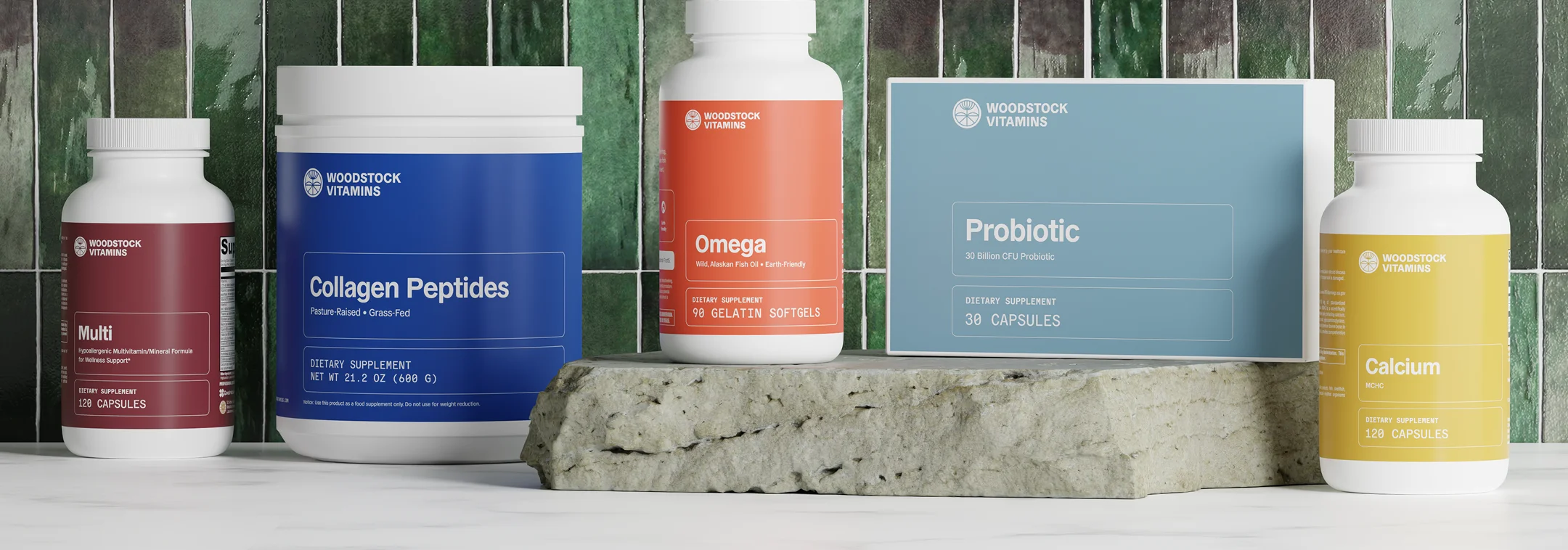


Collagen peptides are like the Swiss Army Knife of supplements. They do a whole lot, inside and out, yet they don’t get much publicity for the foundational nutrients they provide. Collagen peptides’ benefits range from rejuvenating skin health to growing lean muscle mass to supporting gut health. Still, many people are missing the essential amino acids they supply.
That’s why Dr. Neal Smoller, supplement strategist, holistic pharmacist, and founder of Woodstock Vitamins, has been advocating for supplementing with collagen peptides for years. He’s talked about why choosing the right protein supplement is so important to total-body health. We’re going to expand upon his idea, and by the end of this article, you’ll understand why the protein found in collagen peptides is so foundational and how to choose the right protein source for you.
How Collagen Peptides Support The Body
Collagen peptides are special in that they provide a full spectrum of amino acids and 20g of protein (at least our Collagen does). This nutrient profile comes with a whole host of benefits, like:
- Supporting skin structure and elasticity (1)
- Maintaining joint health (2)
- Contributing to bone structure (3)
- Promoting muscle growth (4)
- Improving sleep quality (5)
- Supporting gut health (6)
- Contributing to healthy BMI and metabolism (7)
From your skin, gut, joints, and muscles, collagen peptides aren’t “optional”. They’re a fundamental part of total-body health. Learn more here: Why Our Collagen Peptides is Vital.
The Different Forms of Protein
Most people don’t know this, but “protein” isn’t a monolith. There are several types of protein:
- Structural Proteins: These offer the support and framework for the body (this includes collagen peptides)
- Enzymatic Proteins: These speed up chemical reactions like digestion (these include lactase).
- Hormonal Proteins: These are chemical messengers that communicate in the body (this includes insulin).
- Defensive Proteins: These help protect the body from viruses and pathogens (these include antibodies).
- Transport Proteins: These move compounds around the body (think hemoglobin in the blood).
- Contractile Proteins: These play a role in muscle movement (including actin and myosin).
- Storage Proteins: These store nutrients (think of the casein that’s found in milk)
But not all protein sources are created equal. Some protein sources have more amino acids, others have less. Some are more bioavailable than others. And the list goes on. Here are the three main sources of protein:
- Animal Protein: Considered a complete protein with all nine essential amino acids and plus some (this includes meat, fish, dairy, and eggs).
- Plant Protein: Found in plant-based sources like beans, lentils, nuts, and seeds. This often requires combining different sources to get the full spectrum of amino acids.
- Protein Powder & Supplements: Fast and slow-acting protein sources like whey, casein, pea, and soy that can offer a full spectrum of amino acids or need to be combined with other sources.
Fortunately, with Collagen, you won’t have to worry about getting enough protein to boost your health. Featuring 20g of protein and all nine essential amino acids, this 100% bovine (cow-based) collagen peptides supplement covers your bases.
How Much Protein Do I Need?
How much protein you need per day depends on your gender, weight, movement routine, and health goals. Generally speaking, protein should account for 10-35% of your daily calories if you’re shooting for a 2,000-calorie diet. To make it easy, the formula for the right amount of protein is: Your body weight in lbs x 0.5-0.6 = grams of protein.
While there is no widespread “protein deficiency” in the United States, people still may not be getting the right protein. You’ll need a source that covers your essential amino acid needs and is easily absorbed by the body. Learn more about different protein sources here: How Protein Supplements Are Processed (Within an Inch of Their Lives).
The Different Types of Collagen
Did you know there are over 28 different types of collagen? But three types constitute the vast majority of collagen that are responsible for skin integrity, joint health, and bone integrity.
- Type I: The most common form of collagen, which is responsible for providing strength and structure to skin, joints, bones, and ligaments. It also plays a role in skin elasticity and may help reduce the appearance of wrinkles.
- Type II: This form is mainly found within the body in your cartilage. This type plays an important role in joint flexibility and shock absorption.
- Type III: This type is often found with type I in your muscles, skin, blood vessels, and organs. This type plays a role in the body’s wound healing process.
Of these three types, there are different sources of collagen that may be easier to absorb and more helpful for the body.
- Bovine (Cow): This is what our Collagen is made of, and it mainly contains Types I and III collagen. This makes it especially beneficial for skin and connective tissues.
- Marine (Fish): This form is very bioavailable and provides Type I collagen. This source makes it useful for supporting healthier skin, hair, and nails.
- Chicken: This form is rich in Type II collagen and plays a role in maintaining joint and cartilage health.
Collagen Tested for Quality & Purity
One of the biggest hesitations around collagen supplements and protein powders in general is heavy metals. It’s been well documented that an estimated 70% of protein powders studied exceed safe levels of metals like lead, arsenic, cadmium, and mercury. Fortunately, our Collagen is third-party tested for heavy metals like lead, cadmium, and mercury as well as contaminants like E. coli, Salmonella, yeast, and mold. Testing is a huge component of choosing a protein supplement with confidence. It’s a good idea to give yourself peace of mind by knowing your protein powder has been rigorously tested for heavy metals.
What to Look For When Buying Protein Supplements
As mentioned earlier, not all protein sources are the same. And the same goes for protein supplements. Some contain fillers, too much sodium, questionable ingredients, and the list goes on. Here are a few things to look for when buying a protein supplement:
- Sustainability: Is it made from sustainable sources like grass-fed, free-range cows or conventionally grown with pesticides?
- Processing: Was it minimally processed or refined to no end?
- Fillers: Does it contain artificial colors, sweeteners, or thickeners?
- Contaminants: Was it third-party tested for heavy metals and contaminants?
- Sodium: Is there added sodium that could affect your health in negative ways?
- Caffeine: Does it contain caffeine to boost its properties, or is it caffeine-free?
- Hormones: Does it contain steroids or testosterone? And do you want that in your protein supplement?
What goes in your body matters. Doing your due diligence to peek under the hood of a protein supplement and see how it’s made will pay dividends towards your health goals. Dive deeper into what to look for with protein supplements here: Protein Supplements: Are You Getting Ripped Off?
When to Expect Results
Collagen peptides are not a one-and-done kind of supplement. Consistent intake yields the best results, particularly for your gut, skin, joints, and muscles. Studies show that it takes as little as 8 weeks of continuous use to see results from collagen peptides. So, stick with it — even if you don’t see immediate results — and you’ll be rewarded with the amazing health benefits mentioned earlier.

Where Collagen Fits into Your Health Foundation
At Woodstock Vitamins, we believe in building your health on a solid foundation. Yes, you can fill your body and medicine cabinet with tons of nice-sounding, unnecessary supplements. But why would you when you can get your foundational nutrients solid instead? That’s the logic behind Collagen and all of the First 5.
That’s why Collagen is part of our First5 framework — five foundational inputs most people lack:
In this First5 line-up, Collagen covers your:
- Skin, hair, and nails
- Digestive and gut integrity
- Muscle and joint health
- Weight and metabolic goals
- Sleep quality
These amazing health benefits are why Collagen has been included in our First5. But we always recommend getting all five to cover all of your bases from head to toe.
The Bottom Line
When it comes to total body health, collagen peptides are a powerful way to support your body from the inside out. But most of us don’t get the right form of protein into our diets. That affects everything from how we sleep to whether our gut properly absorbs nutrients. Protein is not “optional”; it’s foundational. Rebuilding your health from the inside out starts with what you put in your body, and our Collagen is a good place to begin. Learn more about Collagen and our other First5 here.
Omega-3s are some of the most powerful (yet underrated) nutrients for total body health. Their benefits range from supporting cognitive health, the body’s natural inflammatory response, skin, joints, and more. Even though Omega-3s are one of the most essential nutrients, up to 85% of the world’s population doesn’t get enough from diet alone.
That’s why Dr. Neal Smoller, supplement strategist, pharmacist, and founder of Woodstock Vitamins, has been advocating for supplementing omega-3s for years. He’s addressed several debunked myths surrounding omega-3s that impact how people think about their omega-3 intake. Hopefully by the end of this article, you’ll understand why omega-3s are so foundational for total-body health and how to choose the right one.
What’s Wrong with Most Omega-3 Supplements
You’ve probably got a bottle of fish oil in your cabinet right now. Maybe you bought it because someone told you to, or you read about a particular brand in some article. Maybe you’re not even sure you’re still taking it. But the truth is, many omega-3s aren’t fresh enough or well-formulated to be effective.
Omega-3 is one of the few nutrients where the gap between what your diet provides and what your body needs is real, consistent, and hard to close with food alone. That’s why it’s in the First5 — not because it sounds foundational, but because most people are genuinely running without it. You don’t need to evaluate omega-3 products. You need a good one, taken consistently. Here’s what you should actually know about whether it’s working — and whether what you have is any good.
Why Omega-3s are Foundational For Your Health
Taking omega-3s isn’t just a good idea; it’s a great idea for ensuring you maintain long-lasting health for years. Generally speaking, omega-3 fatty acids are structural building blocks that support the body in a number of ways. They:
- Support healthy cell membrane flexibility (1)
- Help maintain balanced inflammatory signaling (2)
- Support cardiovascular function (3)
- Contribute to brain structure and cognitive performance (4)
- Promote skin hydration and barrier integrity (5)
- Support joint comfort and mobility (6)
What to Look For in an Omega-3 Supplement
As mentioned earlier, not all omega-3s are created equal. When choosing your omega-3 supplement, avoid these mistakes, and you’ll know you made the right choice:
- Buying low-dose products (300 mg omega-3s is not better than 1,000 mg)
- Ignoring oxidation (fish burps/taste = poor quality)
- Taking inconsistently
- Not considering omega-6 intake
- Assuming plant ALA converts efficiently to DHA (conversion is often <5%)
- Buying from a brand with low ethical standards or questionable sourcing
Just remember, dose, quality, sourcing, and form matter. Choose wisely.
Why Our Omega Isn’t Like the Others
While most people think omega-3s are all the same, that’s anything but true. Our Omega truly stands out in terms of its ingredients, formulation, and absorbability.
- High dose: 1000mg of omega-3s has been shown to provide cognitive, joint, and inflammatory support benefits.
- Low TOTOX score: This makes Omega one of the freshest-tasting omega-3s on the market.
- Sourcing: Our Omega is made from wild-caught Alaskan Pollock from a 35+ year sustainable fishery.
- Bioavailability: Omega is in the Ethyl Esters, a bioavailable form of omega-3s that’s easy on the stomach.
- Pharmacist-formulated: Dr. Neal Smoller, our founder and 20+ year pharmacist, created the formula himself using the latest science.
There are seemingly a million omega-3 supplements on the market; choose wisely with Omega.
Our Omega is Tested for Quality
One of the biggest hesitations around fish oil and getting omega-3s from eating fish is the amount of heavy metals lurking around. Fortunately, our Omega is third-party tested for heavy metals like lead, cadmium, and mercury, as well as contaminants like E. coli, Salmonella, yeast, and mold. Testing is a huge step when choosing an omega-3 supplement. It’s a good idea to give yourself peace of mind by knowing your omega-3s have been rigorously tested for heavy metals.
When to Expect Results from Consistent Omega-3 Use
Omega-3s are not a one-and-done kind of nutrient. Consistent intake yields the best results, particularly for your heart and brain. Studies show that it takes between 6 weeks and 6 months of daily use to see results from omega-3s.
Where Omega Fits into Your Health Foundation
At Woodstock Vitamins, we believe in building your health on a solid foundation. Yes, you can fill your body and medicine cabinet with tons of nice-sounding, unnecessary supplements. But why would you when you can get your foundational nutrients solid instead? That’s the logic behind Omega and all of the First 5.
That’s why Omega is part of our First5 framework — five foundational inputs most people lack:
The Bottom Line
When it comes to total body health, omega-3s don’t get the credit they deserve. And most of us don’t get enough omega-3s from diet alone. It’s affecting everything from how our brains function to our body’s inflammatory response. Omega-3s are not “optional”; they’re foundational. If you’re not sure whether Omega is the right starting point for you — or which of the First5 you actually need — take the quiz. It takes two minutes and tells you exactly where to begin your health journey from the inside out starts with what you put in your body, and our Omega is a good place to begin. Learn more about Omega and our other First5 here.
Walk down the supplement aisle, and you’ll find dozens of fish oil bottles. Most of them look roughly the same. The labels make roughly the same promises. The prices vary, but the pitch doesn’t: take this, get your omega-3s, done.
It isn’t that simple, and the gap between what those bottles claim and what they actually deliver is one of the most consequential quality problems in the supplement category. This article is about what to actually look for in an omega-3 supplement, why most products fall short, and how to think about this nutrient clearly.
The Potency Problem
Most fish oil products contain far less EPA and DHA than the label leads you to believe. Here’s why. A typical fish oil softgel is labeled as “1000mg fish oil.” That sounds meaningful until you read the fine print. That 1000mg figure refers to the total amount of fish oil in the capsule, not the amount of EPA and DHA it contains. Those are the two omega-3 fatty acids that the research actually focuses on.
In many standard fish oils, the actual EPA+DHA content per softgel is somewhere between 180mg and 360mg. To get close to the amounts that appear in the research literature — generally in the range of 1000mg EPA+DHA per day or more, depending on the health goal — a person would need to take three, four, or sometimes five capsules daily.
Most people don’t do that. Most labels don’t make it obvious that they should. The result: products get taken at doses that are too low to accomplish much, the person notices nothing, and they conclude that omega-3 “didn’t work”; when the real problem was potency, not the nutrient.
What to look at instead: The Supplement Facts panel, not the product name. Find the line that says “Total Omega-3” or “EPA + DHA” and look at the actual milligrams per serving. That’s the number that matters.
EPA and DHA: What Each Does, and Why Both Matter
Omega-3 fatty acids are not all the same. The three main types are ALA (alpha-linolenic acid), EPA (eicosapentaenoic acid), and DHA (docosahexaenoic acid).
ALA is found in plant sources — flaxseed, chia, walnuts. It’s a legitimate dietary fat, but the human body converts very little of it into EPA or DHA. The conversion rate is low enough that plant-based omega-3s, by themselves, do not reliably close the same gap that EPA and DHA close. This is an important distinction for anyone eating a plant-heavy diet.
EPA and DHA come primarily from marine sources — fatty fish and the algae those fish eat. These are the forms that appear in the majority of peer-reviewed research on omega-3 supplementation.
What EPA does: EPA plays a role in the body’s normal regulatory processes, including cardiovascular health, mood regulation, and the systems that manage how the body responds to physical stress and recovery. It’s the fatty acid most studied in the context of brain health and normal mood function.
What DHA does: DHA is a structural component of the brain and eyes. Roughly 60% of the brain’s fat content is DHA. It’s critical during development and continues to matter throughout life for cognitive function and long-term brain health.
Why both matter: They work on different systems and neither fully substitutes for the other. A fish oil high in DHA but low in EPA, or vice versa, is not covering the same ground as a well-balanced formula. Look for a product that provides meaningful amounts of both.
On the topic of dose: The research varies by health goal, but the pattern is consistent. Low-dose supplementation (under 500mg EPA+DHA daily) rarely shows the effects that higher-dose supplementation does. Most studies on brain health, cardiovascular support, and joint comfort use doses starting at 1000mg EPA+DHA and up. That’s the number to orient toward.
Form and Absorption: Ethyl Ester vs. Triglyceride
Not all fish oil is processed the same way, and that processing affects how well the omega-3s are absorbed.
Natural triglyceride form is how omega-3s exist in actual fish. The fatty acids are bound to a glycerol backbone in a structure the body recognizes easily. Absorption is good.
Ethyl ester form is a concentrated form produced by processing natural fish oil to increase EPA+DHA potency. The glycerol backbone is replaced with an ethanol molecule. Ethyl ester fish oils can deliver higher EPA+DHA per softgel, which is part of why they’re widely used in higher-potency products.
It’s worth noting that taking fish oil with a fat-containing meal improves absorption for both forms — but especially for ethyl ester. If someone is taking a high-potency ethyl ester product without food, they may be absorbing considerably less than they expect.
Reconstituted triglyceride (rTG) is a third option — fish oil processed to high-potency concentration, then converted back into triglyceride form. It combines the potency advantage of concentration with the absorption advantage of the natural form. It’s also more expensive to produce, which is why fewer products use it.
Our Omega uses the ethyl ester form and was formulated by Dr. Neal himself.
The Oxidation Issue
This is the quality problem most people never think about and one of the more significant ones in the omega-3 category.
Fish oil is highly susceptible to oxidation. When omega-3 fatty acids are exposed to heat, light, or air during processing, storage, or transport, they can degrade and become rancid. Oxidized fish oil doesn’t just fail to help; some research suggests that heavily oxidized oil may contribute to the opposite of the effects you’re taking it for.
The problem is that oxidation isn’t always obvious. A mildly rancid product may still smell acceptable. Heavily flavored or enteric-coated capsules can mask odor entirely. The consumer has no easy way to tell from the outside.
What to look for:
The most reliable signal at home is smell. Break open a softgel. Fresh, high-quality fish oil smells mild, faintly oceanic at most. Rancid oil smells strongly fishy, sour, or like old cooking grease. If the capsule is designed so you can’t do this, that’s worth noting.
Among quality markers to look for on the label or brand’s documentation: third-party testing for oxidation markers, specifically TOTOX (total oxidation) values, peroxide value (PV), and anisidine value (AV). These are the industry standards for measuring oxidation. Brands that test for these and publish the results are doing something most of their competitors are not.
On “fish burps”: Many people interpret the unpleasant aftertaste or reflux from fish oil as evidence that it’s working — a sign of potency. It isn’t. Fish burps are a sign of either a low-quality, poorly processed oil or one that is beginning to oxidize. A well-made, fresh fish oil product should not cause significant fishy reflux.
The takeaway: Our Omega has one of the lowest TOTOX scores on the market, and the capsule is designed to maintain freshness without bringing fish burps to your supplement experience.
Sourcing: What Actually Matters
The omega-3 category has real sourcing variation, and it affects product quality in ways that aren’t always legible from the label.
Wild-caught matters. Fish from wild populations generally have a different fatty acid profile than farmed fish, and wild-caught sourcing is associated with a lower risk of certain contaminants. The certification to look for: the Marine Stewardship Council (MSC) certification indicates sustainable wild-catch practices verified by an independent third party.
Cold, clean water matters. The fish most commonly used for omega-3 supplements — anchovies, sardines, mackerel — are small, short-lived species that accumulate fewer heavy metals than larger fish (like tuna or swordfish) that are higher on the food chain. However, sourcing location still matters. Waters with higher industrial pollution loads produce fish with higher contaminant risk.
Third-party heavy metal and contaminant testing matters. The supplement industry is not subject to the same mandatory pre-market testing that pharmaceuticals are. For fish oil specifically — given the biological concentration of environmental contaminants in marine sources — independent testing for heavy metals (mercury, lead, arsenic, cadmium) and environmental pollutants (PCBs, dioxins) is a meaningful quality marker.
IFOS certification (International Fish Oil Standards) is one of the most recognized third-party programs for omega-3 quality. Products that have been IFOS certified have been tested for purity, potency, and oxidation by an independent lab. It’s not the only marker, but it’s a meaningful one.
What to be skeptical of: Vague language like “pharmaceutical grade,” “ultra-pure,” or “premium quality” means nothing without evidence. These are marketing phrases, not certifications. Ask what the brand can actually document.
Our solution: Fortunately, our Omega is made from wild-caught Alaskan Pollock from a 35-year MSC-certified fishery in America. It’s also third-party tested and pharmacist-formulated.
Where Omega Fits in the Foundation
Omega-3 supplementation is part of the First5 — the five foundational nutrients that most people aren’t getting from food alone, with the strongest evidence across multiple body systems.
The omega-3 gap is one of the most consistent nutritional shortfalls in the modern diet. Western eating patterns, heavy in processed foods and seed oils, are low in EPA and DHA. Most people do not eat fatty fish multiple times a week. That gap is real, and it has downstream effects on systems the body relies on daily.
What consistent omega-3 supplementation helps support:
- Cardiovascular health — EPA and DHA help support healthy triglyceride levels and cardiovascular function (1)
- Brain health — DHA is a structural component of brain tissue; EPA plays a role in normal mood regulation and cognitive function (2)
- Joint comfort — omega-3s help support the body’s normal regulatory processes that affect joint mobility and comfort (3)
- Long-term tissue health — multiple systems benefit from consistent omega-3 intake over time
A critical point about expectations: omega-3 is a long-game supplement. It is not a fast-acting intervention. The research shows benefits that accumulate over weeks and months of consistent intake — not effects that show up in days. If someone takes fish oil for two weeks and doesn’t notice anything, that doesn’t mean it isn’t working. It means they haven’t been taking it long enough for the gap-closing to register.
This is a foundational supplement. That means it belongs in a daily routine not because it produces a dramatic short-term effect, but because the body needs it consistently, the diet usually doesn’t provide it, and the long-term case for it is well-established.
The evaluation you should do before buying anything: Open the Supplement Facts. Find EPA and DHA. Confirm you’re looking at milligrams of those two fatty acids, not total fish oil. That number — not the product name, not the price, not the front-of-label claim — is where the story is.
Do multivitamins actually work? There’s a lot of controversy about them from both the scientific community and regular supplement users. The people who say multivitamins are expensive pee aren’t entirely wrong. Most multivitamins on the market are underdosed, made with cheap forms the body can’t absorb, and formulated to look impressive on a label rather than actually be effective. That’s the real answer to the ‘Do multivitamins work?’ question: it isn’t a yes or no — it’s a ‘it depends entirely on how the multivitamin was built. The multivitamin category is mostly built wrong, and that’s why people are confused about whether they work.
Dr. Neal Smoller formulated our Multi around one question: which nutrients are almost everyone missing, and what forms actually get absorbed? The answer became the formulation. Here’s what that looks like.
Why Multivitamins Have Such Mixed Results
When it comes to multivitamins, not everyone notices the glowing health benefits advertised on the bottle. That’s for one simple reason: forms and formulations. Companies that cut corners on quality ingredients and researched formulations don’t deliver on health benefits. For us, chelated and activated forms of vitamins A through zinc were essential. These forms improve bioavailability and can be more readily absorbed by the body. Dr. Neal Smoller is a pharmacist — the kind who applied clinical skepticism to a category that avoids it. The Multi formulation is what that standard looks like in practice. With that, the multivitamin you choose can make a big difference in the results you receive. The formulation is where it starts.
What is a Multivitamin Supposed to Do
Contrary to popular belief, a multivitamin cannot replace a healthy diet. While the Standard American Diet (rightfully called SAD) has left much to be desired on the nutrition front, a multivitamin can only help fill the gaps it leaves behind, not fix them. The nutrients that move the needle share three qualities: they’re broadly under-consumed, their absence has real downstream effects, and most people can’t close the gap through food alone. The form they come in determines whether they work at all. Methylated B12, chelated minerals, activated folate — these aren’t marketing language. They’re the difference between a pill that absorbs and one that doesn’t.
How Multivitamins Support The Body
Multivitamins have a real impact on total-body health — when they’re built correctly. Their impact can be felt from the inside out, affecting nearly every system of the body. When the nutrients are in forms the body can actually use, the effects touch nearly every system — mood regulation, cognitive function over time, cardiovascular health, and a healthy immune response. These aren’t separate benefits. They’re connected, because the nutrients driving them are connected. That’s what a gap-filling foundation looks like in practice.
What to Look For When Buying a Multivitamin
Not all multivitamins are created equal. Some contain cheap, hard-to-absorb forms of vitamins in low doses, while others contain high-quality chelated and activated forms of the right vitamins and minerals in ideal doses. Knowing what to look for when choosing a multivitamin can save you a lot of time, money, and trial and error. If we were you, this is what we’d look for:
- Forms: Which forms of the vitamins does the product use, and are they natural and able to be utilized by the body?
- Dose: Does it offer 100% of your DV, or far beyond or below that threshold?
- Bioavailability: Are the nutrients chelated and activated for absorbability?
- Quality and testing: Was it third-party tested for heavy metals and contaminants?
- Sustainability: Is the supplement manufactured ethically, and does it feature sustainably sourced ingredients?
What goes into your body really matters. Do your due diligence to evaluate a multivitamin and see how it’s made. Dive deeper into what else to look for with multivitamins here: Choose the Best Multivitamin Supplement: Dr. Neal’s Do’s and Don’ts.
Where Multivitamins Fit into Your Health Foundation
More supplements don’t mean better supplementation. The First5 exists because five nutrients, done right, do more than a cabinet full of nice-sounding additions. That’s the logic behind Multi and all of the First5.
That’s why Probiotic is part of our First5 framework — five foundational inputs most people lack:
These are the reasons Multi earned its place in the First5. But we always recommend getting all five to cover all of your bases.
When to Expect Results
Multivitamins work over time, not overnight. Consistency is what moves the needle — which is why we offer a subscription. For most people, results from using a multivitamin can be seen in a matter of weeks or months. Consistency is key. That’s why we recommend getting at least two bottles of our Multi to ensure you can stay consistent with your daily supplement schedule.
The Bottom Line
Most multivitamins won’t move the needle because they’re not built to. The Multi was built differently. If you’re ready, [start with the Multi]. If you’re not sure where your gaps are, take the quiz. Three minutes is all it takes to tell you exactly which of the First5 you need most.
Most people looking for more energy start by asking the wrong question. They ask what to add — a stimulant, a shot, a “hack” for the afternoon slump. The better question is what’s missing. Energy isn’t manufactured by a single ingredient. It’s produced, continuously, inside your cells — and that process depends on a specific set of nutritional inputs showing up, every day, in the right amounts.
This piece goes one level deeper than our other articles about the specific roles B vitamins, iron, and magnesium play in energy metabolism, and why gaps in any one of them can leave you running on empty no matter how much sleep you get or coffee you drink.
Energy Is Made, Not Found
Every cell in your body produces energy through a process that converts food into a usable form — a molecule called ATP. That process runs on a chain of chemical reactions, and chemical reactions need cofactors: vitamins and minerals that help enzymes do their job. Take enough of the right inputs off the table, and the chain slows down, regardless of how many calories you’re eating.
This is the foundational case for supplementation at all: not to manufacture energy from nothing, but to make sure the machinery that already produces it has what it needs.
B Vitamins: The Metabolic Engine
The B vitamins are the closest thing the body has to a dedicated energy-production team. Several of them work directly inside the pathways that turn carbohydrates, fats, and protein into ATP:
- B1 (thiamine) and B2 (riboflavin) help support the early steps of converting glucose into usable energy.
- B3 (niacin) is a building block for NAD+, a molecule the body’s energy-producing pathways depend on at nearly every step.
- B5 (pantothenic acid) helps support the formation of coenzyme A, a central player in breaking down fats and carbohydrates for fuel.
- B6 plays a role in how the body metabolizes protein and supports normal red blood cell formation.
- B12 and folate support normal red blood cell production and nervous system function — both of which affect how well oxygen and nutrients get where they need to go.
None of these vitamins are stored in large reserves. B12 is the exception with meaningful liver storage, but most B vitamins are water-soluble, meaning your body uses what it needs and clears the rest daily. That makes daily, consistent intake — not occasional dosing — the relevant variable.
Iron: Oxygen Is Non-Negotiable
Cellular energy production requires oxygen. Iron is the reason oxygen gets there. It’s a core component of hemoglobin, the protein in red blood cells that carries oxygen from your lungs to every tissue in your body, including the tissues doing the work of producing energy.
Low iron intake is common, particularly among people who menstruate, endurance athletes, and anyone eating a largely plant-based diet, since iron from plant sources is less readily absorbed than iron from animal sources. When iron intake doesn’t keep pace with what the body needs, oxygen delivery becomes less efficient, and energy metabolism has less to work with, cell by cell.
This is a nutrient gap worth understanding, not a reason to panic. Most people don’t need to test or supplement iron aggressively. They need to know it’s a foundational input worth paying attention to — particularly if diet alone isn’t reliably covering it.
Magnesium: A Closer Look
Magnesium is a cofactor in hundreds of enzymatic reactions in the body, and energy metabolism is one of the biggest. ATP — the energy molecule every cell relies on — is typically bound to magnesium in its usable form. Without adequate magnesium, the body’s ability to actually use the ATP it produces is affected, not just the production of it.
Magnesium intake is low across a lot of populations, which is why it shows up so often in conversations about energy, sleep, and stress. It’s a real nutrient with real science behind its role in metabolism. It’s also why we treat it as a situational add-on rather than a foundational member of the First5: it earns its place after the foundation is covered, not before. Layering magnesium onto a diet that’s still missing its baseline B vitamins and iron is optimization without a foundation underneath it — the exact pattern we built Woodstock Vitamins to help people avoid.
What This Means for Your Foundation
B vitamins and iron are foundational nutrient inputs for energy metabolism — which is why they’re part of what a well-formulated Multi is built to cover. A daily multivitamin, taken consistently, is one of the more direct ways to make sure these inputs aren’t the reason your energy metabolism is working with less than it needs.
Magnesium is worth understanding, and worth considering once your foundation — Omega, Collagen, and Multi, for Energy & Performance — is in place and taken consistently. First things first.
None of this is about finding one nutrient that unlocks more energy. It’s about making sure the inputs your cells already depend on are consistently available. That’s a foundation, not a hack — and it’s the difference between chasing energy and actually producing it.
Curious where your own foundation has gaps? Take the quiz to find out which of the First5 matter most for you.
Low energy is one of the most common complaints people bring to a pharmacist, and one of the most consistently mishandled by the supplement industry. The default response is a stimulant — caffeine, taurine, some proprietary blend with a name that sounds vaguely like a sports car. Take it, feel a spike, crash, repeat.
That cycle isn’t a personal failure. It’s a predictable result of treating energy as a stimulant problem when, for most people, it’s a foundation problem.
The Real Reason Behind “Why Am I So Tired?”
Before reaching for something that revs the engine, it’s worth asking what the engine is actually running on. Energy isn’t manufactured by a supplement — it’s produced by your own cells, constantly, through metabolic processes that depend on specific nutritional inputs. B vitamins, iron, magnesium, healthy fats, and amino acids, to name a few. When those inputs are missing or insufficient, no amount of stimulation fixes the underlying gap. It just borrows energy you don’t have and charges interest later.
This is the lens Woodstock Vitamins applies to energy: not “what can perk me up right now,” but “what does my body actually need to produce energy consistently, day after day.”
Diet, quality, sleep quality, and stress all play a role here, too, and we’ll get to those. But the nutritional foundation is where most energy conversations should start, because it’s the piece most people overlook entirely.
What a Multivitamin Is Actually For
If one product in the First5 carries the most weight for energy, it’s the Multi. And the reason is almost embarrassingly simple. Energy metabolism runs on a cluster of micronutrients that a well-formulated multivitamin is built to cover: B vitamins involved in converting food into usable energy, iron that supports oxygen transport throughout the body, and magnesium, which plays a role in hundreds of enzymatic processes, several of them tied directly to how cells generate energy.
This isn’t a niche claim. It’s basic physiology. The B vitamins, iron, and magnesium are not “energy supplements” in the hype sense; they’re structural inputs to the process that makes energy happen at all. When intake of these is consistently low, the result often isn’t a dramatic deficiency disease. It’s something quieter and more familiar: feeling like you’re running at 70% more often than you’d like.
That’s why Multi is the Superstar for this health concern. Not because it’s flashy, but because it’s foundational. It’s doing the unglamorous work of making sure the inputs are there in the first place.
A well-formulated multivitamin isn’t trying to replace your diet or treat a medical condition. It’s there to do one job well: close the common nutrient gaps that most diets leave behind, so the systems that depend on those nutrients — including the ones that produce energy — have what they need to function normally.

Omega and Collagen: Supporting Energy From a Different Angle
Energy isn’t only a metabolic input problem. It’s also a systemic health problem, and that’s where Omega and Collagen come in. Not as direct “energy” ingredients, but as foundational support for the broader systems that determine how you feel day to day.
Omega-3s (EPA and DHA) help support cardiovascular health and brain health; two systems that have an outsized effect on how energized or sluggish a day feels. A body working harder than it needs to, at the cardiovascular or cognitive level, has less capacity left over for everything else. Omega’s role here is indirect but real: support the systems, and the felt experience of energy tends to follow.
Collagen peptides play a different but related role. Collagen is a structural protein, and structural integrity — joints, connective tissue, the physical infrastructure that lets you move through your day without friction — matters more to sustained energy than people expect. Most diets don’t deliver much collagen at all; modern eating patterns have largely phased out the foods (bone broth, organ meats, skin-on cuts) that used to provide it. That’s a distinct gap from a general protein shortfall, and it’s one that conventional protein sources don’t close.
Neither of these is a stimulant, and neither is being positioned as “the” energy fix. They’re part of the same foundation-first logic: support the systems that energy actually depends on, rather than chasing the feeling of energy directly.
The Stimulant Trap
Here’s the pattern worth naming plainly: most products marketed for energy are built around caffeine, and caffeine works — briefly. It blocks the signals your brain uses to register tiredness. It doesn’t add energy; it masks the request for it. That’s a meaningfully different thing, and the difference is exactly why the stimulant approach tends to fail people over time.
A few things consistently happen with stimulant-first energy products:
- Tolerance builds. What worked at one dose stops working, so the dose creeps up.
- The crash arrives on schedule. Borrowed energy gets paid back, usually right when you need to be functioning.
- The underlying gap never gets addressed. If low iron, low B vitamins, or low magnesium were part of the problem, a stimulant does nothing to close that gap — it just adds noise on top of it.
- Sleep gets worse. Which compounds the very problem the stimulant was supposed to solve.
None of this means caffeine is inherently a problem in moderate, intentional use. It means caffeine isn’t a foundation; it’s a short-term tool layered on top of one, and most energy products on the market skip the foundation entirely and lead with the tool.
The honest version of an energy product doesn’t promise a jolt. It asks a quieter, more useful question: what does your body actually need more of, consistently, so it can produce energy on its own?
What Sustainable Energy Actually Requires
Supplementation supports a foundation. It doesn’t replace one. If the goal is energy that holds up day after day — not just on the days you remember to take something — a few non-negotiables sit alongside the nutritional piece:
- Sleep. No nutrient can compensate for chronically poor sleep. This is the single biggest lever most people aren’t pulling.
- Movement. Counterintuitively, consistent physical activity tends to increase felt energy rather than deplete it.
- Nutrition beyond supplements. A multivitamin fills gaps; it doesn’t offset a diet that’s consistently low in real food.
- Stress management. Chronic stress has its own metabolic cost, and it’s one reason “why am I tired” rarely has a single-variable answer.
This is the same principle that runs through everything Woodstock Vitamins recommends: supplements are one input into a wellness practice, not a replacement for it. Get the foundation right, and the rest of the picture — sleep, movement, real food — has something to build on instead of working against a deficit.
Where Energy Fits Into Your Foundation
If chronic low energy is the concern, the starting point isn’t a stimulant. It’s an honest look at whether the basic inputs — the B vitamins, iron, and magnesium that energy metabolism runs on — are consistently there. For most people, they aren’t, not because of some rare condition, but because modern diets are inconsistent and modern life is demanding.
The First5 approach to energy starts with the Multi, because it’s the most direct way to close that foundational gap, and brings in Omega and Collagen to support the broader systems energy depends on. None of this works in isolation, and none of it works overnight. It works the way foundations always work: consistently, and over time.
Not sure which gaps apply to you? Take the WV quiz to find your starting point or explore the First5 system to see how the foundation fits together.
Do multivitamins actually work? There’s a lot of controversy about them from both the scientific community and regular supplement users. The people who say multivitamins are expensive pee aren’t entirely wrong. Most multivitamins on the market are underdosed, made with cheap forms the body can’t absorb, and formulated to look impressive on a label rather than actually be effective. That’s the real answer to the ‘Do multivitamins work?’ question: it isn’t a yes or no — it’s a ‘it depends entirely on how the multivitamin was built. The multivitamin category is mostly built wrong, and that’s why people are confused about whether they work.
Neal formulated our Multi around one question: which nutrients are almost everyone missing, and what forms actually get absorbed? The answer became the formulation. Here’s what that looks like.
Why Multivitamins Have Such Mixed Results
When it comes to multivitamins, not everyone notices the glowing health benefits that are marketed on the bottle. That’s for one simple reason: forms and formulations. Companies that cut corners on quality ingredients and researched formulations don’t deliver on health benefits. For us, chelated and activated forms of vitamins A through zinc were essential. These forms improve bioavailability and can be more readily absorbed by the body. Dr. Neal Smoller is a pharmacist — the kind who applied clinical skepticism to a category that avoids it. The Multi formulation is what that standard looks like in practice. With that, the multivitamin you choose can make a big difference in the results you receive. The formulation is where it starts.
What is a Multivitamin Supposed to Do
Contrary to popular belief, a multivitamin cannot replace a healthy diet. While the Standard American Diet (rightfully called SAD) has left much to be desired on the nutrition front, a multivitamin can only help fill the gaps left behind, not solely fix them. The nutrients that move the needle share three qualities: they’re broadly under-consumed, their absence has real downstream effects, and most people can’t close the gap through food alone. The form they come in determines whether they work at all. Methylated B12, chelated minerals, activated folate — these aren’t marketing language. They’re the difference between a pill that absorbs and one that doesn’t.
How Multivitamins Support The Body
Multivitamins have a real impact on total-body health — when they’re built correctly. Their impact can be felt from the inside out, affecting nearly every system of the body. When the nutrients are in forms the body can actually use, the effects touch nearly every system — mood regulation, cognitive function over time, cardiovascular health, and a healthy immune response. These aren’t separate benefits. They’re connected, because the nutrients driving them are connected. That’s what a gap-filling foundation looks like in practice.
What to Look For When Buying a Multivitamin
Not all multivitamins are created equal. Some contain cheap, hard-to-absorb forms of vitamins in low doses, while others contain high-quality chelated and activated forms of the right vitamins and minerals in ideal doses. Knowing what to look for when choosing a multivitamin can save you a lot of time, money, and trial and error. If we were you, this is what we’d look for:
- Forms: Which forms of the vitamins does the product use, and are they natural and able to be utilized by the body?
- Dose: Does it offer 100% of your DV, or far beyond or below that threshold?
- Bioavailability: Are the nutrients chelated and activated for absorbability?
- Quality and testing: Was it third-party tested for heavy metals and contaminants?
- Sustainability: Is the supplement manufactured ethically, and does it feature sustainably sourced ingredients?
What goes into your body really matters. Do your due diligence to evaluate a multivitamin and see how it’s made. Dive deeper into what else to look for with multivitamins here: Choose the Best Multivitamin Supplement: Dr. Neal’s Do’s and Don’ts.
Where Multivitamins Fit into Your Health Foundation
More supplements doesn’t mean better supplementation. The First5 exists because five nutrients, done right, do more than a cabinet full of nice-sounding additions. That’s the logic behind Multi and all of the First5.
That’s why Probiotic is part of our First5 framework — five foundational inputs most people lack:
These are the reasons Multi earned its place in the First5. But we always recommend getting all five to cover all of your bases.
When to Expect Results
Multivitamins work over time, not overnight. Consistency is what moves the needle — which is why we offer a subscription. For most people, results from using a multivitamin can be seen in a matter of weeks or months. Consistency is key. That’s why we recommend getting at least two bottles of our Multi to ensure you can stay consistent with your daily supplement schedule.
The Bottom Line
Most multivitamins won’t move the needle because they’re not built to. The Multi was built differently. If you’re ready, [start with the Multi]. If you’re not sure where your gaps are, take the quiz. Three minutes is all it takes to tell you exactly which of the First5 you need most.