





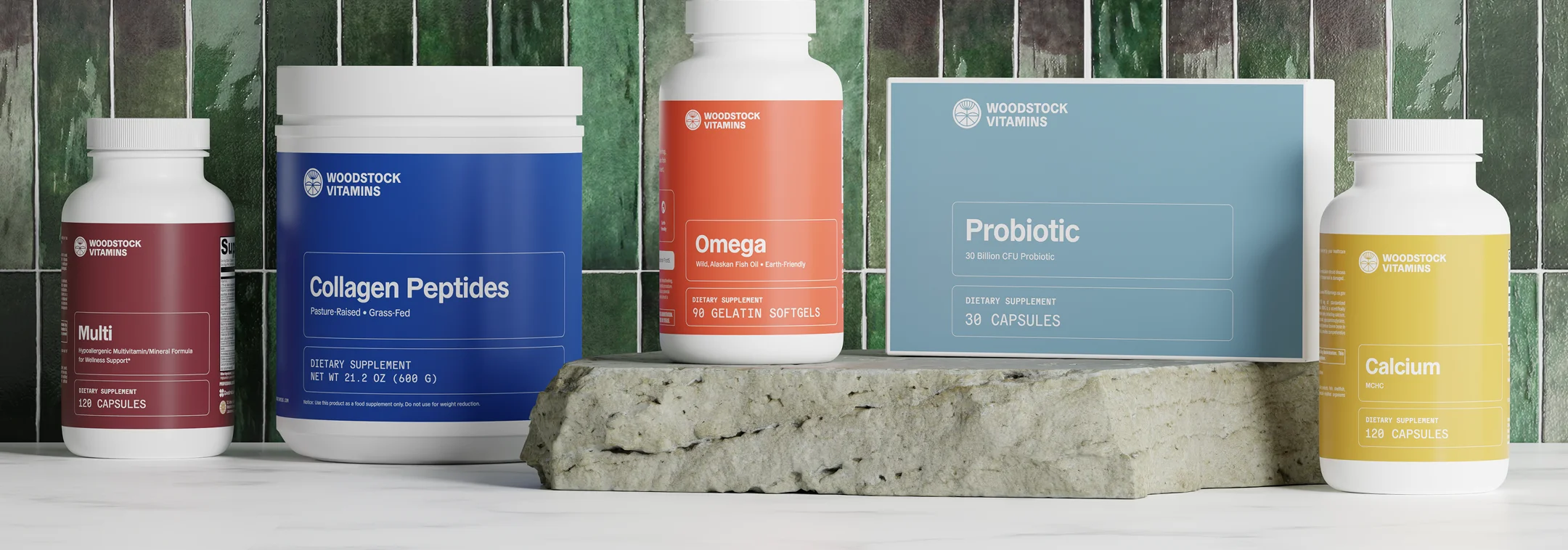

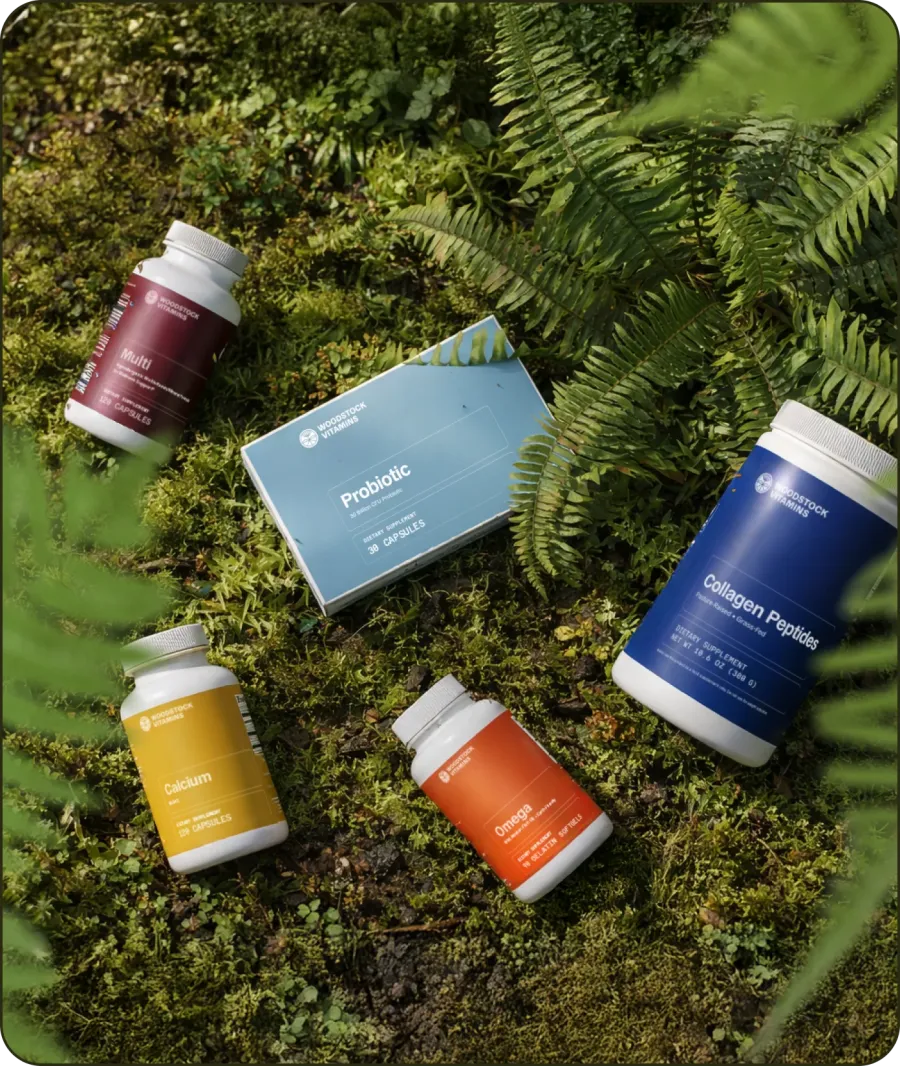
Collagen peptides are like the Swiss Army Knife of supplements. They do a whole lot, inside and out, yet they don’t get much publicity for the foundational nutrients they provide. Collagen peptides’ benefits range from rejuvenating skin health to growing lean muscle mass to supporting gut health. Still, many people are missing the essential amino acids they supply.
That’s why Dr. Neal Smoller, supplement strategist, holistic pharmacist, and founder of Woodstock Vitamins, has been advocating for supplementing with collagen peptides for years. He’s talked about why choosing the right protein supplement is so important to total-body health. We’re going to expand upon his idea, and by the end of this article, you’ll understand why the protein found in collagen peptides is so foundational and how to choose the right protein source for you.
How Collagen Peptides Support The Body
Collagen peptides are special in that they provide a full spectrum of amino acids and 20g of protein (at least our Collagen does). This nutrient profile comes with a whole host of benefits, like:
- Supporting skin structure and elasticity (1)
- Maintaining joint health (2)
- Contributing to bone structure (3)
- Promoting muscle growth (4)
- Improving sleep quality (5)
- Supporting gut health (6)
- Contributing to healthy BMI and metabolism (7)
From your skin, gut, joints, and muscles, collagen peptides aren’t “optional”. They’re a fundamental part of total-body health. Learn more here: Why Our Collagen Peptides is Vital.
The Different Forms of Protein
Most people don’t know this, but “protein” isn’t a monolith. There are several types of protein:
- Structural Proteins: These offer the support and framework for the body (this includes collagen peptides)
- Enzymatic Proteins: These speed up chemical reactions like digestion (these include lactase).
- Hormonal Proteins: These are chemical messengers that communicate in the body (this includes insulin).
- Defensive Proteins: These help protect the body from viruses and pathogens (these include antibodies).
- Transport Proteins: These move compounds around the body (think hemoglobin in the blood).
- Contractile Proteins: These play a role in muscle movement (including actin and myosin).
- Storage Proteins: These store nutrients (think of the casein that’s found in milk)
But not all protein sources are created equal. Some protein sources have more amino acids, others have less. Some are more bioavailable than others. And the list goes on. Here are the three main sources of protein:
- Animal Protein: Considered a complete protein with all nine essential amino acids and plus some (this includes meat, fish, dairy, and eggs).
- Plant Protein: Found in plant-based sources like beans, lentils, nuts, and seeds. This often requires combining different sources to get the full spectrum of amino acids.
- Protein Powder & Supplements: Fast and slow-acting protein sources like whey, casein, pea, and soy that can offer a full spectrum of amino acids or need to be combined with other sources.
Fortunately, with Collagen, you won’t have to worry about getting enough protein to boost your health. Featuring 20g of protein and all nine essential amino acids, this 100% bovine (cow-based) collagen peptides supplement covers your bases.
How Much Protein Do I Need?
How much protein you need per day depends on your gender, weight, movement routine, and health goals. Generally speaking, protein should account for 10-35% of your daily calories if you’re shooting for a 2,000-calorie diet. To make it easy, the formula for the right amount of protein is: Your body weight in lbs x 0.5-0.6 = grams of protein.
While there is no widespread “protein deficiency” in the United States, people still may not be getting the right protein. You’ll need a source that covers your essential amino acid needs and is easily absorbed by the body. Learn more about different protein sources here: How Protein Supplements Are Processed (Within an Inch of Their Lives).
The Different Types of Collagen
Did you know there are over 28 different types of collagen? But three types constitute the vast majority of collagen that are responsible for skin integrity, joint health, and bone integrity.
- Type I: The most common form of collagen, which is responsible for providing strength and structure to skin, joints, bones, and ligaments. It also plays a role in skin elasticity and may help reduce the appearance of wrinkles.
- Type II: This form is mainly found within the body in your cartilage. This type plays an important role in joint flexibility and shock absorption.
- Type III: This type is often found with type I in your muscles, skin, blood vessels, and organs. This type plays a role in the body’s wound healing process.
Of these three types, there are different sources of collagen that may be easier to absorb and more helpful for the body.
- Bovine (Cow): This is what our Collagen is made of, and it mainly contains Types I and III collagen. This makes it especially beneficial for skin and connective tissues.
- Marine (Fish): This form is very bioavailable and provides Type I collagen. This source makes it useful for supporting healthier skin, hair, and nails.
- Chicken: This form is rich in Type II collagen and plays a role in maintaining joint and cartilage health.
Collagen Tested for Quality & Purity
One of the biggest hesitations around collagen supplements and protein powders in general is heavy metals. It’s been well documented that an estimated 70% of protein powders studied exceed safe levels of metals like lead, arsenic, cadmium, and mercury. Fortunately, our Collagen is third-party tested for heavy metals like lead, cadmium, and mercury as well as contaminants like E. coli, Salmonella, yeast, and mold. Testing is a huge component of choosing a protein supplement with confidence. It’s a good idea to give yourself peace of mind by knowing your protein powder has been rigorously tested for heavy metals.
What to Look For When Buying Protein Supplements
As mentioned earlier, not all protein sources are the same. And the same goes for protein supplements. Some contain fillers, too much sodium, questionable ingredients, and the list goes on. Here are a few things to look for when buying a protein supplement:
- Sustainability: Is it made from sustainable sources like grass-fed, free-range cows or conventionally grown with pesticides?
- Processing: Was it minimally processed or refined to no end?
- Fillers: Does it contain artificial colors, sweeteners, or thickeners?
- Contaminants: Was it third-party tested for heavy metals and contaminants?
- Sodium: Is there added sodium that could affect your health in negative ways?
- Caffeine: Does it contain caffeine to boost its properties, or is it caffeine-free?
- Hormones: Does it contain steroids or testosterone? And do you want that in your protein supplement?
What goes in your body matters. Doing your due diligence to peek under the hood of a protein supplement and see how it’s made will pay dividends towards your health goals. Dive deeper into what to look for with protein supplements here: Protein Supplements: Are You Getting Ripped Off?
When to Expect Results
Collagen peptides are not a one-and-done kind of supplement. Consistent intake yields the best results, particularly for your gut, skin, joints, and muscles. Studies show that it takes as little as 8 weeks of continuous use to see results from collagen peptides. So, stick with it — even if you don’t see immediate results — and you’ll be rewarded with the amazing health benefits mentioned earlier.

Where Collagen Fits into Your Health Foundation
At Woodstock Vitamins, we believe in building your health on a solid foundation. Yes, you can fill your body and medicine cabinet with tons of nice-sounding, unnecessary supplements. But why would you when you can get your foundational nutrients solid instead? That’s the logic behind Collagen and all of the First 5.
That’s why Collagen is part of our First5 framework — five foundational inputs most people lack:
In this First5 line-up, Collagen covers your:
- Skin, hair, and nails
- Digestive and gut integrity
- Muscle and joint health
- Weight and metabolic goals
- Sleep quality
These amazing health benefits are why Collagen has been included in our First5. But we always recommend getting all five to cover all of your bases from head to toe.
The Bottom Line
When it comes to total body health, collagen peptides are a powerful way to support your body from the inside out. But most of us don’t get the right form of protein into our diets. That affects everything from how we sleep to whether our gut properly absorbs nutrients. Protein is not “optional”; it’s foundational. Rebuilding your health from the inside out starts with what you put in your body, and our Collagen is a good place to begin. Learn more about Collagen and our other First5 here.
Most people looking for more energy start by asking the wrong question. They ask what to add — a stimulant, a shot, a “hack” for the afternoon slump. The better question is what’s missing. Energy isn’t manufactured by a single ingredient. It’s produced, continuously, inside your cells — and that process depends on a specific set of nutritional inputs showing up, every day, in the right amounts.
This piece goes one level deeper than our other articles about the specific roles B vitamins, iron, and magnesium play in energy metabolism, and why gaps in any one of them can leave you running on empty no matter how much sleep you get or coffee you drink.
Energy Is Made, Not Found
Every cell in your body produces energy through a process that converts food into a usable form — a molecule called ATP. That process runs on a chain of chemical reactions, and chemical reactions need cofactors: vitamins and minerals that help enzymes do their job. Take enough of the right inputs off the table, and the chain slows down, regardless of how many calories you’re eating.
This is the foundational case for supplementation at all: not to manufacture energy from nothing, but to make sure the machinery that already produces it has what it needs.
B Vitamins: The Metabolic Engine
The B vitamins are the closest thing the body has to a dedicated energy-production team. Several of them work directly inside the pathways that turn carbohydrates, fats, and protein into ATP:
- B1 (thiamine) and B2 (riboflavin) help support the early steps of converting glucose into usable energy.
- B3 (niacin) is a building block for NAD+, a molecule the body’s energy-producing pathways depend on at nearly every step.
- B5 (pantothenic acid) helps support the formation of coenzyme A, a central player in breaking down fats and carbohydrates for fuel.
- B6 plays a role in how the body metabolizes protein and supports normal red blood cell formation.
- B12 and folate support normal red blood cell production and nervous system function — both of which affect how well oxygen and nutrients get where they need to go.
None of these vitamins are stored in large reserves. B12 is the exception with meaningful liver storage, but most B vitamins are water-soluble, meaning your body uses what it needs and clears the rest daily. That makes daily, consistent intake — not occasional dosing — the relevant variable.
Iron: Oxygen Is Non-Negotiable
Cellular energy production requires oxygen. Iron is the reason oxygen gets there. It’s a core component of hemoglobin, the protein in red blood cells that carries oxygen from your lungs to every tissue in your body, including the tissues doing the work of producing energy.
Low iron intake is common, particularly among people who menstruate, endurance athletes, and anyone eating a largely plant-based diet, since iron from plant sources is less readily absorbed than iron from animal sources. When iron intake doesn’t keep pace with what the body needs, oxygen delivery becomes less efficient, and energy metabolism has less to work with, cell by cell.
This is a nutrient gap worth understanding, not a reason to panic. Most people don’t need to test or supplement iron aggressively. They need to know it’s a foundational input worth paying attention to — particularly if diet alone isn’t reliably covering it.
Magnesium: A Closer Look
Magnesium is a cofactor in hundreds of enzymatic reactions in the body, and energy metabolism is one of the biggest. ATP — the energy molecule every cell relies on — is typically bound to magnesium in its usable form. Without adequate magnesium, the body’s ability to actually use the ATP it produces is affected, not just the production of it.
Magnesium intake is low across a lot of populations, which is why it shows up so often in conversations about energy, sleep, and stress. It’s a real nutrient with real science behind its role in metabolism. It’s also why we treat it as a situational add-on rather than a foundational member of the First5: it earns its place after the foundation is covered, not before. Layering magnesium onto a diet that’s still missing its baseline B vitamins and iron is optimization without a foundation underneath it — the exact pattern we built Woodstock Vitamins to help people avoid.
What This Means for Your Foundation
B vitamins and iron are foundational nutrient inputs for energy metabolism — which is why they’re part of what a well-formulated Multi is built to cover. A daily multivitamin, taken consistently, is one of the more direct ways to make sure these inputs aren’t the reason your energy metabolism is working with less than it needs.
Magnesium is worth understanding, and worth considering once your foundation — Omega, Collagen, and Multi, for Energy & Performance — is in place and taken consistently. First things first.
None of this is about finding one nutrient that unlocks more energy. It’s about making sure the inputs your cells already depend on are consistently available. That’s a foundation, not a hack — and it’s the difference between chasing energy and actually producing it.
Curious where your own foundation has gaps? Take the quiz to find out which of the First5 matter most for you.
We all want to feel more energized. Play with our kids, hike up a mountain, and have laser focus at work. The problem is, most of us are approaching it all wrong. Instead of doing the daily habits and consuming the foundational nutrients we need for natural energy, we find ourselves in the energy supplement aisle. There you’ll find hundreds of promises: more focus, more drive, more stamina — usually delivered by a bigger dose of caffeine than the last one. It works, for about an hour. Then you’re back where you started. That’s not an energy solution. It’s a trap. We’ll explain.
The Stimulant Trap
Caffeine and other stimulants don’t create energy. They block the signals that tell your brain you’re tired, which is a different thing entirely. Your body still did the work, used the resources, and built up the fatigue — you just stopped being able to feel it for a while.
Do that often enough and two things happen. First, tolerance builds, so the same dose stops doing much of anything, which is how a single afternoon coffee turns into a pre-workout, an energy drink, and a second coffee just to feel normal. Second, the crash that follows isn’t random — it’s the fatigue you postponed, arriving all at once with the stimulant’s exit.
This is the loop most “energy” products are built around: mask the symptom, sell the next dose. It’s a real category, and it has its place. It is not the same thing as addressing why you’re tired in the first place.
What Real Energy Actually Requires
Energy, in the physiological sense, isn’t a feeling you manufacture. It’s a process your body runs constantly, converting food into usable fuel at the cellular level. That process depends on a specific set of nutrients doing their jobs: B vitamins that support energy metabolism, iron that carries oxygen to the tissues that need it, magnesium involved in hundreds of the reactions that keep the process running.
When one of these inputs is running low — and for B vitamins, iron, and magnesium, that’s a common story, not a rare one — the whole system runs less efficiently. You feel it as low energy, poor focus, that “tired but wired” state that no amount of caffeine actually resolves, because caffeine was never addressing the input problem to begin with.
Why Stacking Stimulants Doesn’t Fix a Gap
Here’s what’s not said: if the fatigue is coming from a nutrient gap, a stimulant can’t close it. It can only override the signal telling you the gap exists. That’s why the pattern of “more caffeine, same tiredness” feels so familiar to so many people. The underlying cause was never addressed, just muted for a few hours at a time.
Foundational nutrition doesn’t work like a switch. It works by giving the system what it needs to run the way it’s supposed to, consistently, so the fatigue doesn’t build up, looking for an override in the first place.
The Foundation-First Approach
For Energy & Performance, Multi is the Superstar — it’s the most direct way to close the B vitamin, iron, and magnesium gaps that feed into normal energy metabolism. Built to our pharmacist-formulated standard, with activated forms and doses that reflect what the research actually supports, not what looks impressive on a label.
The complete foundation adds two more angles. Omega supports energy from a structural and cognitive-function standpoint — a different mechanism entirely from a B-vitamin gap. Collagen contributes amino acids that play a role in the body’s broader recovery and repair processes, which matters more to sustained energy than people usually assume.
None of these are a stimulant. None of them will make you feel “wired” in twenty minutes. That’s the point — they’re addressing the input, not overriding the signal.
What Else Actually Matters
No foundation fixes fatigue on its own if the basics aren’t in place. Sleep debt, dehydration, and a sedentary stretch of days will outweigh any supplement on the shelf. Foundational nutrition supports the energy system — it doesn’t replace the conditions that system needs to function.
If you’re consistently reaching for another cup of coffee just to feel normal, that’s worth paying attention to. It’s usually not a caffeine problem. It’s a foundation problem wearing a caffeine disguise.
Want to know where your foundation actually stands? Take the Woodstock Vitamins quiz to find out what belongs in your foundation first, or check out the Energy & Performance foundation for the full picture.
You may have heard of collagen somewhere on the internet. Maybe a YouTube video explained how to keep your skin looking young with collagen supplements. An influencer on social media created a delicious-looking collagen protein shake in their morning routine. Or perhaps some news article highlighted the benefits of collagen for your joint and digestive health. All of the above are true, but which type and source of collagen you choose makes a big difference in the benefits you’ll get. In this article, we’re going to break down what collagen is, how it works, and which form will give you many of the health benefits you’re looking for.
What Collagen Actually Is
Collagen is a structural protein — the most abundant protein in the human body. It’s the framework material: the scaffolding that gives skin its structure, joints their cushioning, bones their matrix, and connective tissue its integrity.
Most people don’t get enough protein quality overall. But even people who do are almost certainly not getting enough collagen specifically. Modern diets have largely eliminated the foods that used to supply it — bone broth, organ meats, skin-on cuts — in favor of the lean, trimmed cuts that dominate a typical plate.
A chicken breast and a cup of bone broth can both hit the same gram count on a protein tracker. Only one of them contains the amino acid profile your body uses to maintain collagen-dependent structures. Closing the collagen gap isn’t about eating more protein; it’s about restoring a specific input that most conventional protein sources don’t carry.
Why Whole Collagen Doesn’t Work as a Supplement
Here’s the problem: collagen, in its natural form, is a large, tightly wound triple-helix molecule. It’s built to be strong and stable, which is exactly what makes it useless to swallow as-is. Whole collagen is too large to cross the gut lining intact. Eaten on its own, it’s broken down into individual amino acids before absorption, the same as any other protein, and loses the specific peptide structure that makes it useful for connective tissue support.
This is the piece most collagen supplement brands don’t talk about. A supplement can list “collagen” on the label and still deliver almost none of what made collagen worth taking in the first place.
What Hydrolyzation Actually Does
Hydrolyzation solves the problem of making collagen more digestible. It’s an enzymatic process that breaks the collagen molecule down before it ever gets to you. This cuts the long protein chain into much smaller fragments called peptides, including short chains known as di- and tri-peptides.
This matters for one reason: size determines whether something can be absorbed intact. Smaller peptide chains are able to pass through the gut lining largely whole, rather than being fully broken down into individual amino acids first. That means a meaningful share of what you take reaches circulation still carrying the specific peptide sequences your body recognizes and uses for collagen-dependent structures — not just a generic amino acid pool.
This is what “hydrolyzed” means on a label, and it’s the difference between a collagen supplement that does something specific and one that behaves like any other protein source once it’s been digested.
The Amino Acid Profile That Makes It Work
Collagen peptides help support healthy skin, joints, and connective tissue because of what they’re made of, not just because they’re protein. Three amino acids define the profile: glycine, proline, and hydroxyproline. Together, they make up a significant share of the collagen molecule and are the specific building blocks your body draws on to maintain skin, joint, bone, and connective tissue structure.
Conventional protein sources — chicken, eggs, whey, plant proteins — don’t carry this profile in meaningful amounts. You can eat plenty of high-quality protein and still be missing the specific inputs collagen peptides supply. That’s the distinction worth holding onto: this isn’t about adding more protein to your day. It’s about supplying an input that a well-rounded diet still tends to miss.
What This Looks Like in Our Collagen
A few formulation decisions follow directly from the science above:
Bovine, not marine. Bovine collagen peptides offer a well-studied amino acid profile suited to skin, joint, and connective tissue support, with a formulation that’s easier to source consistently at scale.
Pasture-raised, grass-fed sourcing. Sourcing affects quality. We chose pasture-raised, grass-fed cows over conventional sourcing.
Unflavored, single ingredient. No added sugars, fillers, or flavor systems — nothing standing between the peptides and the amino acid profile that makes them work.
18g per serving. A dose sized to matter, not to make a label look generous.
The Takeaway
Not all collagen supplements are doing the same thing once they’re in your body. Hydrolyzation — the process that breaks collagen down into smaller, absorbable peptides — is what determines whether a supplement delivers a meaningful amount of the amino acid profile your connective tissue actually depends on, or just another source of generic protein you’ve already got covered. Collagen is one of the First5 — the foundational nutrients most people are missing, and the first place to start before adding anything else.
For decades, the supplement industry has sold a comforting idea: one bottle, one pill, one habit, and you’re covered. Multivitamin in the morning, box checked, done thinking about it. It’s a tidy story. It’s also the wrong question. No single supplement can provide a person’s complete nutrition — even if they want it to. Building an intentional supplement stack where a few good supplements support multiple systems in the body.
The Multi-As-Everything Fallacy
A multivitamin is built to do one job well: fill small, broad gaps across a wide range of vitamins and minerals at modest doses that meet your daily value. That’s a legitimate and important job. It is not the same job as closing five distinct, well-documented nutrient gaps that most people’s diets leave wide open.
Here’s the math problem hiding inside the one-a-day mindset. A multivitamin formulated to cover 23 nutrients at sensible doses simply doesn’t have room — physically, in a capsule someone will actually swallow — for a gram of EPA and DHA, or 30 billion CFU from targeted probiotic strains, or 700mg of calcium paired with real Vitamin D3, or a meaningful dose of collagen peptides. Trying to cram all of that into one pill doesn’t produce a better multivitamin. It produces an enormous pill nobody takes consistently, at doses too small to matter for any single nutrient.
That’s the fallacy in one sentence: a single pill can’t replace five distinct nutrient priorities, because it was never designed to carry the dose any one of them requires.
Why the First5 Are Separated on Purpose
Woodstock Vitamins built the First5 — Omega, Probiotic, Calcium+D, Collagen, and Multi — around a simple rule: each nutrient earned its place because it’s broadly under-consumed, backed by strong evidence, relevant to multiple body systems, and meant for long-term daily use. Those five criteria are also why they can’t be flattened into one formula.
Each of the First5 works through a different mechanism, at a different dose, often needing a different delivery format entirely:
- Omega needs enough EPA and DHA — real gram-level amounts — to matter, in a form the body can actually absorb.
- Probiotic needs live, targeted strains that survive stomach acid to reach the gut. That’s a delivery problem a standard tablet doesn’t solve.
- Calcium+D needs a calcium dose large enough to matter, paired with Vitamin D3, because calcium absorption depends on it.
- Collagen isn’t a vitamin or mineral at all — it’s a structural protein, and it needs to be dosed in grams, not milligrams, to supply the amino acid profile connective tissue actually uses.
- Multi does what a multivitamin does best: covers the broad vitamin and mineral gaps at sensible, Daily-Value doses.
None of these substitute for each other. A well-formulated Multi helps support baseline nutritional gaps. It was never built to also help support cardiovascular health, a balanced gut microbiome, and connective tissue in the same swallow.
The Category Illusion
The “all-in-one” pitch is appealing precisely because it promises to make a decision disappear. One choice, made once, and you’re finished. That’s a comforting story — and it’s exactly the kind of story the supplement industry tells to keep things simple to sell, not simple to actually work.
The honest version is less tidy but more useful: most people aren’t under-supplemented because they’re missing one magic formula. They’re under-supplemented because a handful of specific, well-evidenced nutrients are missing from a typical diet, and no single pill is built to close all of those gaps in workable amounts.
That’s not a reason to feel behind. It’s a reason to stop looking for the one pill and start looking at the handful of specific gaps that are actually there.
Foundation, Not Accumulation, is Key
To be clear, the answer to “a multivitamin isn’t everything” is not “add more supplements.” The First5 exists precisely to prevent that spiral — five nutrients, chosen because the evidence says they matter broadly, not an invitation to start collecting bottles.
A Multi is a reasonable place to start. It’s a poor place to stop, if the goal is actually closing the gaps that most affect how people feel and function over time. The right question was never “which one pill does everything?” It’s “which of the specific nutrient gaps do I actually need to close?”
That’s the question the First5 was built to answer. Find your foundation with the Woodstock Vitamins quiz, or read more about the reasoning behind the First5.
If you eat a thoughtful, well-planned plant-based diet, you’re probably doing more for your long-term health than most people who eat whatever they want. That’s worth saying plainly, because most of what gets written about vegan and vegetarian nutrition starts from a place of suspicion — as if the diet itself is the problem.
It isn’t. But it does change the math on a few specific nutrients. Not because plant-based eating is deficient by nature, but because a handful of nutrients are structurally easier to get from animal foods and food alone. No matter how well you eat, you have a harder time closing those particular nutrient gaps than your omnivore peers.
This isn’t a piece about what’s wrong with plant-based eating. It’s a piece about which nutritional gaps may arise, which of the First5 actually addresses them, and where we’re honest that our current product lineup doesn’t fully fill a gap.
Why Some Gaps Don’t Close Through Food Alone
Most nutrient conversations treat “eat better” as the answer to everything. For most nutrients, that’s true. For a few, it isn’t, and the reason has nothing to do with effort or diet quality.
Some nutrients are concentrated almost entirely in animal tissue. Others exist in plant form, but in a version the body has to convert before it can use it. And that conversion is inefficient enough that food intake and usable nutrient status aren’t the same thing. A plant-based eater can do everything right at the plate and still end up falling short, simply because the chemistry doesn’t fully translate.
That distinction matters because it changes what “fixing it” looks like. A nutrient that’s just low in the diet can usually be addressed by eating more of the right foods. A nutrient that the body can’t efficiently make from plant sources needs a different kind of intervention, which is exactly where a foundation-first approach to supplementation earns its place.
Where the First5 Helps — and Where It’s Honest About Its Limits
The First5 wasn’t built around any single dietary pattern. It was built around the nutrients that are broadly under-consumed across nearly everyone, regardless of how they eat. For plant-based eaters, some of those nutrients become more important, not less, and a couple of them need a closer look.
Omega-3 is the clearest case, and the most complicated one. Plant foods contain ALA, an omega-3 precursor. But the body has to convert ALA into EPA and DHA, the forms that actually do the work for brain, heart, and joint health, and that conversion is inefficient at best. This is why omega-3 status is one of the more consistent gaps in plant-based diets, even among people eating plenty of flax, walnuts, and chia. It’s also why omega-3 sits in the First5 in the first place — the gap is common in any diet, but it shows up earlier and more reliably in a plant-based one.
Here’s the honest part: our current Omega is sourced from wild-caught fish. It is not a fit for someone following a strict vegan diet. Algae-based EPA/DHA exists as a category and is the standard plant-based alternative, and it’s not something we currently offer. If you’re vegan and looking to close this specific gap today, an algae-based omega-3 from a brand built for that audience is the more honest recommendation than pretending our Omega works for you when it doesn’t.
Calcium+D is relevant, though less dramatically than people assume. Plant foods do contain calcium, but some of the best plant sources also contain compounds that interfere with how well that calcium gets absorbed — so intake on paper doesn’t always translate to intake in practice. Vitamin D adds a second layer, since the most concentrated dietary sources are animal-based and most people’s sun exposure isn’t reliable enough to close the gap on its own, regardless of diet. Calcium+D in the First5 is formulated as Calcium Hydroxyapatite, a non-animal mineral source, paired with D3 — making it a reasonable fit for vegetarians. For strict vegans, it’s worth checking the D3 source specifically, since D3 is most commonly derived from lanolin; a vegan-sourced D3 (typically from lichen) is the alternative to look for if that distinction matters to you.
Multi covers general gaps that plant-based eaters share with almost everyone else. But one nutrient deserves a specific callout that a general multivitamin conversation usually skips: vitamin B12. B12 is reliably found only in animal foods. There’s no meaningful plant source, fortification aside, which makes it one of the few nutrients where “eat more variety” genuinely isn’t the answer for a vegan diet. This isn’t a multivitamin footnote — it’s close to a non-negotiable for anyone eating fully plant-based, and worth confirming specifically rather than assuming a general multi has it covered at a meaningful dose.
Collagen is where we’re most direct. Collagen peptides are a structural protein found in animal connective tissue — there is no plant equivalent that does the same thing in the body. Plant-based “collagen support” products on the market typically work by supplying the building blocks (like vitamin C, which supports the body’s own collagen production) rather than supplying collagen peptides themselves, because that’s the only mechanism available without an animal source. Our Collagen is bovine-sourced. If you’re vegan, it’s not a product we can recommend for you, and we’d rather say that clearly than beat around it.
Probiotic is the most diet-neutral of the five. Gut health doesn’t run on animal protein, and strain-specific probiotic formulation works the same way regardless of how you eat. This is the one place in the First5 where plant-based eaters aren’t navigating a structural gap at all.
The Honest Summary
Plant-based eating doesn’t create five new problems. It sharpens a couple of existing ones and leaves the rest unchanged. If you’re vegetarian, the First5 framework mostly holds, with a closer look at D3 sourcing being the main thing worth checking. If you’re vegan, two of the five — Omega and Collagen — aren’t something our current catalog solves for you, and B12 deserves specific attention rather than general multivitamin coverage.
We’d rather tell you that directly than blur the formulation details to make five-for-five work on paper. Foundations only mean something if they’re built honestly — and that includes being honest about where ours doesn’t yet reach.
Low energy is one of the most common complaints people bring to a pharmacist, and one of the most consistently mishandled by the supplement industry. The default response is a stimulant — caffeine, taurine, some proprietary blend with a name that sounds vaguely like a sports car. Take it, feel a spike, crash, repeat.
That cycle isn’t a personal failure. It’s a predictable result of treating energy as a stimulant problem when, for most people, it’s a foundation problem.
The Real Reason Behind “Why Am I So Tired?”
Before reaching for something that revs the engine, it’s worth asking what the engine is actually running on. Energy isn’t manufactured by a supplement — it’s produced by your own cells, constantly, through metabolic processes that depend on specific nutritional inputs. B vitamins, iron, magnesium, healthy fats, and amino acids, to name a few. When those inputs are missing or insufficient, no amount of stimulation fixes the underlying gap. It just borrows energy you don’t have and charges interest later.
This is the lens Woodstock Vitamins applies to energy: not “what can perk me up right now,” but “what does my body actually need to produce energy consistently, day after day.”
Diet, quality, sleep quality, and stress all play a role here, too, and we’ll get to those. But the nutritional foundation is where most energy conversations should start, because it’s the piece most people overlook entirely.
What a Multivitamin Is Actually For
If one product in the First5 carries the most weight for energy, it’s the Multi. And the reason is almost embarrassingly simple. Energy metabolism runs on a cluster of micronutrients that a well-formulated multivitamin is built to cover: B vitamins involved in converting food into usable energy, iron that supports oxygen transport throughout the body, and magnesium, which plays a role in hundreds of enzymatic processes, several of them tied directly to how cells generate energy.
This isn’t a niche claim. It’s basic physiology. The B vitamins, iron, and magnesium are not “energy supplements” in the hype sense; they’re structural inputs to the process that makes energy happen at all. When intake of these is consistently low, the result often isn’t a dramatic deficiency disease. It’s something quieter and more familiar: feeling like you’re running at 70% more often than you’d like.
That’s why Multi is the Superstar for this health concern. Not because it’s flashy, but because it’s foundational. It’s doing the unglamorous work of making sure the inputs are there in the first place.
A well-formulated multivitamin isn’t trying to replace your diet or treat a medical condition. It’s there to do one job well: close the common nutrient gaps that most diets leave behind, so the systems that depend on those nutrients — including the ones that produce energy — have what they need to function normally.

Omega and Collagen: Supporting Energy From a Different Angle
Energy isn’t only a metabolic input problem. It’s also a systemic health problem, and that’s where Omega and Collagen come in. Not as direct “energy” ingredients, but as foundational support for the broader systems that determine how you feel day to day.
Omega-3s (EPA and DHA) help support cardiovascular health and brain health; two systems that have an outsized effect on how energized or sluggish a day feels. A body working harder than it needs to, at the cardiovascular or cognitive level, has less capacity left over for everything else. Omega’s role here is indirect but real: support the systems, and the felt experience of energy tends to follow.
Collagen peptides play a different but related role. Collagen is a structural protein, and structural integrity — joints, connective tissue, the physical infrastructure that lets you move through your day without friction — matters more to sustained energy than people expect. Most diets don’t deliver much collagen at all; modern eating patterns have largely phased out the foods (bone broth, organ meats, skin-on cuts) that used to provide it. That’s a distinct gap from a general protein shortfall, and it’s one that conventional protein sources don’t close.
Neither of these is a stimulant, and neither is being positioned as “the” energy fix. They’re part of the same foundation-first logic: support the systems that energy actually depends on, rather than chasing the feeling of energy directly.
The Stimulant Trap
Here’s the pattern worth naming plainly: most products marketed for energy are built around caffeine, and caffeine works — briefly. It blocks the signals your brain uses to register tiredness. It doesn’t add energy; it masks the request for it. That’s a meaningfully different thing, and the difference is exactly why the stimulant approach tends to fail people over time.
A few things consistently happen with stimulant-first energy products:
- Tolerance builds. What worked at one dose stops working, so the dose creeps up.
- The crash arrives on schedule. Borrowed energy gets paid back, usually right when you need to be functioning.
- The underlying gap never gets addressed. If low iron, low B vitamins, or low magnesium were part of the problem, a stimulant does nothing to close that gap — it just adds noise on top of it.
- Sleep gets worse. Which compounds the very problem the stimulant was supposed to solve.
None of this means caffeine is inherently a problem in moderate, intentional use. It means caffeine isn’t a foundation; it’s a short-term tool layered on top of one, and most energy products on the market skip the foundation entirely and lead with the tool.
The honest version of an energy product doesn’t promise a jolt. It asks a quieter, more useful question: what does your body actually need more of, consistently, so it can produce energy on its own?
What Sustainable Energy Actually Requires
Supplementation supports a foundation. It doesn’t replace one. If the goal is energy that holds up day after day — not just on the days you remember to take something — a few non-negotiables sit alongside the nutritional piece:
- Sleep. No nutrient can compensate for chronically poor sleep. This is the single biggest lever most people aren’t pulling.
- Movement. Counterintuitively, consistent physical activity tends to increase felt energy rather than deplete it.
- Nutrition beyond supplements. A multivitamin fills gaps; it doesn’t offset a diet that’s consistently low in real food.
- Stress management. Chronic stress has its own metabolic cost, and it’s one reason “why am I tired” rarely has a single-variable answer.
This is the same principle that runs through everything Woodstock Vitamins recommends: supplements are one input into a wellness practice, not a replacement for it. Get the foundation right, and the rest of the picture — sleep, movement, real food — has something to build on instead of working against a deficit.
Where Energy Fits Into Your Foundation
If chronic low energy is the concern, the starting point isn’t a stimulant. It’s an honest look at whether the basic inputs — the B vitamins, iron, and magnesium that energy metabolism runs on — are consistently there. For most people, they aren’t, not because of some rare condition, but because modern diets are inconsistent and modern life is demanding.
The First5 approach to energy starts with the Multi, because it’s the most direct way to close that foundational gap, and brings in Omega and Collagen to support the broader systems energy depends on. None of this works in isolation, and none of it works overnight. It works the way foundations always work: consistently, and over time.
Not sure which gaps apply to you? Take the WV quiz to find your starting point or explore the First5 system to see how the foundation fits together.
Most people don’t think about their skeleton until something reminds them to. A knee that aches on stairs. A frame that feels less sturdy than it used to. A bone density scan that comes back lower than expected, seemingly out of nowhere.
Bone and joint health is a long, quiet process that starts decades before anyone notices a problem, and the supplement industry’s response to that process has mostly been to oversimplify it. Take calcium and the problem’s solved.
It isn’t that simple, and treating it that simply is part of why so many people end up with a cabinet full of bone-health products and very little change in how their bones and joints feel. Strong structure isn’t built by one mineral working alone. It’s built by a foundation — several nutrients working together, consistently, over years.
Bone Loss Starts Earlier Than You’d Think
Bone is living tissue. It’s constantly being broken down and rebuilt in a process called remodeling, and for most of early adulthood, rebuilding keeps pace with breakdown. That balance doesn’t hold forever.
For most people, peak bone mass is reached by their late twenties to early thirties. After that, the balance gradually tips — breakdown starts to outpace rebuilding, slowly, every year, for the rest of life. This isn’t a malfunction. It’s the normal trajectory of human bone.
What changes the slope of that decline is largely about who’s paying attention and when. Women experience an acceleration around menopause, when declining estrogen speeds up bone loss considerably. But men aren’t exempt; they simply tend to notice later after decades of a slower decline. Low dairy intake, limited sun exposure, sedentary habits, and certain medications can all steepen the curve at any age.
The point isn’t to alarm anyone. It’s to be honest about timing: if you wait until your joints hurt or a scan flags a problem to think about bone and joint health, you’ve been losing ground for a long time already. Foundational nutrition matters most when nothing feels wrong yet because that’s when it’s doing the most work.
The Calcium Myth: Why More Isn’t the Answer
Calcium gets credit for being the bone nutrient, and that reputation isn’t bad; it’s just incomplete. The myth is that taking more calcium, on its own, rebuilds bone. It doesn’t work that way.
Calcium’s primary role is maintaining bone structure that’s already there, not generating new structure out of nothing. And calcium absorbed without the right supporting nutrients often isn’t absorbed well at all. It can pass through the body largely unused. Megadosing calcium doesn’t fix this. It just means more calcium passing through unused, with little additional benefit and some evidence of added risk at very high intakes.
The dose matters more than people expect. Research consistently points to roughly 700mg of calcium as a sound daily target for most adults closing a dietary gap. More isn’t automatically better here. Matching the dose to what the evidence actually supports is.
Form matters too. Calcium Hydroxyapatite, Calcium Carbonate, and Calcium Citrate are absorbed differently, and the differences aren’t trivial. They affect how much of what’s on the label actually becomes available to your body. A supplement that looks identical on a nutrition facts panel can perform very differently once it’s swallowed.
Calcium is necessary. It has just never been sufficient on its own, and the industry has not been especially eager to say so.
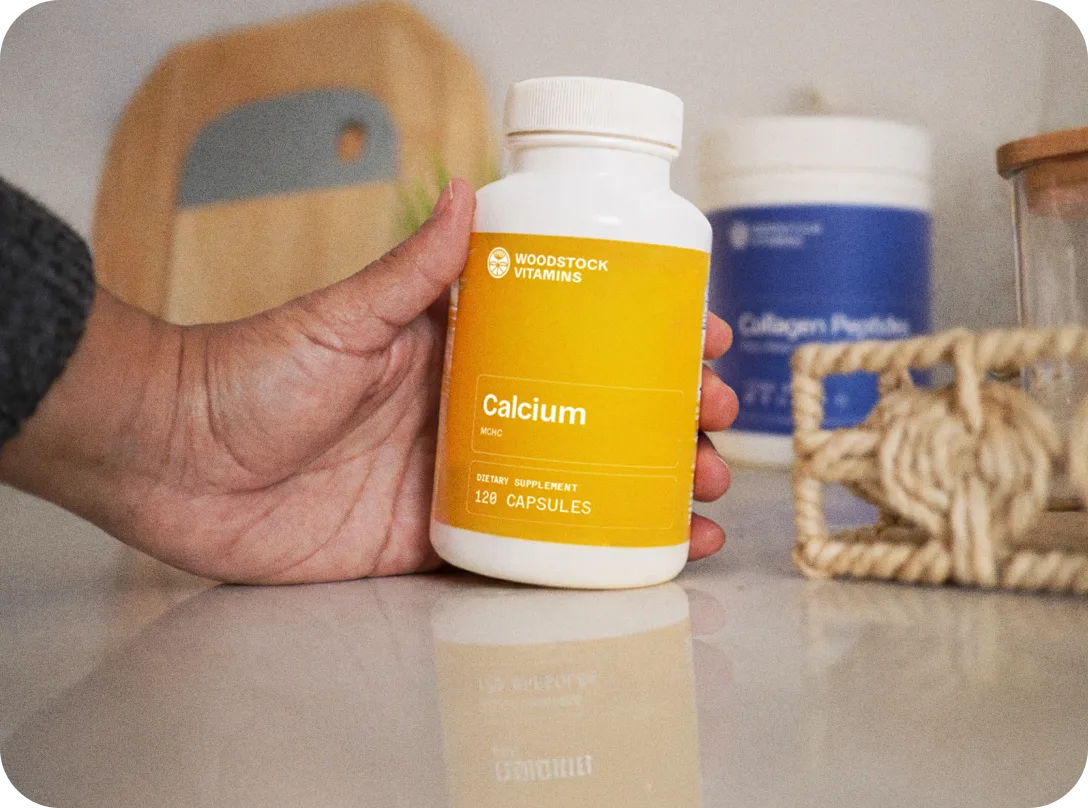
Why Calcium and Vitamin D Work as a System
Here’s the part that calcium-only marketing leaves out: calcium absorption is vitamin D-dependent. Without adequate vitamin D, the body’s ability to absorb calcium from the gut is severely limited, no matter how much calcium you’re taking.
This isn’t a minor footnote. It’s the reason Calcium+D exists as a pairing rather than two separate decisions. Vitamin D regulates how much of the calcium you consume actually gets absorbed and put to use. Calcium without D is a nutrient with nowhere to go. D without calcium has nothing to help direct.
Vitamin D’s role goes beyond absorption, too. It plays a part in muscle function and immune regulation, both of which connect back to structural health in their own way. A body that can’t build adequate muscle around a joint puts more strain on that joint over time. This is why we don’t talk about calcium and D as two separate supplements that happen to ship together. They’re one system, and the system is the point.
Why Omega Supports Joint Comfort
Bone gets most of the attention in this conversation, but joints are a different structure with different needs. Omega-3 fatty acids are part of how the body manages the wear and tear that comes with daily movement.
EPA and DHA, the two primary omega-3s, help support the body’s natural inflammatory response — the process that governs how the body handles everyday physical stress, including the kind that accumulates in joints from years of use. They’re also a structural component of synovial fluid, the fluid that lubricates joints and allows them to move smoothly against each other.
This is a different mechanism than calcium’s. Calcium and D build and maintain bone structure. Omega supports the tissue and fluid systems around the joints that keep that structure moving comfortably. Bone and joint health get talked about as one topic, but they’re really two systems that benefit from different foundational inputs, which is exactly why a single-ingredient approach to either one falls short.
The Collagen Connection: Cartilage, Connective Tissue, and Bone Matrix
Collagen is the most abundant protein in the human body, and it’s also the most overlooked piece of the bone-and-joint conversation; probably because “protein” doesn’t sound like a bone nutrient.
Bone isn’t pure mineral. It’s a matrix, a structural framework, largely made of collagen, with calcium and other minerals deposited into it. Cartilage, the tissue that cushions joints, is also largely collagen. So is the connective tissue that holds the whole structural system together.
Collagen production declines with age, and most people aren’t closing that gap through diet. This is a different problem than not getting enough protein in general. Most people don’t get enough protein, period — and even people who do eat enough protein have usually eliminated the specific foods (bone broth, organ meats, skin-on cuts) that once supplied collagen-rich amino acids as a matter of course. Modern diets simply don’t include them anymore. A protein-adequate diet and a collagen-adequate diet are not the same thing, and closing one gap doesn’t close the other.
For bone and joint health specifically, that matters because the mineral side of the equation — the calcium, the vitamin D has nothing to attach to without a sound structural matrix underneath it. Collagen is that matrix.
What Else Helps
Supplements support a structural practice. They don’t replace one. Weight-bearing exercise is the single most direct signal the body has for maintaining bone density. Bone responds to mechanical load by staying strong, and it responds to its absence by weakening. Walking, resistance training, and any activity that puts load through the skeleton all count.
Diet matters beyond the specific nutrients already covered — adequate overall protein and a variety of whole foods give the body more to work with. Sun exposure plays a role in the body’s own vitamin D production, though for many people, especially in northern climates or during winter months, it isn’t enough on its own. And movement variety — not just one repeated motion — helps joints stay mobile across their full range rather than just the range they’re used most often. None of this is a substitute for the nutritional foundation. It’s the other half of it.
Where Bone & Joint Health Fits Into Your Foundation
Calcium+D, Omega, and Collagen each address a different layer of structural health: mineral maintenance, joint comfort and lubrication, and the connective framework that holds everything together. None of the three does the other’s job. That’s exactly why they belong together rather than as a single product chosen in isolation.
This is the foundation-first approach in practice. Most people don’t need to start by chasing a niche joint supplement or a trendy bone-density ingredient. They need the structural basics in place first — consistently, for the long haul — because that’s what gives any further optimization something solid to build on.
If you’re not sure where your own foundation has gaps, the quiz is built to help you find out — not by diagnosing anything, but by identifying where your First5 foundation needs to start.
Most people think about gut health when something goes wrong. Bloating after dinner. Digestive discomfort that comes and goes. A few days of irregularity that sends them down a rabbit hole of probiotic searches online.
That’s the wrong entry point, and the supplement industry is happy to let you stay there.
Gut health isn’t a digestive issue. It’s a system issue. What happens in your gut ripples into your immune function, your mood, your ability to absorb nutrients, and the list goes on. The gut is not one organ doing one job. It is the foundation of multiple systems that most people never connect the dots on.
This piece explains why gut health belongs at the center of your supplement foundation, not as a specialty concern for when things go wrong, but as the place every serious wellness practice starts.
Your Gut Isn’t Just for Digestion
The framing of gut health is almost entirely about digestion: bloat, regularity, and having a “happy belly”. It’s not exactly wrong, but it’s radically incomplete. Here’s what the gut is actually doing.
Immune function
Roughly 70 percent of immune cells reside in the gut-associated lymphoid tissue, the immune infrastructure that lines your digestive tract. A disrupted gut microbiome doesn’t just affect digestion. It affects how well your immune system can distinguish between threats and normal inputs. The two systems are not separate. One depends on the other.
Nutrient absorption
The gut is where nutrients actually enter the body. A compromised gut lining from inflammation, disrupted flora, or poor integrity affects how much of what you consume actually gets absorbed. This matters for food. It matters even more for supplements. If the gut isn’t functioning well, the benefit of everything else you’re taking is reduced.
Mood and cognition
The gut produces a significant portion of the body’s serotonin, a neurotransmitter associated with mood regulation and normal brain signaling. The gut-brain axis is a two-way communication pathway: stress affects gut function, and gut function affects how we perceive and respond to stress. This isn’t fringe science. It’s well-established physiology that the supplement category has been slow to take seriously.
The takeaway is that it’s foundational. When the gut isn’t working well, other systems feel it, even when the connection isn’t obvious.
What Disrupts Gut Balance
The gut microbiome — the ecosystem of bacteria, fungi, and other microorganisms that live in your digestive tract — is not static. It responds to what you eat, what you take, and how you live. Several things reliably push it out of balance.
Diet
Diets low in fiber and high in refined carbohydrates and ultra-processed foods deprive beneficial bacteria of the substrates they need to thrive. A poor-quality diet doesn’t just fail to nourish you; it gradually reshapes your microbiome in ways that undermine gut function over time.
Antibiotics
Antibiotics do what they’re designed to do: eliminate bacteria. The problem is that they don’t discriminate between harmful bacteria and the beneficial microorganisms that support gut health. A single course of antibiotics can significantly alter the gut microbiome, and research suggests those alterations can persist longer than most people expect. Recovery isn’t automatic. It takes time and, in many cases, active work.
Stress
The gut-brain axis runs in both directions. Chronic stress affects gut motility, epithelial permeability, and the composition of the microbiome itself. This is part of why stress so often shows up as physical digestive symptoms; it isn’t imagined. The signaling is real.
Age
The gut microbiome changes as we age. Diversity tends to decline, and some of the bacterial strains associated with healthy gut function become less prevalent. This is a gradual process, not a cliff edge, but it’s one more reason gut support becomes more important over time, not less.
None of these are exotic or unusual. They describe the lives most people are actually living. The gut is under constant pressure. Treating it as a specialty concern, like something to address only when symptoms arise, misses the point.
Why Generic Probiotics Fail
Here’s where the supplement industry reliably misleads people: CFU count.
Walk into any supplement section, and you’ll find probiotics advertising 50 billion, 100 billion, even 200 billion CFUs. The number is on the front of the label. It’s the primary selling point. And it is almost entirely beside the point.
CFU, colony-forming units, measures quantity. It says nothing about which strains you’re getting or what those bacteria actually do in the human body. The relevant variable is strain specificity. Different bacterial strains have different, well-researched functions. A strain that supports gut barrier integrity is not interchangeable with a strain associated with immune modulation. Combining 30 billion CFUs of vaguely labeled Lactobacillus from various sources is not a meaningful gut health strategy. It’s a number designed to impress consumers who haven’t been told what actually matters.
Strain specificity is how you evaluate a probiotic. Delivery mechanism matters too, like whether the bacteria can survive stomach acid and reach the colon where they’re needed. Shelf stability affects whether the live cultures in the bottle are actually viable by the time you open it. These are the formulation factors that determine whether a probiotic does anything. CFU count is easier to print on a label.
The other problem with generic probiotic thinking is scope creep. Probiotics have been studied for specific applications — gut barrier support, post-antibiotic recovery, immune modulation, the gut-brain axis — with meaningful evidence in some of those areas. They have not been studied as a general wellness cure-all, and treating them that way sets up unrealistic expectations. Probiotics are a targeted tool with a defined role. That role is important. It is not unlimited.
The Omega-Gut Connection
Gut health is not a single-supplement problem, and the probiotic-centric framing of gut wellbeing misses something important.
Omega-3 fatty acids, specifically EPA and DHA, play a role in supporting the gut environment that most people never hear about. EPA and DHA help support the body’s natural regulatory processes, including those that affect the gut lining and the epithelial barrier function that keeps the gut from becoming a source of systemic disruption. They also support the conditions under which beneficial bacteria thrive.
This isn’t a reason to swap omega-3 for a probiotic. It’s a reason to treat them as complementary. The gut doesn’t operate in isolation, and neither does gut health supplementation.

The Collagen-Gut Lining Connection
Collagen gets most of its attention in the context of skin and joints, and those applications are legitimate. But collagen’s role in gut health is underappreciated and worth understanding.
The gut lining — the epithelial layer that serves as the interface between the contents of your digestive tract and the rest of your body — relies on structural proteins for integrity. Glycine, proline, and hydroxyproline, the amino acids that make up a significant portion of collagen peptides, are used in the repair and maintenance of connective tissue throughout the body, including in the gut. This is not a disease claim. It’s structural biology: the gut lining is tissue, and tissue integrity depends on the building blocks available to maintain it.
Modern diets are nearly devoid of the collagen-rich foods like bone broth, slow-cooked meats, and organ meats that historically provided these amino acids. The gap is real. It’s not that a collagen supplement treats a gut condition. It’s that foundational structural support is part of what a well-functioning gut requires.
What to Realistically Expect
The gut health category has a timeline problem. Many companies promise fast results because fast results sell. The actual biology doesn’t work that way.
Gut restoration is a weeks-to-months practice. The microbiome shifts gradually. Epithelial integrity improves over time with consistent support. The gut-brain axis responds to sustained inputs, not single doses. People who start with realistic expectations tend to stay consistent long enough to see the benefits. People who expect transformation in two weeks tend to give up before anything meaningful has happened.
This is not a complication. It’s just how the body works. And it’s the same argument for treating gut health as a foundational practice rather than an acute fix: the benefits are real, they compound, and they require consistency to materialize.
What changes when people get gut health right?
Digestion often improves, like regularity, comfort, and the absence of the chronic low-grade symptoms that so many people have normalized. But the less obvious benefits are often more significant: clearer thinking, steadier mood, better sleep, improved tolerance for the stresses of daily life. These are not coincidences. They reflect how thoroughly gut function is woven into overall health.
Focus on Your Foundation Before Anything Else
There’s a pattern worth naming. People come to gut health looking for a solution to a specific symptom. They leave with a different understanding of how their body works.
The gut isn’t a specialty concern. It’s where foundational health either holds or starts to unravel. Immune function, mood, nutrient absorption, systemic resilience all of these have roots in the gut. Addressing gut health first isn’t a compromise. It’s the right starting point.
That’s the argument for treating gut health as part of your foundation, not as a reactive supplement you reach for when something goes wrong.
If you’re not sure where to start, the quiz will help you figure out which foundational gaps apply to you and what to do about them.
Does this sound like you: you started taking collagen because you thought it would help rejuvenate your skin. To be fair, there is ample evidence for that. But if you walk away from this page thinking collagen is only for beauty, we haven’t done our job.
Collagen is a structural protein. It contains nearly two dozen essential amino acids. And it’s the most abundant one in your body. And the gap most people have in this nutrient isn’t just for beauty but one that reaches into other areas of the body.
The Protein Gap Most People Miss
You’ve probably heard that Americans don’t get enough protein. That’s not true. In fact, most of us get too much. Here’s the part that gets glossed over: even though most of us get enough protein, almost certainly we aren’t getting enough from collagen specifically. Those are two completely different problems, and conventional protein sources don’t fix the second one.
When someone hits their daily protein target from chicken breast, Greek yogurt, eggs, and protein powder, their body gets a wide range of amino acids, which is great. What it doesn’t get is the specific amino acid profile that the body uses to build and maintain collagen-dependent structures: primarily glycine, proline, and hydroxyproline. These aren’t abundant in the muscle meats that make up most people’s protein intake.
The foods that historically closed this gap — bone broth, organ meats, slow-cooked cuts with skin and connective tissue — have largely disappeared from modern diets. We’ve optimized toward lean protein and engineered the collagen out of how we eat.
A person can hit their protein target every single day and still have a meaningful collagen gap. That’s not a protein problem. It’s a structural nutrition problem. And it’s the reason Collagen belongs in the First5. Not because it’s a trendy ingredient, but because nothing else in the modern diet replaces what it provides.
What Collagen Actually Is
Collagen is the primary structural protein in the human body. It forms the framework of skin, tendons, ligaments, cartilage, bones, and the gut lining. Think of it as the scaffolding that holds everything together.
Your body produces collagen continuously, but production declines with age, starting as early as your mid-twenties. By the time most people notice the effects (less skin elasticity, stiffer joints, slower recovery), the gap has been building for years. This is a slow process. The benefits of addressing it are also slow, which is exactly why starting sooner matters more than most people realize.
How Collagen Peptides Work
The collagen in a supplement isn’t the same as the collagen in your body. Raw collagen is a large, complex molecule that the body can’t absorb directly. What makes collagen peptides useful is hydrolysis — a process that breaks collagen down into short amino acid chains (peptides) small enough to enter the bloodstream.
Once absorbed, those peptides don’t simply get routed to collagen structures like a direct deposit. The body uses them as building blocks and signaling molecules. Research suggests that collagen-derived peptides may also signal fibroblast cells — the cells responsible for collagen synthesis — to ramp up production.
This is why form matters. Hydrolyzed collagen peptides are bioavailable in a way that other forms of collagen protein are not. An unhydrolyzed collagen supplement is, for most practical purposes, not doing the same job.
What the Evidence Shows
The collagen research base has grown considerably in recent years. Here’s what it shows and what it doesn’t.
Skin elasticity and hydration
Multiple randomized controlled trials have found that regular collagen peptide supplementation helps support skin hydration and elasticity over time. Realistic timeframe: most studies show measurable changes after 8–12 weeks of consistent use.
Joint comfort and connective tissue support
Research supports collagen peptides in helping maintain joint comfort, particularly in active individuals and those noticing the effects of aging. The mechanism likely involves collagen’s role as a structural component of cartilage and connective tissue, along with its potential to support the tissue-building environment around joints.
Bone structure
Bone is approximately one-third collagen by composition. The mineral framework of bone, calcium and phosphate, sits within a collagen matrix. Research on collagen peptides and bone health is still developing, but the structural relationship is established science.
Gut lining integrity
The gut lining is rich in collagen. This is an area of active research. The connection between collagen and gut lining support has biological plausibility, and it’s one of the reasons collagen is strongly recommended with our other gut and digestion supplements.
What Collagen Doesn’t Do
The collagen category has a credibility problem, and it’s earned. Here’s what the evidence does not support:
Dramatic anti-aging
Collagen doesn’t reverse aging. It helps support the structural integrity of tissues that decline over time. That’s meaningful. It’s not the same as the transformation language that fills collagen marketing.
Rapid hair growth
Hair growth claims are widespread in the collagen space. The direct evidence is weak. Some indirect benefits (via scalp and follicle tissue health) are plausible, but making hair growth the lead claim is a distortion of what the research actually supports.
Muscle replacement
Collagen peptides are not a high-BCAA protein source. They are not optimized for muscle protein synthesis the way whey or other complete proteins are. If someone is supplementing collagen hoping to replace a protein shake for athletic performance, they’re using the wrong tool for that job.
Overnight results
This applies to most foundational supplements, especially collagen. It works through structural support, over time, consistently. People who stop taking it after two weeks because they haven’t noticed a change have not given it a fair trial.
Collagen Sourcing Matters
Not all collagen peptides are the same, and the sourcing decisions behind a formula tell you a lot about the quality.
Why bovine over marine
Bovine collagen is primarily Type I and Type III — the types most relevant to skin, joints, bone, and gut lining. Marine collagen is predominantly Type I, with a different amino acid profile. For the structural applications that put Collagen in the First5, the bovine profile is the better-evidenced choice.
Why pasture-raised matters
The quality of collagen is directly tied to the quality of the source animal’s connective tissue. Pasture-raised, grass-fed cattle produce collagen that has a cleaner composition, which is why our Collagen is a high-quality choice. It’s not a sourcing detail; it’s a formulation decision with real downstream implications.
Why single-ingredient and unflavored are ideal
Flavored collagen products typically add sweeteners, flavorings, and fillers that introduce variables into both bioavailability and daily compliance. A single-ingredient, unflavored formula keeps the focus where it belongs. It also mixes cleanly into anything, which matters for the kind of daily consistency that actually produces results.

Where Collagen Fits in the First5
Collagen isn’t in the First5 because it’s popular. It’s there because it closes a specific gap that almost no one is closing through diet and because no other supplement or protein source replaces what it provides.
It supports the structural systems that hold everything else together: skin, joints, bones, connective tissue, and the gut lining. Those systems decline slowly and quietly. The benefits of supporting them also build slowly and quietly. That’s not a weakness; that’s how long-term structural nutrition works.
The goal of the First5 isn’t to stack impressive-sounding ingredients. It’s to make sure the foundational inputs are covered. Collagen belongs in that category, not because it’s exciting, but because the consequences of a collagen gap compound over time, and so do the benefits of addressing it.
Did you know that over 90% of Americans are deficient in at least one essential nutrient? While just having a deficiency doesn’t seem like a big deal, most people’s diets leave gaps. That’s not because they’re eating badly but because certain nutrients are simply hard to get enough of, no matter how well you eat. Those gaps have consequences across your whole body, and most people are missing the five nutrients they need to function properly.
Here’s the truth: most people approach supplements the wrong way. They start with a brand, a trend, or whatever their friend is taking, and they purchase without thinking about whether that supplement is actually necessary. That’s how you end up with a cabinet full of half-used bottles and no idea if any of it is working. The right question isn’t “what’s the best supplement brand?” It’s “which nutrients do most people need and aren’t getting?” When you ask it that way, you get five clear answers. Every time.
We’ve identified five simple supplements that work together to address all of these body systems in their own way, leading to total-body health that’s long-lasting. We call them the First 5.
Who Came Up With the First5
The First5 came from our founder and supplement strategist, Dr. Neal Smoller. It was born out of his family-owned pharmacy practice in Woodstock, New York. After being constantly asked by his patients what single supplement would help optimize their health, Dr. Neal started researching the nutrients that people actually lacked. He concluded there was no single magic pill or one nutrient that could do it all, but rather five categories of nutrients that, when optimized, would remarkably improve one’s health. Each of these nutrients works with different body systems and simultaneously builds up everything from the inside out.
Why Just Five?
These five nutrients were selected based on three specific evidence-based criteria: they are hard to get in adequate amounts from diet alone, they help fill widespread deficiencies in the body, and they have health impacts that are well-supported by evidence. In a nutshell, they are the gaps that diet leaves behind, and they move the needle on your overall health.
The First5 is a framework designed to help people achieve total-body health in the simplest way possible and addresses the core nutrients that every body needs to thrive. So no unnecessary supplements with empty promises and exotic ingredients. Instead, we focus on essential nutrients that your body is begging you for. Those that really make the difference.
The goal of the First5 is simple: to simplify your supplements while delivering on foundational nutrients. Most wellness seekers struggle with this. We find they’re overwhelmed by too many choices and confusing, contradictory information on what’s actually going to get them closer to their health goals. So they struggle with persistent symptoms and waste their time and money on low-quality or unnecessary supplements that don’t help at all. The First5 is your ally to cut through the noise and focus on what’s most essential.
The Five Nutrients and Why Each Made the Cut
The First5 are comprised of omega-3s, probiotics, bone support (calcium and vitamin D), a multivitamin, and protein. Here’s why they made the cut and how they work to support total body health.
Omega is in the First5 because its reach is unusually broad, supporting everything from your brain, heart, joints, and inflammation response. On top of Omega providing total-body benefits, it doesn’t skimp on EPA or DHA. It provides over 1,000 mg in a fresh-tasting soft-gel capsule that’s easy to integrate into your daily routine.
Probiotic isn’t just for the gut. Its benefits also influence the immune system, nutrient absorption, and even mental health. Our Probiotic contains 30 million CFU of bacteria that support all of these systems — all without needing to be refrigerated like other forms of probiotics.
Calcium is an important mineral for a whole host of health concerns. It plays an important role in bone health, density, and integrity, as well as muscle functioning. Vitamin D supports immune health and also helps improve calcium absorption. It helps that our Calcium is made from calcium hydroxyapatite, the form of calcium your body most recognizes, to make it even easier to absorb than other calcium supplements.
Multi: As mentioned earlier, most Americans are deficient in at least one essential nutrient. A multivitamin helps fill most of those micronutrient gaps. With nutrients ranging from vitamin A through zinc, a well-formulated multivitamin can help support hair, skin, and nails. Our Multi has 23+ activated and chelated vitamins and minerals, making it even easier to absorb and support the body from head to toe.
Collagen: While most Americans aren’t deficient in protein, getting the right amino acid profile and nutrients from your protein source can play a huge role in health. Collagen supports skin elasticity, joint comfort, bone structure, and gut lining integrity — the kind of structural foundation that doesn’t get flashy attention but shows up everywhere over time. Our Collagen has one simple ingredient plus 20g of amino acids and protein that really get to work building up your protein stores.
These Five Come First
We hope by the end of this article that you understand this: if you could only choose five supplements to support the normal and optimal functioning of your body, the First5 are it. Whether you’re looking to work on a short-term health issue or promote longevity over time, Omega, Calcium + D, a Multi, Collagen, and a Probiotic are a dream team for your body’s systems. You can simplify your foundation while getting the nutrients your body needs to perform at its peak with just five supplements. Before you pick up anything fancy, exotic, or trendy, focus on these five to build your foundational health. You don’t have to figure out where to start on your own. Our quiz does that. Answer a few questions, and you’ll get a clear, specific starting point — no guessing, no overwhelm. Take the quiz and find your foundation.