







Supplement labels are written by companies to convince you that a product is worth buying. Legal teams approve supplement claims. Almost none of the language on the front of a bottle is written by anyone who understands what’s actually happening inside your body — and that’s not an accident. It’s the business model.
Our founder, Dr. Neal Smoller, has spent decades reading these labels the way he was trained to read a drug insert: skeptically, literally, and with the assumption that anything not backed by a specific number is just fluff. Most of what’s printed on a supplement bottle is designed to sound amazing without necessarily backing it up.
Here’s how to read the three phrases that do the most damage — plus a few honorable mentions — the way a pharmacist would read them.
“Clinically Studied”
What it sounds like: This exact product went through a clinical trial and the results were good.
What it usually means: An ingredient — maybe the one in this product, maybe a version of it, maybe just a molecule with the same name — showed up in a study somewhere. That’s it. “Clinically studied” doesn’t say which study, doesn’t say what dose was used, doesn’t say whether the dose in the study matches the dose in the bottle, and doesn’t say whether the outcome was meaningful or barely distinguishable from placebo.
It’s a true statement built to imply something the brand can’t actually say. “Clinically proven” is worse. It claims a level of certainty that a single study, or even a handful of them, rarely earns. Both phrases are doing the same job: borrowing the credibility of science without committing to any of its specifics.
The pharmacist’s read: Ask which study, what dose, and what population. If the brand can’t answer in one sentence, the phrase is decoration. A nutrient’s track record matters — the volume and quality of research behind it, the doses that were actually tested, the outcomes that actually held up. That’s worth knowing. A sticker that says “clinically studied” tells you none of it.
“Proprietary Blend”
What it sounds like: A specially engineered formula, expertly balanced, too sophisticated to spell out.
What it usually means: The label doesn’t have to disclose how much of each ingredient is in there. That’s the entire function of the phrase — it’s a legal workaround, not a formulation achievement. A “proprietary blend” can be 90% of the cheapest ingredient on the list and a trace amount of everything else that sounds impressive in the name.
If a formula actually worked because of a specific dose of a specific ingredient — which is how nutrients actually work — the brand would want you to see that dose. Hiding it isn’t sophistication. It’s the manipulation.
The pharmacist’s read: No exceptions here. If you can’t see the milligrams, you can’t evaluate the product. Full stop. This is one of the clearest signs in the entire category, and it’s why every Woodstock Vitamins label lists exact doses for every active ingredient — nothing blended, nothing hidden.
“Immune Boosting”
What it sounds like: This will ramp up your immune system and make you less likely to get sick.
What it usually means: Nothing specific, because your immune system isn’t a dial you can turn up. It’s a regulatory system that’s constantly adjusting itself up and down depending on what your body needs at that moment. “Boosting” it isn’t a real mechanism, and the FTC has flagged the phrase as misleading for exactly that reason. It’s a feeling, not a function.
What certain nutrients — Vitamin D, for example — actually do is help support your immune system’s normal function. That’s a real, defensible statement. It’s also a much smaller promise than “boosting,” which is precisely why most brands don’t use it.
The pharmacist’s read: Anytime a claim describes a body system as something you can supercharge, fight with, or battle your way through, that’s marketing language standing in for a mechanism nobody can point to. The honest version is almost always quieter: helps support, not boosts.
A Few More Worth Knowing
“Doctor recommended.” Recommended by which doctor, under what circumstances, and were they paid? This phrase implies an endorsement relationship the label almost never discloses. It’s meant to borrow authority, not demonstrate it.
“Detox” / “Detoxify.” Your liver and kidneys already do this continuously, without help. No supplement has been shown to meaningfully enhance that process. If a product claims to detoxify you, ask what, specifically, it’s removing that your organs weren’t already handling.
“Natural” / “Pure” / “Clean.” These words have no regulatory definition in the supplement industry. Anyone can put them on a bottle. They tell you nothing about sourcing, dosage, testing, or quality — which is exactly why they’re used so often. A specific claim about where an ingredient came from and how it was tested is worth something. “Natural” is worth nothing.
The Pattern Behind All of It
Every one of these phrases is doing the same job: replacing a specific, checkable fact with a vague, reassuring one. That’s not always malicious — sometimes it’s just how the category has always talked. But the effect is the same either way. It trains you to feel confident about a product without ever giving you a reason to be.
A pharmacist’s habit is simple: read past the adjective and look for the number. The dose. The form. The source. The study. If a claim can survive being rewritten with the vague word removed, it was probably true to begin with. If it collapses the moment you ask “compared to what, exactly?” — that’s the tell.
This is the same lens Neal applies to every product Woodstock Vitamins puts its name on. Not because we think the industry is full of bad people, but because we think the incentives are broken, and the language is where it shows first.
Next: see How to Read a Supplement Label Like a Pharmacist for what to look for once the marketing language is stripped away — or read more about What It Means to Have Neal in Your Corner.
Everyone says more is more when it comes to supplements. But is it? When a concern comes up, the instinct is to buy something new for it. Low energy? Add B vitamins to cart. Poor sleep? Grab magnesium. Joint discomfort? Try Collagen. Immune support? More vitamin C and zinc are needed. When you repeat that process enough times, the cabinet fills with bottles that each seem reasonable on their own. Months later, the routine is more complicated, more expensive, and often no more effective than when it started. This isn’t a willpower problem or a discipline problem. It’s a structural one. Adding supplements on top of a missing foundation doesn’t compound. It stalls your progress. Here’s why more isn’t more and what you should do instead.
The Assumption That Doesn’t Hold Up
The logic behind “more” feels sound on the surface: more nutrients, more coverage, more bases covered. But the body isn’t a checklist. Nutrients don’t work in isolation, nor in a vacuum. They depend on a baseline of foundational nutrients that impact nearly every body system and fill the gaps diet leaves behind.
When that nutritional baseline is missing, a newly added, more targeted product isn’t going to build upon your health goals. It’s operating without the groundwork that gives it a system to work within. The result is a routine that looks thorough on paper and doesn’t move the needle in practice.
Why Foundations Matter
A nutritional foundation isn’t about finding the “perfect” supplement. It’s about ensuring that the nutrients with the broadest impact—the ones many people don’t consistently get enough of through diet alone—are adequately covered before moving on to more targeted goals.
Foundational nutrients support processes that happen every day:
- Energy production
- Muscle function
- Bone health
- Immune function
- Nervous system signaling
- Cellular repair
- Protein synthesis
- Hormone production
When those systems are well supported, the body is generally in a better position to respond to more specific interventions. That doesn’t mean every targeted supplement suddenly becomes dramatically more effective. It means they’re no longer trying to compensate for a more basic nutritional gap.
What Happens Without a Foundation
Here’s how routines typically drift away from what’s actually useful.
Redundancy Without Coverage
One of the most common patterns is overlap. A multivitamin, greens powder, immune blend, and recovery formula may all contain some of the same vitamins and minerals, while still leaving genuinely under-consumed nutrients insufficient. In other words, you can end up taking multiple products that all emphasize similar ingredients while missing the nutrients that actually deserve priority. The cabinet looks complete. The nutritional foundation isn’t.
Chasing Symptoms Instead of Systems
Many supplements are marketed around individual concerns. One product promises better focus. Another promises better sleep. Another promises joint comfort. Another immunity. Each addresses a single outcome. But those outcomes don’t exist independently. Sleep influences recovery. Recovery influences exercise performance. Exercise affects energy. Energy affects cognitive function. Nutrition supports every one of those systems simultaneously. When the foundation isn’t covered, it’s easy to spend months treating individual symptoms without improving the broader physiological environment that supports them all.
Less Clarity on What Moved the Needle
The more products that enter a routine without a clear purpose, the harder it becomes to evaluate what’s actually helping. If energy improves, was it the new magnesium? Better sleep? More consistent vitamin D? The extra protein? Something unrelated entirely? Likewise, if nothing changes, it’s impossible to know whether the routine needs more time, fewer products, or a completely different approach. Every unnecessary addition makes the reasoning weaker. Simple routines create clearer feedback.
Cost Without Better Results
Supplement spending often grows much faster than benefit. It’s easy to spend hundreds of dollars each month assembling products aimed at increasingly narrow goals while overlooking the nutrients with the strongest evidence for broad, everyday health. A foundation-first approach does the opposite. It prioritizes nutrients that support multiple body systems, have substantial research behind them, and are commonly under-consumed. Only after that foundation is established does it make sense to ask whether something more specialized is likely to provide additional value.
Abandoning Supplements Too Early
Complex routines don’t usually fail because they’re ineffective. They fail because they’re difficult to maintain. You’ve got morning pills, evening pills, products that need food, products that need an empty stomach, products before workouts, products after workouts, and the list goes on. Even the most motivated people eventually miss days, then weeks, then stop altogether. Consistency matters more than complexity. A routine that someone follows for years will almost always outperform a theoretically perfect routine that lasts six weeks.
The Hidden Cost of Constantly Adding
There’s another downside that often goes unnoticed. Every new supplement changes expectations. Instead of asking, “Am I covering the basics?” people begin asking, “What’s the next thing I should add?” The routine gradually becomes centered around accumulation rather than evaluation. More bottles become a substitute for better decision-making. This creates an endless cycle of optimization without much actual progress. Sometimes the best next step isn’t another supplement. It’s simplifying the routine enough to identify what’s actually providing value.
The Case for Foundation-First
The nutrients that belong in a foundation share several characteristics. They’re commonly under-consumed, even among people who generally eat well. They support multiple physiological systems rather than one narrow function. They’ve been studied extensively and have evidence supporting long-term, daily use when intake is inadequate.
And they’re relevant to a broad portion of the population—not because everyone is deficient, but because dietary intake often falls short of recommended levels. That combination is what makes them worth prioritizing before anything else. Not because targeted supplements don’t have a place. Not because personalization doesn’t matter. But because specialization only makes sense once the fundamentals are in place.
Consistency Beats Constant Optimization
It’s tempting to think better results come from finding increasingly specialized solutions. In reality, many of the biggest gains come from consistently doing the basics well. A routine built on a solid nutritional foundation—and followed day after day—is usually more valuable than a larger collection of products taken inconsistently.
This isn’t the least ambitious approach. It’s the one most aligned with how long-term health behaviors actually succeed. Foundations aren’t meant to be exciting. They’re meant to be effective.
Where This Leaves You
None of this means additional, more targeted supplements are the wrong idea. For the right person, with the right goal, at the right time, they can absolutely make sense. But they’re rarely the right first step. Start with the nutrients that provide the broadest support, establish consistency, and then evaluate whether there’s a clear reason to add something more specific.
Foundation first. Everything else second. Not because more is inherently bad, but because more without a foundation underneath it rarely produces the results people are actually looking for. If you’re not sure whether your own routine has that foundation in place, start with the quiz. It’s the fastest way to identify what’s actually missing before adding anything else.
If your cabinet is full and your results still feel uneven, the problem usually isn’t willpower. It’s sequence. Most people don’t build a supplement routine on purpose. They add things as they hear about them — a recommendation from a friend, a claim from an ad, a new release that sounds promising. Nothing about that process is irrational. It’s just missing an order of operations.
A supplement strategy has three components, and they only work in order: What We All Need, What YOU Need, What You Want. Almost every supplement mistake we see traces back to skipping one of these, or taking them out of order. Here are the three that come up most.
Mistake 1: Skipping the Foundation
This is the most common mistake, and the most consequential one. Foundational nutrients — the ones broadly under-consumed even in strong diets, the ones that help support multiple body systems over years of consistent use — are easy to skip because they don’t feel urgent. There’s no dramatic before-and-after. There’s no single moment where you notice a gap in Omega-3s or Vitamin D closing.
So people go straight to the exciting part: the targeted product, the trending ingredient, the thing a podcast just mentioned. And when it doesn’t seem to do much, they assume it’s the product’s fault. Often, it’s the sequence’s fault. Adding a specific tool on top of a missing foundation is like renovating a room in a house with no plumbing. The renovation isn’t the problem. The order is.
What this looks like in practice: a cabinet full of targeted, symptom-chasing products and an empty space where the basics should be. Foundational nutrients aren’t the part of a routine you graduate from — they’re the part everything else depends on.
Mistake 2: Adding Wants Before Needs
Once the foundation is covered, most people still have a specific health picture — their own history, their own labs, their own lifestyle — that deserves its own set of evidence-based choices. That’s What YOU Need, and it’s real, individual work.
The second mistake happens when people skip straight past it to What You Want: the supplement that’s trending, the one with the compelling ad, the one a friend swears by. There’s nothing wrong with wanting to try something new — that’s a normal part of taking an interest in your own health. The mistake is reaching for it before the first two components are locked in.
A want-driven addition on top of an unaddressed need doesn’t just fail to help. It can crowd out the decision that would have actually mattered. If your personal health picture hasn’t been addressed, a trending ingredient is optimizing the wrong layer.
What this looks like in practice: a routine that reflects what’s exciting in the wellness conversation this month, rather than what your own health picture actually calls for.
Mistake 3: Mistaking Complexity for Strategy
The third mistake is the one that’s easiest to feel good about while you’re making it: assuming that more products, more categories, more ingredients on the label means a more serious approach to your health.
It doesn’t. A strategy is a framework for deciding what belongs in your routine and what doesn’t. A pile of products accumulated over time — a stack, in the loosest sense of the word — is the opposite of that. It’s not a decision. It’s an accumulation. And accumulation without a framework tends to produce redundancy, not results: multiple products doing overlapping jobs, doses that don’t add up to anything coherent, and a routine that’s genuinely hard to stick with.
Complexity feels like progress because it feels like effort. But consistency with the right few things beats a shelf of well-intentioned everything, every time.
What this looks like in practice: a routine that keeps growing but never gets evaluated — where the question is always “what should I add next” and never “does everything already here still belong?”
Why the Order Matters More Than the Products
None of these three mistakes are really about which products are on the shelf. They’re about sequence. What We All Need comes first because it’s the part almost everyone is missing and almost everyone benefits from. What YOU Need comes second because it’s where your specific picture belongs — not before the foundation, not skipped in favor of something newer. What You Want comes last, and that’s not a demotion. It’s what earns it: once the first two are handled, you’ve earned the freedom to explore.
Skip the order, and even good products end up working against each other instead of together.
If you’re not sure where your own routine stands, find your foundation with the quiz — it’s a faster way to see which of these three components actually needs your attention first.
We all know probiotics are great for brain, gut, and digestive health. But the lingering question is: which one? It’s not obvious which probiotic will do the trick for your health goals because every probiotic bottle looks the same. They’re all playing the same numbers game. 30 billion colony-forming units (CFUs) here. 50 billion CFUs there. 100 billion CFUs, right there on the front, in the biggest font on the bottle. Probiotics use CFU count like it’s a competition, and bigger automatically wins.
The truth is, CFU count is the number the industry wants you looking at, because it’s the easiest number to make big. It is not the number that tells you whether a probiotic will actually do anything once it’s in you. Instead of guessing, here are other components — beyond CFU count — that actually matter in your probiotic decision.
Strain Specificity: What, Exactly, Is In There?
A probiotic is not a monolith. It’s a category name for thousands of different bacterial strains, and each strain behaves differently in the body. A formula that just says “probiotic blend” or lists a genus without a specific strain (Lactobacillus, on its own, tells you almost nothing) is a formula that’s asking you to trust a category instead of an ingredient. The gold standard for probiotics is: Bifidobacterium Lactis, Lactobacillus Acidophilus, Lactobacillus Plantarum, Bifidobacterium Longum. They’re the most researched strains and have the most evidence for their efficacy behind them. Finding a probiotic with these strains is a good first step towards finding the right probiotic for you. But there’s more to check for.
Check for:
- Specific strains listed by full name — genus, species, and strain designation (for example, Lactobacillus rhamnosus GG, not just “Lactobacillus”)
- A small number of targeted strains rather than a long list of unnamed ones — strain specificity beats strain count
- Some indication of why each strain is included, not just that it’s included
Red flag: A CFU number in giant type and a strain list in tiny type, if it’s listed at all. That’s a label built to be looked at, not read.
CFU Reality: The Number That Matters Isn’t the Number on the Front
What’s inside is what counts. CFU (colony-forming units) measures how many live organisms were in the product at the time of manufacturing — not how many are alive when you take it, and not how many survive long enough to matter. CFUs can be misleading. A 100-billion-CFU product that’s mostly dead by the time it reaches you is worse than a well-formulated 30-billion-CFU product that survives the trip. That’s why there are other questions to ask beyond how much bacteria is in the bottle to determine whether a probiotic is worth your time and will work for you.
Check for:
- CFU count guaranteed through the end of shelf life — not just at manufacturing
- CFU count tied to specific, named strains — an unattributed total CFU number across an unnamed blend tells you nothing about what’s actually surviving
- A brand that explains its CFU number rather than just displaying it
Red flag: “Up to” language (“up to 50 billion CFU”) without a guaranteed minimum. That phrasing exists to let a brand claim a number it isn’t required to deliver.
Shelf Stability: Does It Survive the Time Between Manufacturing and Your Cabinet?
It’s simple: live bacteria die. That’s not a flaw in probiotics; it’s just biology. When evaluating a probiotic, the question is whether a product is formulated to slow that die-off, or whether it’s counting on you taking it fast and storing it perfectly. Don’t put your eggs in the latter basket. You want a probiotic that stays potent as long as it can — without refrigeration if possible. Most probiotic-rich foods and supplements need a fridge to stay fresh, but the no-refrigeration-required formulas often have more advanced formulations and can often be more potent because of it. With that, there are a few things to check for to ensure you’re choosing a good formula.
Check for:
- Shelf-stable formulation that doesn’t require refrigeration — refrigeration-dependent products are more vulnerable to breaks in the cold chain between the manufacturer, the shelf, and your kitchen
- Manufacturing processes designed for bacterial survival (moisture control, packaging that limits oxygen exposure)
- A stated shelf-life CFU guarantee, not just a “best by” date on the box
Red flag: No mention of stability testing at all. If a brand can’t tell you how it keeps the bacteria alive between the factory and your first dose, assume it hasn’t solved that problem.
pH Resistance: Does It Survive You?
Now this is the step most labels skip entirely, and it might be the most important one. Even a probiotic with the right strains, a real CFU guarantee, and solid shelf stability still has to survive stomach acid to reach the gut, where it actually has a job to do. A lot of live bacteria never make it that far. That’s where pH resistance capsules and coatings can make a big difference. Choosing a probiotic that can withstand your stomach acid and not go rancid before it gets to the right place is crucial. But here are some other elements to keep in mind.
Check for:
- Delivery formulated for acid resistance — delayed-release capsules, acid-resistant coatings, or strains with documented ability to survive gastric transit
- Evidence that this specific product’s delivery method has been evaluated for survival, not just the strain in isolation
- No assumption that “probiotic” alone means it’s built to get where it needs to go
Red flag: A standard capsule with no delivery technology mentioned, paired with a big CFU claim. Impressive number, uncertain odds it arrives intact.
Run this Checklist Before You Buy
When it comes to probiotics, not all are created equal. Strain specificity and which bacteria are actually in your supplement mean a lot. The CFU reality that more doesn’t always mean better is something to check. Shelf stability and whether the probiotic can hang when you need it is an underrated element. And finally, pH resistance and whether the good bacteria will ever make it to your gut and digestion is imperative. The order is important, because each one is a gate the last one has to pass through first — the right strain that doesn’t survive shelf life doesn’t matter, and the CFU count that doesn’t survive your stomach doesn’t matter either. A probiotic is a formulation problem wearing a marketing number. Judge it by the formulation.
If you’d rather start from a probiotic that’s already been built to clear all four, that’s what ours is for. See Why We Recommend Our Probiotic.
Buying supplements has become a national sport. Thousands of people stand in the supplement aisle or scroll online and scan every bottle that promises miraculous results overnight. They add to cart, try it out, and after a few weeks, feel let down by the lack of results.
From the outside, one bottle of fish oil looks about as trustworthy as the next, but it isn’t. The supplement category has limited oversight, unchecked marketing claims, and enormous variation in quality within the exact same product type. Two bottles of the same nutrient, sitting next to each other on the same shelf, can be built to completely different standards — and nothing on the label will tell you that at a glance.
That’s the problem this guide solves. Not by telling you which brand to trust, but by giving you the actual questions to ask before anything goes in your cart or your body.
We evaluate every product we sell against four dimensions: Science, Compliance, Virtue, and Value, the main components of our Supplement Quality Standard (SQS). You don’t need to work here to use this framework. Here’s how to run it yourself, on anything.
Science: Is this backed by evidence, or just a study citation?
A lot of labels lean on the word “studied” like it settles the question. The real questions are about what was studied, at what dose, and whether that has anything to do with what’s actually in the bottle. When it comes to science, different studies point to different conclusions. We’re not asking you to be an expert in supplement science, but there are a few things to check for to ensure you’re reading evidence for a supplement’s efficacy that makes sense.
Check for:
- The dose on the label matches doses used in published research — not a fraction of it
- The ingredient itself (not just the broader category) has evidence behind it — “omega-3” isn’t specific enough; you want EPA and DHA amounts called out
- The product isn’t relying on a single small study to justify a big claim
- Claims describe what a nutrient does in the body — not what it does to a diagnosed condition. If a claim requires naming a disease to make sense, that’s a sign to look elsewhere
Red flag: A “proprietary blend” with no individual ingredient amounts listed. If a brand won’t tell you how much of something is actually in there, assume it’s less than you’d want.
Compliance: Is this made the way it says it’s made?
This is the part most people skip entirely, because it isn’t visible on the label. It’s visible in what the brand is willing to show you. Compliance ensures that the supplement was made in a safe, clean, and certified facility and that it’s tested for quality and effectiveness. Many brands skip this step, and without explicit mention of where they manufacture their supplement and how it’s made, you could be ingesting something that’s incredibly unsafe. Here are a few things to check for before you buy.
Check for:
- Manufactured in a cGMP-compliant facility (this should be stated, not implied)
- Third-party tested for potency and contaminants — and the brand can point to how, not just claim it
- Label accuracy — what’s on the label matches what’s in the capsule, in the amounts stated
- Sourcing is traceable. If you ask where an ingredient comes from, there’s a real answer
Red flag: Vague language like “pure” or “natural” standing in for actual testing information. Neither word has a regulatory definition in this category. They describe nothing. Ask what a brand actually tests for instead of what it calls itself.
Virtue: What does a brand do when nobody is watching?
Quality isn’t only about what’s in the formula. It’s the decisions a brand makes when a shortcut wouldn’t have shown up anywhere a customer could see it. It matters where a brand gets its ingredients and whether they were ethically sourced. If they’re using animal ingredients, were they fished or farmed in a way that benefits people and the planet? Most brands don’t want to reveal the dark underbelly of their sourcing and ingredients. But you can do your due diligence by checking for some key components.
Check for:
- Ethical sourcing that holds up under a specific question, not a general claim
- Ingredient amounts that reflect what the research supports — not what’s cheapest to include
- No filler ingredients added just to bulk out a capsule
- A brand that will tell you what it turned down, not just what it sells
Red flag: A brand whose entire quality pitch is a single word on the front of the bottle — “clean,” “premium,” “pure” — with nothing underneath it. Real virtue is specific. It survives a follow-up question.
Value: Is the price connected to anything real?
Value isn’t the lowest number on the shelf. An underdosed product isn’t a bargain — it’s a product that doesn’t do the job, priced to look like it does. Value is about being honest. Does the price of the supplement match the quality, or is it overpriced and overrated? You should be able to check for a few things to ensure that you’re being charged a fair rate for a supplement and not getting ripped off in the process.
Check for:
- The dose is high enough to matter and move the needle
- The price reflects the ingredient quality and testing — not just the packaging
- There’s no unnecessary ingredient inflation — a longer label isn’t a better one
- You’re not paying extra for a claim that has no science behind it
Red flag: A “22-in-1” formula priced like a specialty product. More ingredients at fractional doses usually means less of what actually matters, spread thinner.
Run the Checklist Before You Buy
Remember the four components of the Supplement Quality Standard: science, compliance. Virtue and value. In that order. A product that’s all bark and no bite on any one of these four components isn’t a deal — it’s a decision you’ll probably regret in three months, when the bottle’s still two-thirds full, and nothing’s changed.
This isn’t a checklist you run once and forget. It’s how we think about every product before it ever reaches our shelves, and it’s worth thinking the same way before anything reaches yours.
If you’d rather skip the aisle-by-aisle audit and start from a foundation that’s already been through this process, that’s what the First5 is for. All of the First5 are run through the SQS to ensure you’re getting simpler, more effective supplements that are sustainably sourced and a good value. But not every part of the First5 might be right for you. Get your own personalized supplement recommendations by finding your foundation here.
Listen, we know you don’t have time to become a supplement expert. You have a job, a family, a to-do list that never actually clears, and about four minutes of quiet before the day starts again. Good news: you don’t need to become an expert. You need a strategy.
A supplement strategy is different from a stack. A stack is what happens when you add products one at a time — a new bottle here, a trending ingredient there — until your cabinet is full and you’re still not sure any of it is working. A strategy is a filter. You build it once, and it tells you what belongs in your routine and what doesn’t. No more guessing every time a new product shows up in your feed.
Here’s the whole framework, in three simple, busy-person-friendly parts.
1. What We ALL Need
These are your foundational nutrients, a.k.a. the First5. These are the five nutrients that most people don’t get enough of, even with a solid diet, and that help support multiple systems in the body over time: brain, gut, bones, joints, and the everyday gaps a busy diet leaves behind.
This is where everyone starts. Not because it’s simple marketing but because it’s the highest-leverage place to put your attention when your attention is limited. Foundation before optimization.
Your move: Start with what foundational nutrients. If you only do one thing from this guide, it’s this.
2. What YOU Need
Once your foundation is in place, the next layer is more personal. This is where your specific health picture comes in — your health history, your personal goals, your lifestyle, and what you’re actually dealing with day to day.
This is not a second round of guessing. It’s where a real recommendation, built around your foundation, replaces the generic “everyone should take this” advice. You can get personalized recommendations on what you need by taking our quiz. It only takes a couple of minutes, but you’ll get a A LOT more clarity on what’s needed — and what’s missing — after you take it.
Your move: This is what Your Practice and a quick quiz are for — matching your foundation to what your picture actually calls for, without you having to research it yourself.
3. What You WANT
Last comes the fun part: the supplements with newer or more limited evidence that you’re curious about. Maybe it’s something you saw discussed somewhere; maybe it’s just interesting to you.
This tier is fine. It’s allowed. The rule is simply this: it comes last. Adding a “want” before your “need” is covered is how people end up with a cabinet full of half-used bottles and no foundation underneath any of it.
Your move: Explore here only after the first two layers are locked in. Not a second before.
Why the Order Is the Whole Strategy
Skipping ahead like jumping straight to what’s trending without a foundation underneath it is the single most common and most expensive mistake in this category. It’s also exactly what the supplement industry is built to encourage, because confusion keeps people buying without ever feeling settled.
The order isn’t a suggestion. It’s the strategy. Foundation, then personal, then curiosity — in that sequence, every time.
The Two-Minute Takeaway
If you remember nothing else from this guide, remember this:
- Need comes first — the First5, your foundation.
- You come second — your specific picture, personalized.
- Want comes last — and only after the first two are handled.
That’s the whole system. No spreadsheets, no research rabbit holes, no twelve-step protocol to memorize before bed. Just a filter you build once and reuse for every new product, trend, or claim that crosses your path from here on out.
Not sure where your foundation stands right now? Find your foundation — it takes less time than reading this guide did.
For decades, the supplement industry has sold a comforting idea: one bottle, one pill, one habit, and you’re covered. Multivitamin in the morning, box checked, done thinking about it. It’s a tidy story. It’s also the wrong question. No single supplement can provide a person’s complete nutrition — even if they want it to. Building an intentional supplement stack where a few good supplements support multiple systems in the body.
The Multi-As-Everything Fallacy
A multivitamin is built to do one job well: fill small, broad gaps across a wide range of vitamins and minerals at modest doses that meet your daily value. That’s a legitimate and important job. It is not the same job as closing five distinct, well-documented nutrient gaps that most people’s diets leave wide open.
Here’s the math problem hiding inside the one-a-day mindset. A multivitamin formulated to cover 23 nutrients at sensible doses simply doesn’t have room — physically, in a capsule someone will actually swallow — for a gram of EPA and DHA, or 30 billion CFU from targeted probiotic strains, or 700mg of calcium paired with real Vitamin D3, or a meaningful dose of collagen peptides. Trying to cram all of that into one pill doesn’t produce a better multivitamin. It produces an enormous pill nobody takes consistently, at doses too small to matter for any single nutrient.
That’s the fallacy in one sentence: a single pill can’t replace five distinct nutrient priorities, because it was never designed to carry the dose any one of them requires.
Why the First5 Are Separated on Purpose
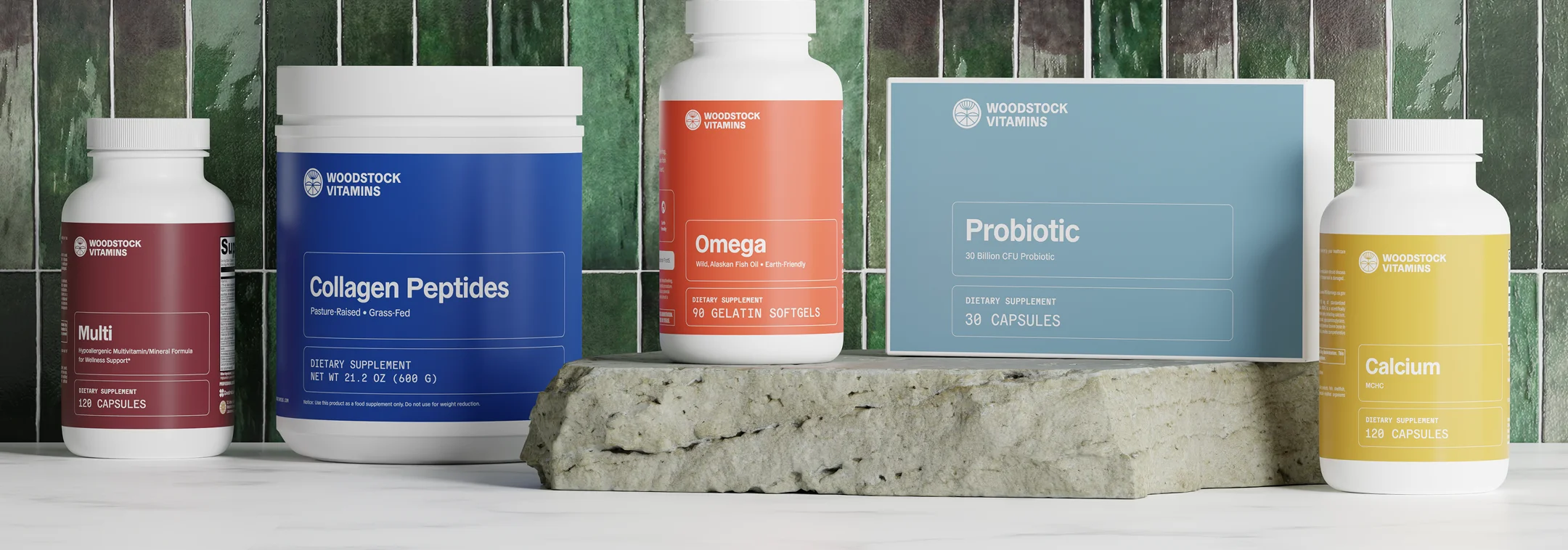
Woodstock Vitamins built the First5 — Omega, Probiotic, Calcium+D, Collagen, and Multi — around a simple rule: each nutrient earned its place because it’s broadly under-consumed, backed by strong evidence, relevant to multiple body systems, and meant for long-term daily use. Those five criteria are also why they can’t be flattened into one formula.
Each of the First5 works through a different mechanism, at a different dose, often needing a different delivery format entirely:
- Omega needs enough EPA and DHA — real gram-level amounts — to matter, in a form the body can actually absorb.
- Probiotic needs live, targeted strains that survive stomach acid to reach the gut. That’s a delivery problem a standard tablet doesn’t solve.
- Calcium+D needs a calcium dose large enough to matter, paired with Vitamin D3, because calcium absorption depends on it.
- Collagen isn’t a vitamin or mineral at all — it’s a structural protein, and it needs to be dosed in grams, not milligrams, to supply the amino acid profile connective tissue actually uses.
- Multi does what a multivitamin does best: covers the broad vitamin and mineral gaps at sensible, Daily-Value doses.
None of these substitute for each other. A well-formulated Multi helps support baseline nutritional gaps. It was never built to also help support cardiovascular health, a balanced gut microbiome, and connective tissue in the same swallow.
The Category Illusion
The “all-in-one” pitch is appealing precisely because it promises to make a decision disappear. One choice, made once, and you’re finished. That’s a comforting story — and it’s exactly the kind of story the supplement industry tells to keep things simple to sell, not simple to actually work.
The honest version is less tidy but more useful: most people aren’t under-supplemented because they’re missing one magic formula. They’re under-supplemented because a handful of specific, well-evidenced nutrients are missing from a typical diet, and no single pill is built to close all of those gaps in workable amounts.
That’s not a reason to feel behind. It’s a reason to stop looking for the one pill and start looking at the handful of specific gaps that are actually there.
Foundation, Not Accumulation, is Key
To be clear, the answer to “a multivitamin isn’t everything” is not “add more supplements.” The First5 exists precisely to prevent that spiral — five nutrients, chosen because the evidence says they matter broadly, not an invitation to start collecting bottles.
A Multi is a reasonable place to start. It’s a poor place to stop, if the goal is actually closing the gaps that most affect how people feel and function over time. The right question was never “which one pill does everything?” It’s “which of the specific nutrient gaps do I actually need to close?”
That’s the question the First5 was built to answer. Find your foundation with the Woodstock Vitamins quiz, or read more about the reasoning behind the First5.
If you’ve ever wondered what the difference is between a cabinet full of supplements and an intentional supplement stack, it’s this: a stack is a collection, and the First5 is a foundation. Let us explain.
That distinction sounds small but isn’t. Anyone can collect bottles of supplements for hair, skin, gut, and digestion, but a stack is a select group of supplements that have specific intentions that work together in unison. It’s the difference between adding a new supplement versus choosing an intentional product. This distinction is the reason the First5 was never meant to be read as a bundle of five products sitting next to each other on a shelf. But instead, as a stackable, cohesive group of products that work with nearly every major body system to bring out longer-lasting, total body health.
What a Stack Actually Is
Ask anyone you know to describe their “stack,” and you’ll get a list. A greens powder here, a nootropic there, and whatever a friend swore by. Each item earned its place for its own reason, on its own timeline, usually with its own separate story about why it got added.
That’s not a criticism of the people building their supplement regimen this way. It’s a description of how the category trains people to think. More products means more combinations, and even more personalization dressed up as precision. The underlying logic isn’t “what does the evidence say I’m missing” — it’s “what haven’t I tried yet.”
A stack can be extensive and still be directionless. Nothing about having twelve bottles on the counter tells you whether any of them are the right place to start.
The First5 Asks a Different Question
The First5 didn’t begin with a list of products. It began with a question: which nutrients are broadly under-consumed, well-supported by real evidence, relevant to multiple body systems, and worth taking consistently over the long term?
Run every nutrient in the category through that filter, honestly, and the field narrows fast. Most ingredients fail at least one of those four tests — they’re niche, they’re trendy, they’re single-system, or the evidence doesn’t hold up outside of a press release. What’s left is a short list. Not because five is a tidy marketing number, but because five is what the evidence actually supports as foundational.
That’s the reordering that matters. A stack starts with the product and works backward to a justification. The First5 starts with the criteria and works forward to whichever nutrients survive them.
Order Isn’t Arbitrary Here
In a stack, order is usually whatever you added most recently, or whatever’s cheapest to swap out. In the First5, the order reflects the weight of the evidence behind each nutrient — it’s fixed because the reasoning behind it doesn’t change from one marketing cycle to the next.
That’s a meaningful difference in how the two ideas function. A stack can be rearranged on a whim because nothing was holding it together in the first place. The First5 holds its shape because the criteria that built it haven’t moved.
A Framework Tells You What to Do With New Information
This is where the difference matters most in practice. A stack has no mechanism for handling something new. A trending ingredient shows up, and the only available response is to add it because adding is the whole operating model.
A framework responds differently. When something new comes along, the question isn’t “should I add this too?” It’s “does this meet the same bar the First5 already meets?” Most of the time, it doesn’t — and that’s fine. Not making the cut doesn’t mean a nutrient is useless. It means it isn’t foundational, which is a different and much narrower decision.
That’s also why the First5 is described as a living model rather than a fixed list. The model can evolve if the evidence genuinely shifts. What it won’t do is expand just because something new showed up and asked nicely.
Fewer Moving Parts, Not Fewer Standards
None of this is an argument that five is a magic number, or that nothing outside the First5 has value. It’s an argument about where to start and what to trust as the base of a routine. Foundational nutrients earn that role by clearing a high bar consistently — not by being new, not by being trendy, not by being marketed as personalized.
Once that foundation is in place, there’s room for a more individual layer — supplements that make sense for a specific health picture — and beyond that, room for the things a person simply wants to try. But that ordering only holds if the foundation was built on a framework in the first place. Skip that step, and what looks like a personalized plan is really just a stack with better branding.
Start With the Foundation, Not the List
The First5 isn’t asking anyone to memorize five products. It’s asking a simpler question first: are you building on a foundation, or are you just accumulating? Answer that honestly, and the rest of the decision gets a lot easier. Not sure where your own foundation stands? Take the quiz to see which of the First5 nutrients matter most for you
There’s a moment almost everyone hits eventually: nothing feels like it’s working, so you add something. A new bottle. A new blend. Something with a bolder label than the last one. It feels like progress, but it rarely is. “More” is the industry’s default answer to almost every problem. It’s also, most of the time, the wrong one. Let us explain.
The “More” Reflex and Why It Doesn’t Compound
Adding a product on top of a shaky nutritional foundation doesn’t create momentum or lead to good results. It creates noise. If your baseline nutrient gaps are still open, a new supplement or product isn’t building on anything. Your progress ends up being imaginary.
This is the quiet failure behind most crowded supplement cabinets. It’s not laziness or a lack of effort. It’s a structural mistake. It’s treating supplementation like a collection to have instead of a foundation to build up. Ten half-used bottles rarely outperform two or three thoughtfully taken ones with consistency. That’s because the ten were never really working together in the first place. They were working around each other. Remember, results don’t compound when the thing underneath them keeps shifting.
What Compounding Actually Looks Like
Compounding requires two things: the right starting points and time spent not disrupting them.
In nutrition, that means closing the gaps that are broadly under-consumed and are foundational to total body health. These are the nutrients most diets miss regardless of how careful someone is, and then giving the body a consistent baseline to work from. Omega-3s help support brain and cardiovascular health. Calcium and Vitamin D help support bone strength and density over time. A balanced gut microbiome, supported by the right probiotic strains, plays a role in digestion and broader system function. None of that shows up as a single dramatic before-and-after. It shows up as a baseline that holds month after month, instead of resetting every time a routine changes.
That’s the part the industry rarely tells you: benefits compound. They don’t spike and then crash. A formula that promises a fast, singular turnaround is, by definition, promising something a nutrient can’t deliver on its own. The honest version is slower and less exciting to put on a label — and it’s the one that actually holds up over time.
Why the Foundation Has to Come First
This is the reasoning behind the First5: five nutrients that are broadly under-consumed even in strong diets, backed by a meaningful body of evidence, relevant across multiple body systems, and appropriate for long-term daily use. Everything else — however well-formulated and interesting from a research perspective — is secondary until that baseline is in place.
Layering something promising on top of an open gap doesn’t get you further ahead. It just means you’re optimizing on top of a hole. Foundation first isn’t a slogan. It’s the only sequence that lets anything after it actually work.
Restraint Is Part of the Strategy
We say no to more products more often than we say yes to them — on purpose. A well-marketed add-on that isn’t yet earned doesn’t belong in a starting recommendation, no matter how good the story behind it sounds. Situational supplements have a place, but only after consistency with the foundation is already established. Not before. Not instead of.
This is a different posture than most of the category takes, and it’s a deliberate one. A crowded cabinet isn’t a sign of a serious wellness practice. A short list, taken consistently, usually is.
What This Looks Like in Practice
Start with the foundation, not the newest thing on the shelf. If you’re not sure where your own gaps are, Find Your Foundation walks you through it. It’s built to identify which of the First5 belong in your starting point, not to hand you a shopping list. From there, the work is mostly about showing up: the same handful of things, taken the same way, for long enough that they can actually do what they’re formulated to do.
This is what turns supplementation from a stack of purchases into an actual practice — one you commit to because the foundation is right, not because you found one more thing to add to the pile. Fewer supplements. Better decisions. Results that build instead of fade.
Most supplement routines aren’t built — they’re accumulated. A bottle here because a friend recommended it. A powder there because an ad found you at the right moment. A few months later, the cabinet is full, and half of it goes untouched. Not because any single product was wrong, but because nothing was ever put in order.
A sustainable routine isn’t about which products you own. It’s about the sequence you add them in and the role they play. Get the order right, and a supplement routine becomes something you barely think about — a few minutes a day sets the foundation for months of intentional supplementation. Get the order wrong, and even good products turn into unused bottles collecting dust in your cabinet. Here’s how to build it the right way, one layer at a time.

Start With What We All Need: The First5
Every sustainable routine starts in the same place — not with your specific goals, your labs, or your latest curiosity, but with the foundation nearly everyone is missing regardless of any of that. This is Component 1 of a real supplement strategy: what we ALL need.
That foundation is the First5 — five nutrients that are broadly under-consumed even in strong diets, backed by a deep body of evidence, and built for long-term, daily use rather than a quick fix:
- Omega — helps support brain, heart, and joint health
- Probiotic — helps support a balanced gut microbiome
- Calcium+D — helps support bone strength and structure
- Collagen — helps support skin, joints, bones, and connective tissue
- Multi — helps support the nutrient gaps most diets leave behind
Not everyone needs all five. The First5 isn’t a checklist to complete — it’s a set of gaps to check against your own life. If you’re not sure which of the five actually apply to you, that’s exactly what Find Your Foundation is for. It won’t hand you a personalized health plan, and it isn’t meant to. Its one job is to tell you where your foundation has real gaps, so you’re not guessing.
This is the step people are most tempted to skip, usually because it feels too basic to matter. It’s also the step that determines whether everything you add later actually works. A supplement that targets a specific concern can’t do much if the foundation underneath it is missing. Foundation first, always — not because it’s exciting, but because it’s what everything else depends on.
Turn the Foundation Into a Daily Habit
A foundation only works if it’s actually taken. This is where most routines quietly fail — not from a bad product, but from a routine that never became automatic.
A few things make it stick:
- Anchor it to something you already do. Keep your First5 next to your coffee maker, your toothbrush, or wherever your morning already lands. The goal isn’t a new ritual; it’s attaching the new habit to one that’s already unbreakable.
- Same time, same place. Consistency beats precision. Taking your foundation at roughly the same time every day matters more than taking it at the “optimal” time.
- Keep it visible. Out of sight is out of routine. A cabinet is where good intentions go to be forgotten.
- Give it weeks, not days. Foundational nutrients work by closing gaps that built up over years. Expecting an overnight shift sets you up to quit right before it starts working. Let the habit run before you judge the results.
If this is the only layer you ever build, that’s a complete, defensible routine. For a lot of people, a solid foundation is enough. The layers below are for those whose picture is a little more specific.
Layer In What YOU Need
Once your foundation is steady — not perfect, just consistent — some people have a health picture that calls for more. This is Component 2 of a real supplement strategy: what YOU need.
This layer is personal by design. It’s shaped by your health history, your labs, your lifestyle — the kind of picture a quiz can’t responsibly capture and shouldn’t try to. This is where Dr. Neal’s guidance on DrNealSmoller.com comes in. His role is to help you understand your own picture and what, if anything, belongs beyond the foundation. Woodstock Vitamins’ role is to make sure that foundation is solid enough to build on when you get there.
The mistake to avoid here is skipping to this layer before the first one is locked in. A targeted addition can’t compensate for a missing foundation; it just adds a second thing to be inconsistent about.
Add What You Want Once the First Two Are Earned
The last layer is Component 3: what you want. This is where situational add-ons and newer, less-established supplements belong — the ones you’re curious about, want to try, or have read about somewhere.
This layer isn’t off-limits. It’s just last, and for a reason: it’s the layer with the least evidence behind it, so it should never be competing for space with the layers that have the most. A few ground rules keep it from undoing everything above it:
- Never first. If your foundation isn’t consistent yet, this layer waits.
- One at a time. Adding a single new product lets you actually notice how it fits your routine. Adding three at once just recreates the cabinet problem you were trying to avoid.
- Earned, not automatic. This layer exists for real situations, not because a product showed up in your feed. If you can’t say what gap it’s closing, it doesn’t belong yet.
Getting to this layer isn’t a failure of the first two — it’s what the first two were built to support.
The Order Is the Strategy
None of this is complicated on its own. What makes a routine sustainable is doing these three things in order, and not letting excitement about layer three pull you past layers one and two.
Build your foundation. Then your needs. Then your wants. In that order, every time, because a strategy isn’t a list of products. It’s a filter for deciding what earns a place in your routine, and when. If you haven’t found your foundation yet, that’s the only place to start: Find Your Foundation.
At some point, almost everyone who starts thinking seriously about supplements asks the same question: what’s the best brand?
It feels like a reasonable place to start. Brands are how we navigate most consumer categories. You find one you trust, you buy from it, you don’t have to think too hard about the rest. The problem is that supplements don’t work like most consumer categories — and starting with brand leads almost everyone to the same place: a cabinet full of things they’re not sure about, a routine they can’t sustain, and results that are hard to measure and easy to doubt.
The question isn’t wrong because brands don’t matter. They do. The question is wrong because it skips the step that actually determines whether a supplement is worth taking at all.
The Wrong Question
Brand-first thinking puts marketing in charge of your supplement decisions. And supplement marketing is very good at one thing: making you feel like whatever you’re currently taking isn’t quite enough.
There’s always a new ingredient. A new delivery mechanism. A new study — usually preliminary — that generates a wave of products and claims before the research has had time to replicate. The brand-first approach means you’re navigating that noise without a filter. You’re comparing labels, reading reviews, trying to parse the difference between “clinically studied” and “clinically effective,” wondering whether the 47-ingredient formula is better than the 12-ingredient one, and whether the one your friend takes is actually doing anything.
This isn’t a consumer failure. It’s what the industry is designed to produce. Confusion is profitable. A person who has a clear sense of what they need and why is a much harder sell than a perpetually uncertain person.
The same dynamic drives trend-first supplement thinking. When something trends — collagen a few years ago, lion’s mane more recently, whatever comes next — the question it generates is “should I be taking this?” That question assumes the trend is the starting point. It isn’t. The trend is a marketing event. Whether the ingredient deserves a place in your routine is a completely separate question, and one that requires a different kind of answer.
The Right Question
The question that actually produces useful answers is this: which nutrients do most people need and aren’t getting?
That’s it. When you start there, the noise drops out immediately. You’re no longer evaluating brands or trends. You’re evaluating nutrients — what they do in the body, what the evidence shows, how common deficiency or insufficiency actually is, and whether a person can realistically get enough from food alone.
When Neal started asking that question — applying a pharmacist’s evidence standard to the supplement category — a pattern emerged that he couldn’t ignore. Across the population, the same nutrients kept showing up as undersupplied. The same gaps kept appearing in the same people. And the science supporting supplementation for those specific nutrients was far stronger and more consistent than the science supporting most of what fills supplement shelves.
The answer to the right question isn’t a brand. It’s five nutrients. Every time.

The First5 and Why
The First5 aren’t a product bundle. They’re the answer to a nutrient question, and they’re there because they each cleared the same bar: broadly under-consumed in modern diets, supported by strong and consistent evidence, relevant to multiple body systems, and safe for long-term daily use.
Omega-3s. EPA and DHA — the long-chain omega-3s found in fatty fish — are the building blocks of cell membranes throughout the body, including in the brain and cardiovascular system. Modern diets, even reasonably healthy ones, rarely deliver the amounts the research associates with meaningful benefit. Plant-based omega-3 sources provide ALA, which the body converts to EPA and DHA inefficiently. Most people are running low on the forms that actually matter, and the downstream effects influence your natural inflammatory response, cognitive function, joint health, and cardiovascular health — which is what it looks like when a nutrient is relevant across multiple systems.
Probiotics. The gut microbiome — the ecosystem of bacteria that lives in the digestive system — is involved in far more than digestion. It influences immune function, mood, and nutrient absorption. Modern life is systematically hard on that ecosystem: processed food, antibiotic use, chronic stress, and environmental factors all disrupt it. A well-formulated probiotic, chosen for strain specificity rather than CFU count, supports the gut environment that everything else depends on.
Calcium and Vitamin D. Calcium is the structural mineral of bone. Vitamin D is the mechanism by which the body absorbs and uses it. The two are inseparable — calcium without adequate D doesn’t behave the same way in the body — and insufficiency in both is common across the population, not just in the groups that typically get warned about it. Low sun exposure, limited dairy, and the gradual decline in bone density that begins earlier than most people expect make this a foundation piece for most adults.
Collagen Peptides. Collagen is the most abundant protein in the human body — the structural material of skin, joints, bones, connective tissue, and the gut lining. The body produces it, but production declines with age, and modern diets have almost entirely eliminated the collagen-rich foods — bone broth, skin-on cuts, organ meats — that used to supply it. This isn’t a general protein gap. It’s a specific structural gap that no other protein source closes, and the research on hydrolyzed collagen peptides shows meaningful support for the systems that depend on it.
Multivitamin. Not the multi-as-everything solution that decades of marketing has promised — but a well-formulated multivitamin as a genuine gap-closer. Modern food supply, dietary patterns, and individual variation leave most people consistently short on specific vitamins and minerals: B vitamins, magnesium, vitamin D, iron. A multivitamin built with the right forms at clinically relevant doses addresses those gaps without requiring a person to figure out and manage each one individually.
These five are in the First5 because the evidence put them there. They’re not the most exciting category. They’re not trending. They’re the nutrients that most people are missing and that the science most consistently supports — and that combination, it turns out, is both rare and worth paying attention to.
The Execution Gap
Here’s where things get complicated. Most people who take at least some of these nutrients aren’t taking them correctly — and in supplements, how you take something is often as important as what you take.
Form is the clearest example. Many multivitamins use synthetic B vitamins that a meaningful portion of the population can’t properly convert into usable forms. Many calcium supplements use calcium carbonate, which has lower bioavailability than other forms and requires stomach acid to absorb — an issue for anyone whose stomach acid is reduced, which includes a large number of older adults. Many fish oils deliver far less active EPA and DHA than their label implies, because the label counts total omega-3 rather than the fractions that the research actually studied. Many probiotics lead with CFU count — billions of bacteria — when strain specificity is what determines whether a probiotic does anything relevant to your health.
Dose matters for the same reason. An ingredient at half the dose used in the research that supports its claims is not half as effective. It may be effectively ineffective, depending on the nutrient and the outcome. This is not a minor distinction. It’s the difference between a supplement routine that produces results and one that produces expensive urine.
Getting the right nutrients matters. Getting them right matters more.
What Changes When You Get This Right
The most common thing people report when they’ve been consistent with the First5 for a few months isn’t a dramatic transformation. It’s the absence of certain things — the midday energy collapse that had become normal, the joint stiffness that seemed like an inevitable part of aging, the digestive inconsistency that was easy to attribute to stress or diet but never quite resolved.
This is what foundational nutrition looks like. It doesn’t announce itself. It supports systems that are supposed to work quietly in the background, and when those systems are better supported, daily life feels different in ways that are hard to attribute to any single thing — which is exactly what you’d expect if the foundation was doing its job.
People who get the First5 right also stop chasing the next thing. Not because they’ve decided to ignore the supplement category, but because they’re not operating from the anxiety that drives most supplement decisions. When you have a clear foundation, and you understand why it’s there, the next trending ingredient is just an ingredient — something to evaluate on its merits, not something to feel behind on.
This is what supplements as a wellness practice actually look like. Not a cabinet full of uncertainty. A small number of things taken consistently, for good reasons, with realistic expectations and real results over time.
Start Here
Not everyone needs all five. The goal of the First5 isn’t to add five products to your routine — it’s to identify which gaps exist in yours and close them. You can find which gaps you need to fill by taking our two-minute quiz.
Some people have the omega piece handled. Some have been consistent with a quality probiotic for years. Some have dietary patterns that partially address specific needs. The quiz exists to help you figure out where your actual gaps are, so you start with what matters most for you rather than working through the full five on the assumption that more is better.
More is rarely better. The right things, taken correctly, consistently — that’s what produces results that last.
Take a look in your cabinet. What do you see? Half-used bottles? Most of which are pretty much expired? That’s all too common. That magical supplement that promised to cure everything under the sun actually delivered nothing after two days. You spent the money on something you read about, saw advertised, or heard was life-changing — and then completely forgot about it behind your oatmeal.
We want you to know you are not the problem. This isn’t about willpower. This is a strategy problem. You see, the supplement industry is very good at one thing: convincing you that the next product is the ultimate answer. But it’s not true.
A supplement strategy is the antidote. It’s a framework that, once you build it, wipes your conscience clean of every false claim, new trend, shiny bottle that comes your way. Finally, you can develop a framework for choosing the right supplements for you without wasting time, money, or gambling with your health.
The Supplement Industry Is Designed to Overwhelm You
We know, surprise surprise. The industry is always churning out new products, new trends, and new claims. They promise overnight results from ingredients and formulations that have little or no scientific backing. The noise is real, but it’s not an accident. It’s the business model. Confusion keeps people spending and second-guessing. It keeps them spinning their wheels, wondering what the next big thing is. A supplement strategy is there to cut through the noise and turn your supplement journey from confused to confident.
What a Strategy Actually Is (And What It Isn’t)
Plainly put, a supplement strategy is not a list of products. It’s not random. It’s not based on trends or hype. In other words, it’s not a stack, a protocol, or a routine. A supplement strategy is a framework for choosing the right supplements for you at this moment — filtering out what’s not going to help. It’s a framework for choosing the right supplements that target your specific health issue. It’s not fleeting or for a season. You build it once. It works for a long time.

Meet the Man Behind Your Supplement Plan
Our founder, Dr. Neal Smoller, has spent decades in a holistic pharmacy practice where he saw dozens of people pick up supplements without a plan. He saw people waste money and lose faith in their supplements because they failed to work. Or so they thought. It wasn’t them. It was their lack of strategy. As a Supplement Strategist, a term he coined, he built a three-part framework to help you build a supplement strategy that works for you today, tomorrow, and into the future. Here’s how it works.
1. Supplements You Need to Build Foundational Health
The first part of a supplement strategy is to build your foundational wellness. This means choosing supplements that work across body systems, like your immune, digestive, musculoskeletal, lymphatic, etc. We have exactly what you need: The First5.
These are not five supplements we happen to recommend. They are the five essential nutrients that data shows are under-consumed, have the most scientific backing, and impact multiple body systems. Those are:
Not everyone needs all five. But everyone starts here. If you’d like to find your ideal First5 combination, take our quiz. You would be just two minutes away from finding the essential nutrients you need to thrive.
2. Supplements You Want To Solve a Specific Problem
Now that you’ve got your foundation in place, the next part of your supplement strategy gets personal. Part 2 is about being intentional about your specific health goals and the issues you’re trying to solve. Next, you should choose the supplements with strong evidence that are relevant to your situation. Whether you’re battling something with your heart, digestion, skin, bones, or cognitive health, pick a supplement that’s going to hyper-target that issue. Base your choice on your health history, lab results, and your lifestyle.
3. Supplements for the Bells and Whistles
The last part of your supplement strategy is all about having fun and taking supplements that you’re curious about and want to experiment with. Once parts one and two are solid in your strategy, you’ve earned the right to explore. Try supplements with emerging data, ingredients that you’re curious about, or just things you want to try. This is where gimmicks live, and we’re totally fine with that, as long as the foundation is covered first. But don’t forget your foundations. No resveratrol for heart health if your omega-3 supplement isn’t in place. No lion’s mane if your brain health foundations aren’t covered. Part three is your reward for doing the first two correctly.
Why the Order Is Everything
When it comes to your supplement strategy, less is more. That’s choosing your strategic foundations first, which is so important. Don’t jump to part three without getting parts one and two locked. That is precisely how people waste money and get no results. It’s also exactly what the supplement industry wants you to do — because focusing on part three is where the margins are. Be smarter than the industry.
The order is the strategy. Start with your foundations first. Get focused on your health goals. Then have fun with any additional supplements. If you stick with this sequence, every supplement you take will have a reason to be there, and your health will likely flourish because of it.
Start Here
Now that you have the framework, the next step is finding your foundation. Take our quiz. It takes three minutes and tells you exactly which of the First5 belongs at the start of your strategy — and what to build from there.