





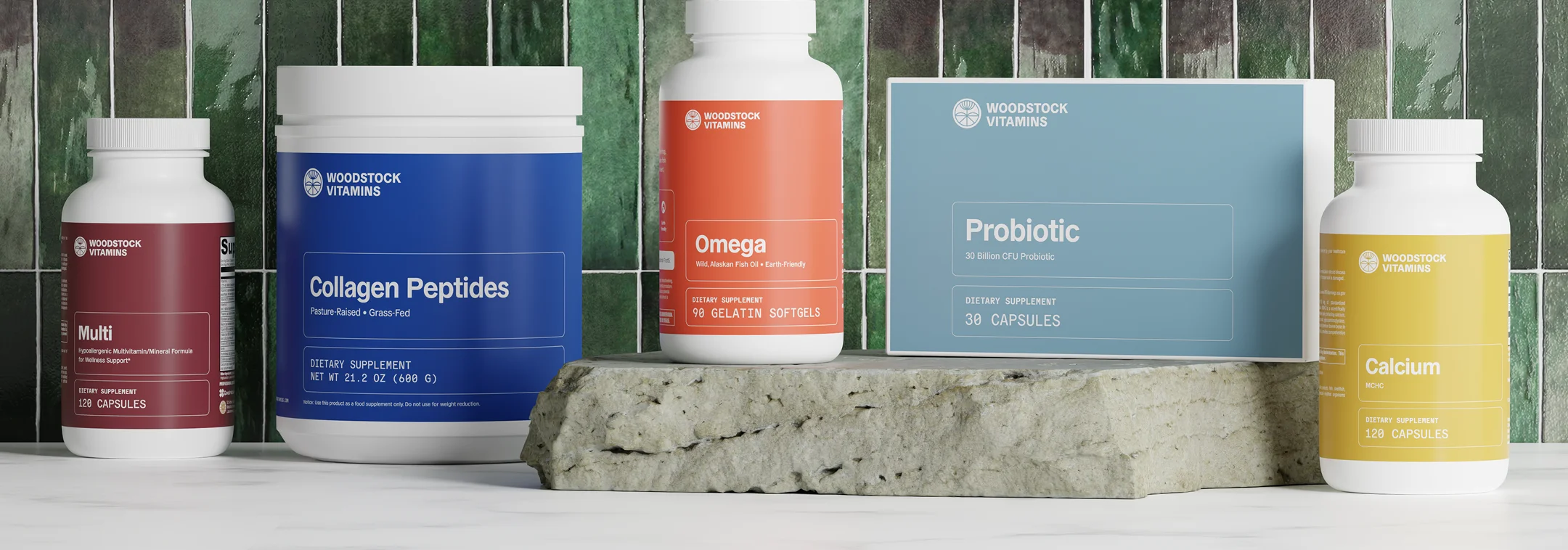


Omega-3s are some of the most powerful (yet underrated) nutrients for total body health. Their benefits range from supporting cognitive health, the body’s natural inflammatory response, skin, joints, and more. Even though Omega-3s are one of the most essential nutrients, up to 85% of the world’s population doesn’t get enough from diet alone.
That’s why Dr. Neal Smoller, supplement strategist, pharmacist, and founder of Woodstock Vitamins, has been advocating for supplementing omega-3s for years. He’s addressed several debunked myths surrounding omega-3s that impact how people think about their omega-3 intake. Hopefully by the end of this article, you’ll understand why omega-3s are so foundational for total-body health and how to choose the right one.
What’s Wrong with Most Omega-3 Supplements
You’ve probably got a bottle of fish oil in your cabinet right now. Maybe you bought it because someone told you to, or you read about a particular brand in some article. Maybe you’re not even sure you’re still taking it. But the truth is, many omega-3s aren’t fresh enough or well-formulated to be effective.
Omega-3 is one of the few nutrients where the gap between what your diet provides and what your body needs is real, consistent, and hard to close with food alone. That’s why it’s in the First5 — not because it sounds foundational, but because most people are genuinely running without it. You don’t need to evaluate omega-3 products. You need a good one, taken consistently. Here’s what you should actually know about whether it’s working — and whether what you have is any good.
Why Omega-3s are Foundational For Your Health
Taking omega-3s isn’t just a good idea; it’s a great idea for ensuring you maintain long-lasting health for years. Generally speaking, omega-3 fatty acids are structural building blocks that support the body in a number of ways. They:
- Support healthy cell membrane flexibility (1)
- Help maintain balanced inflammatory signaling (2)
- Support cardiovascular function (3)
- Contribute to brain structure and cognitive performance (4)
- Promote skin hydration and barrier integrity (5)
- Support joint comfort and mobility (6)
What to Look For in an Omega-3 Supplement
As mentioned earlier, not all omega-3s are created equal. When choosing your omega-3 supplement, avoid these mistakes, and you’ll know you made the right choice:
- Buying low-dose products (300 mg omega-3s is not better than 1,000 mg)
- Ignoring oxidation (fish burps/taste = poor quality)
- Taking inconsistently
- Not considering omega-6 intake
- Assuming plant ALA converts efficiently to DHA (conversion is often <5%)
- Buying from a brand with low ethical standards or questionable sourcing
Just remember, dose, quality, sourcing, and form matter. Choose wisely.
Why Our Omega Isn’t Like the Others
While most people think omega-3s are all the same, that’s anything but true. Our Omega truly stands out in terms of its ingredients, formulation, and absorbability.
- High dose: 1000mg of omega-3s has been shown to provide cognitive, joint, and inflammatory support benefits.
- Low TOTOX score: This makes Omega one of the freshest-tasting omega-3s on the market.
- Sourcing: Our Omega is made from wild-caught Alaskan Pollock from a 35+ year sustainable fishery.
- Bioavailability: Omega is in the Ethyl Esters, a bioavailable form of omega-3s that’s easy on the stomach.
- Pharmacist-formulated: Dr. Neal Smoller, our founder and 20+ year pharmacist, created the formula himself using the latest science.
There are seemingly a million omega-3 supplements on the market; choose wisely with Omega.
Our Omega is Tested for Quality
One of the biggest hesitations around fish oil and getting omega-3s from eating fish is the amount of heavy metals lurking around. Fortunately, our Omega is third-party tested for heavy metals like lead, cadmium, and mercury, as well as contaminants like E. coli, Salmonella, yeast, and mold. Testing is a huge step when choosing an omega-3 supplement. It’s a good idea to give yourself peace of mind by knowing your omega-3s have been rigorously tested for heavy metals.
When to Expect Results from Consistent Omega-3 Use
Omega-3s are not a one-and-done kind of nutrient. Consistent intake yields the best results, particularly for your heart and brain. Studies show that it takes between 6 weeks and 6 months of daily use to see results from omega-3s.

Where Omega Fits into Your Health Foundation
At Woodstock Vitamins, we believe in building your health on a solid foundation. Yes, you can fill your body and medicine cabinet with tons of nice-sounding, unnecessary supplements. But why would you when you can get your foundational nutrients solid instead? That’s the logic behind Omega and all of the First 5.
That’s why Omega is part of our First5 framework — five foundational inputs most people lack:
The Bottom Line
When it comes to total body health, omega-3s don’t get the credit they deserve. And most of us don’t get enough omega-3s from diet alone. It’s affecting everything from how our brains function to our body’s inflammatory response. Omega-3s are not “optional”; they’re foundational. If you’re not sure whether Omega is the right starting point for you — or which of the First5 you actually need — take the quiz. It takes two minutes and tells you exactly where to begin your health journey from the inside out starts with what you put in your body, and our Omega is a good place to begin. Learn more about Omega and our other First5 here.
Walk down the supplement aisle, and you’ll find dozens of fish oil bottles. Most of them look roughly the same. The labels make roughly the same promises. The prices vary, but the pitch doesn’t: take this, get your omega-3s, done.
It isn’t that simple, and the gap between what those bottles claim and what they actually deliver is one of the most consequential quality problems in the supplement category. This article is about what to actually look for in an omega-3 supplement, why most products fall short, and how to think about this nutrient clearly.
The Potency Problem
Most fish oil products contain far less EPA and DHA than the label leads you to believe. Here’s why. A typical fish oil softgel is labeled as “1000mg fish oil.” That sounds meaningful until you read the fine print. That 1000mg figure refers to the total amount of fish oil in the capsule, not the amount of EPA and DHA it contains. Those are the two omega-3 fatty acids that the research actually focuses on.
In many standard fish oils, the actual EPA+DHA content per softgel is somewhere between 180mg and 360mg. To get close to the amounts that appear in the research literature — generally in the range of 1000mg EPA+DHA per day or more, depending on the health goal — a person would need to take three, four, or sometimes five capsules daily.
Most people don’t do that. Most labels don’t make it obvious that they should. The result: products get taken at doses that are too low to accomplish much, the person notices nothing, and they conclude that omega-3 “didn’t work”; when the real problem was potency, not the nutrient.
What to look at instead: The Supplement Facts panel, not the product name. Find the line that says “Total Omega-3” or “EPA + DHA” and look at the actual milligrams per serving. That’s the number that matters.
EPA and DHA: What Each Does, and Why Both Matter
Omega-3 fatty acids are not all the same. The three main types are ALA (alpha-linolenic acid), EPA (eicosapentaenoic acid), and DHA (docosahexaenoic acid).
ALA is found in plant sources — flaxseed, chia, walnuts. It’s a legitimate dietary fat, but the human body converts very little of it into EPA or DHA. The conversion rate is low enough that plant-based omega-3s, by themselves, do not reliably close the same gap that EPA and DHA close. This is an important distinction for anyone eating a plant-heavy diet.
EPA and DHA come primarily from marine sources — fatty fish and the algae those fish eat. These are the forms that appear in the majority of peer-reviewed research on omega-3 supplementation.
What EPA does: EPA plays a role in the body’s normal regulatory processes, including cardiovascular health, mood regulation, and the systems that manage how the body responds to physical stress and recovery. It’s the fatty acid most studied in the context of brain health and normal mood function.
What DHA does: DHA is a structural component of the brain and eyes. Roughly 60% of the brain’s fat content is DHA. It’s critical during development and continues to matter throughout life for cognitive function and long-term brain health.
Why both matter: They work on different systems and neither fully substitutes for the other. A fish oil high in DHA but low in EPA, or vice versa, is not covering the same ground as a well-balanced formula. Look for a product that provides meaningful amounts of both.
On the topic of dose: The research varies by health goal, but the pattern is consistent. Low-dose supplementation (under 500mg EPA+DHA daily) rarely shows the effects that higher-dose supplementation does. Most studies on brain health, cardiovascular support, and joint comfort use doses starting at 1000mg EPA+DHA and up. That’s the number to orient toward.
Form and Absorption: Ethyl Ester vs. Triglyceride
Not all fish oil is processed the same way, and that processing affects how well the omega-3s are absorbed.
Natural triglyceride form is how omega-3s exist in actual fish. The fatty acids are bound to a glycerol backbone in a structure the body recognizes easily. Absorption is good.
Ethyl ester form is a concentrated form produced by processing natural fish oil to increase EPA+DHA potency. The glycerol backbone is replaced with an ethanol molecule. Ethyl ester fish oils can deliver higher EPA+DHA per softgel, which is part of why they’re widely used in higher-potency products.
It’s worth noting that taking fish oil with a fat-containing meal improves absorption for both forms — but especially for ethyl ester. If someone is taking a high-potency ethyl ester product without food, they may be absorbing considerably less than they expect.
Reconstituted triglyceride (rTG) is a third option — fish oil processed to high-potency concentration, then converted back into triglyceride form. It combines the potency advantage of concentration with the absorption advantage of the natural form. It’s also more expensive to produce, which is why fewer products use it.
Our Omega uses the ethyl ester form and was formulated by Dr. Neal himself.
The Oxidation Issue
This is the quality problem most people never think about and one of the more significant ones in the omega-3 category.
Fish oil is highly susceptible to oxidation. When omega-3 fatty acids are exposed to heat, light, or air during processing, storage, or transport, they can degrade and become rancid. Oxidized fish oil doesn’t just fail to help; some research suggests that heavily oxidized oil may contribute to the opposite of the effects you’re taking it for.
The problem is that oxidation isn’t always obvious. A mildly rancid product may still smell acceptable. Heavily flavored or enteric-coated capsules can mask odor entirely. The consumer has no easy way to tell from the outside.
What to look for:
The most reliable signal at home is smell. Break open a softgel. Fresh, high-quality fish oil smells mild, faintly oceanic at most. Rancid oil smells strongly fishy, sour, or like old cooking grease. If the capsule is designed so you can’t do this, that’s worth noting.
Among quality markers to look for on the label or brand’s documentation: third-party testing for oxidation markers, specifically TOTOX (total oxidation) values, peroxide value (PV), and anisidine value (AV). These are the industry standards for measuring oxidation. Brands that test for these and publish the results are doing something most of their competitors are not.
On “fish burps”: Many people interpret the unpleasant aftertaste or reflux from fish oil as evidence that it’s working — a sign of potency. It isn’t. Fish burps are a sign of either a low-quality, poorly processed oil or one that is beginning to oxidize. A well-made, fresh fish oil product should not cause significant fishy reflux.
The takeaway: Our Omega has one of the lowest TOTOX scores on the market, and the capsule is designed to maintain freshness without bringing fish burps to your supplement experience.
Sourcing: What Actually Matters
The omega-3 category has real sourcing variation, and it affects product quality in ways that aren’t always legible from the label.
Wild-caught matters. Fish from wild populations generally have a different fatty acid profile than farmed fish, and wild-caught sourcing is associated with a lower risk of certain contaminants. The certification to look for: the Marine Stewardship Council (MSC) certification indicates sustainable wild-catch practices verified by an independent third party.
Cold, clean water matters. The fish most commonly used for omega-3 supplements — anchovies, sardines, mackerel — are small, short-lived species that accumulate fewer heavy metals than larger fish (like tuna or swordfish) that are higher on the food chain. However, sourcing location still matters. Waters with higher industrial pollution loads produce fish with higher contaminant risk.
Third-party heavy metal and contaminant testing matters. The supplement industry is not subject to the same mandatory pre-market testing that pharmaceuticals are. For fish oil specifically — given the biological concentration of environmental contaminants in marine sources — independent testing for heavy metals (mercury, lead, arsenic, cadmium) and environmental pollutants (PCBs, dioxins) is a meaningful quality marker.
IFOS certification (International Fish Oil Standards) is one of the most recognized third-party programs for omega-3 quality. Products that have been IFOS certified have been tested for purity, potency, and oxidation by an independent lab. It’s not the only marker, but it’s a meaningful one.
What to be skeptical of: Vague language like “pharmaceutical grade,” “ultra-pure,” or “premium quality” means nothing without evidence. These are marketing phrases, not certifications. Ask what the brand can actually document.
Our solution: Fortunately, our Omega is made from wild-caught Alaskan Pollock from a 35-year MSC-certified fishery in America. It’s also third-party tested and pharmacist-formulated.
Where Omega Fits in the Foundation
Omega-3 supplementation is part of the First5 — the five foundational nutrients that most people aren’t getting from food alone, with the strongest evidence across multiple body systems.
The omega-3 gap is one of the most consistent nutritional shortfalls in the modern diet. Western eating patterns, heavy in processed foods and seed oils, are low in EPA and DHA. Most people do not eat fatty fish multiple times a week. That gap is real, and it has downstream effects on systems the body relies on daily.
What consistent omega-3 supplementation helps support:
- Cardiovascular health — EPA and DHA help support healthy triglyceride levels and cardiovascular function (1)
- Brain health — DHA is a structural component of brain tissue; EPA plays a role in normal mood regulation and cognitive function (2)
- Joint comfort — omega-3s help support the body’s normal regulatory processes that affect joint mobility and comfort (3)
- Long-term tissue health — multiple systems benefit from consistent omega-3 intake over time
A critical point about expectations: omega-3 is a long-game supplement. It is not a fast-acting intervention. The research shows benefits that accumulate over weeks and months of consistent intake — not effects that show up in days. If someone takes fish oil for two weeks and doesn’t notice anything, that doesn’t mean it isn’t working. It means they haven’t been taking it long enough for the gap-closing to register.
This is a foundational supplement. That means it belongs in a daily routine not because it produces a dramatic short-term effect, but because the body needs it consistently, the diet usually doesn’t provide it, and the long-term case for it is well-established.
The evaluation you should do before buying anything: Open the Supplement Facts. Find EPA and DHA. Confirm you’re looking at milligrams of those two fatty acids, not total fish oil. That number — not the product name, not the price, not the front-of-label claim — is where the story is.
Most people looking for more energy start by asking the wrong question. They ask what to add — a stimulant, a shot, a “hack” for the afternoon slump. The better question is what’s missing. Energy isn’t manufactured by a single ingredient. It’s produced, continuously, inside your cells — and that process depends on a specific set of nutritional inputs showing up, every day, in the right amounts.
This piece goes one level deeper than our other articles about the specific roles B vitamins, iron, and magnesium play in energy metabolism, and why gaps in any one of them can leave you running on empty no matter how much sleep you get or coffee you drink.
Energy Is Made, Not Found
Every cell in your body produces energy through a process that converts food into a usable form — a molecule called ATP. That process runs on a chain of chemical reactions, and chemical reactions need cofactors: vitamins and minerals that help enzymes do their job. Take enough of the right inputs off the table, and the chain slows down, regardless of how many calories you’re eating.
This is the foundational case for supplementation at all: not to manufacture energy from nothing, but to make sure the machinery that already produces it has what it needs.
B Vitamins: The Metabolic Engine
The B vitamins are the closest thing the body has to a dedicated energy-production team. Several of them work directly inside the pathways that turn carbohydrates, fats, and protein into ATP:
- B1 (thiamine) and B2 (riboflavin) help support the early steps of converting glucose into usable energy.
- B3 (niacin) is a building block for NAD+, a molecule the body’s energy-producing pathways depend on at nearly every step.
- B5 (pantothenic acid) helps support the formation of coenzyme A, a central player in breaking down fats and carbohydrates for fuel.
- B6 plays a role in how the body metabolizes protein and supports normal red blood cell formation.
- B12 and folate support normal red blood cell production and nervous system function — both of which affect how well oxygen and nutrients get where they need to go.
None of these vitamins are stored in large reserves. B12 is the exception with meaningful liver storage, but most B vitamins are water-soluble, meaning your body uses what it needs and clears the rest daily. That makes daily, consistent intake — not occasional dosing — the relevant variable.
Iron: Oxygen Is Non-Negotiable
Cellular energy production requires oxygen. Iron is the reason oxygen gets there. It’s a core component of hemoglobin, the protein in red blood cells that carries oxygen from your lungs to every tissue in your body, including the tissues doing the work of producing energy.
Low iron intake is common, particularly among people who menstruate, endurance athletes, and anyone eating a largely plant-based diet, since iron from plant sources is less readily absorbed than iron from animal sources. When iron intake doesn’t keep pace with what the body needs, oxygen delivery becomes less efficient, and energy metabolism has less to work with, cell by cell.
This is a nutrient gap worth understanding, not a reason to panic. Most people don’t need to test or supplement iron aggressively. They need to know it’s a foundational input worth paying attention to — particularly if diet alone isn’t reliably covering it.
Magnesium: A Closer Look
Magnesium is a cofactor in hundreds of enzymatic reactions in the body, and energy metabolism is one of the biggest. ATP — the energy molecule every cell relies on — is typically bound to magnesium in its usable form. Without adequate magnesium, the body’s ability to actually use the ATP it produces is affected, not just the production of it.
Magnesium intake is low across a lot of populations, which is why it shows up so often in conversations about energy, sleep, and stress. It’s a real nutrient with real science behind its role in metabolism. It’s also why we treat it as a situational add-on rather than a foundational member of the First5: it earns its place after the foundation is covered, not before. Layering magnesium onto a diet that’s still missing its baseline B vitamins and iron is optimization without a foundation underneath it — the exact pattern we built Woodstock Vitamins to help people avoid.
What This Means for Your Foundation
B vitamins and iron are foundational nutrient inputs for energy metabolism — which is why they’re part of what a well-formulated Multi is built to cover. A daily multivitamin, taken consistently, is one of the more direct ways to make sure these inputs aren’t the reason your energy metabolism is working with less than it needs.
Magnesium is worth understanding, and worth considering once your foundation — Omega, Collagen, and Multi, for Energy & Performance — is in place and taken consistently. First things first.
None of this is about finding one nutrient that unlocks more energy. It’s about making sure the inputs your cells already depend on are consistently available. That’s a foundation, not a hack — and it’s the difference between chasing energy and actually producing it.
Curious where your own foundation has gaps? Take the quiz to find out which of the First5 matter most for you.
Ask the internet how to improve your mood, and you’ll get a thousand answers. Most of them are contradictory, and the other half are selling something. Strip away the noise and the actual evidence points somewhere much less exciting: four unglamorous levers — sleep, movement, connection, and diet — do more for everyday mood and stress resilience than almost anything else available to you. No trend required.
This isn’t a substitute for professional care when it’s genuinely needed. It’s what’s true for the everyday stress and low mood most people carry around without ever addressing the root causes.
Sleep: The Lever Everything Else Depends On
Mood regulation is downstream of sleep, not the other way around. A single short night measurably shifts emotional reactivity — small frustrations register as bigger ones, and the mental bandwidth for handling stress shrinks along with the hours you got.
The fix isn’t complicated, but it is consistent: a stable wake time, a wind-down period free of screens, and treating sleep as non-negotiable rather than the first thing sacrificed when the schedule gets tight. If your mood has been off and your sleep has also been off, start there before you start anywhere else.
Movement: Not About the Workout You’re Skipping
Exercise doesn’t need to be intense to matter for mood. Regular, moderate movement — a daily walk, a bike ride, anything that gets the body working consistently — is associated with meaningfully better stress resilience and day-to-day mood stability. The mechanism isn’t mysterious: movement regulates the same stress-hormone systems that chronic sitting and chronic stress both push out of balance.
The threshold that matters most is consistency, not intensity. Fifteen minutes most days does more for mood than an hour once a week that you dread and eventually skip.
Connection: The Most Overlooked Lever of the Four
Isolation is a measurable stressor on the body, not just an emotional experience. Regular social contact — a standing coffee, a weekly call, showing up somewhere in person — supports the same nervous system regulation that sleep and movement do, and it’s the lever people neglect first when life gets busy, precisely because it feels optional. It isn’t. Treat a recurring connection point in your week with the same seriousness you’d give a workout or a bedtime.
Diet: Feeding the System That Runs Your Mood
Mood regulation runs on specific nutritional inputs — the same B vitamins, omega-3s, and gut-supportive nutrients that show up everywhere else in foundational health. A pattern heavy in ultra-processed food and light on whole foods doesn’t just affect energy and digestion; it removes raw material the nervous system depends on to regulate itself.
You don’t need a restrictive diet to fix this. You need consistent access to the nutrients that are already known to matter — protein, fiber, omega-3s, and a gut environment that’s actually functioning, since a meaningful share of the body’s mood-relevant neurotransmitter activity originates in the gut, not the brain.
Why None of These Work in Isolation
Here’s the part that gets lost in most “top tips” lists: these four levers reinforce each other. Poor sleep saps the motivation to move. Skipping movement makes sleep worse. Isolation removes the accountability that helps both. A diet leaning on convenience food is often what’s left when sleep and stress have already eaten into the time and energy for anything else.
That’s why chasing one lever in isolation — a single supplement, a single habit change — rarely moves the needle much on its own. The foundation has to be built, not patched.
Where Supplementation Fits — and Where It Doesn’t
Foundational nutrition supports this system; it doesn’t replace it. For everyday stress and mood, Omega is the Superstar — EPA specifically is among the more studied nutrients for supporting normal mood regulation. The complete foundation adds Probiotic, given the gut’s direct role in mood-relevant signaling, Calcium+D for the broader nutrient baseline tied to nervous system function, and Multi to close the B-vitamin and mineral gaps that feed into the same system.
None of these are a stand-in for sleep, movement, connection, or diet. They’re the nutritional floor that makes it easier for the other four levers to actually work — not a shortcut around them.
The Real Takeaway
If your mood has felt off and you’re looking for the one thing to fix it, the honest answer is that there isn’t one thing. There are four ordinary, unglamorous levers, and they compound. Start wherever feels most doable this week — sleep is usually the highest-leverage place to begin — and build from there.
Want to know where your foundation actually stands? Take our quiz to see what belongs in your foundation first, or check out the Stress & Mood Health foundation for the full picture.
We all want to feel more energized. Play with our kids, hike up a mountain, and have laser focus at work. The problem is, most of us are approaching it all wrong. Instead of doing the daily habits and consuming the foundational nutrients we need for natural energy, we find ourselves in the energy supplement aisle. There you’ll find hundreds of promises: more focus, more drive, more stamina — usually delivered by a bigger dose of caffeine than the last one. It works, for about an hour. Then you’re back where you started. That’s not an energy solution. It’s a trap. We’ll explain.
The Stimulant Trap
Caffeine and other stimulants don’t create energy. They block the signals that tell your brain you’re tired, which is a different thing entirely. Your body still did the work, used the resources, and built up the fatigue — you just stopped being able to feel it for a while.
Do that often enough and two things happen. First, tolerance builds, so the same dose stops doing much of anything, which is how a single afternoon coffee turns into a pre-workout, an energy drink, and a second coffee just to feel normal. Second, the crash that follows isn’t random — it’s the fatigue you postponed, arriving all at once with the stimulant’s exit.
This is the loop most “energy” products are built around: mask the symptom, sell the next dose. It’s a real category, and it has its place. It is not the same thing as addressing why you’re tired in the first place.
What Real Energy Actually Requires
Energy, in the physiological sense, isn’t a feeling you manufacture. It’s a process your body runs constantly, converting food into usable fuel at the cellular level. That process depends on a specific set of nutrients doing their jobs: B vitamins that support energy metabolism, iron that carries oxygen to the tissues that need it, magnesium involved in hundreds of the reactions that keep the process running.
When one of these inputs is running low — and for B vitamins, iron, and magnesium, that’s a common story, not a rare one — the whole system runs less efficiently. You feel it as low energy, poor focus, that “tired but wired” state that no amount of caffeine actually resolves, because caffeine was never addressing the input problem to begin with.
Why Stacking Stimulants Doesn’t Fix a Gap
Here’s what’s not said: if the fatigue is coming from a nutrient gap, a stimulant can’t close it. It can only override the signal telling you the gap exists. That’s why the pattern of “more caffeine, same tiredness” feels so familiar to so many people. The underlying cause was never addressed, just muted for a few hours at a time.
Foundational nutrition doesn’t work like a switch. It works by giving the system what it needs to run the way it’s supposed to, consistently, so the fatigue doesn’t build up, looking for an override in the first place.
The Foundation-First Approach
For Energy & Performance, Multi is the Superstar — it’s the most direct way to close the B vitamin, iron, and magnesium gaps that feed into normal energy metabolism. Built to our pharmacist-formulated standard, with activated forms and doses that reflect what the research actually supports, not what looks impressive on a label.
The complete foundation adds two more angles. Omega supports energy from a structural and cognitive-function standpoint — a different mechanism entirely from a B-vitamin gap. Collagen contributes amino acids that play a role in the body’s broader recovery and repair processes, which matters more to sustained energy than people usually assume.
None of these are a stimulant. None of them will make you feel “wired” in twenty minutes. That’s the point — they’re addressing the input, not overriding the signal.
What Else Actually Matters
No foundation fixes fatigue on its own if the basics aren’t in place. Sleep debt, dehydration, and a sedentary stretch of days will outweigh any supplement on the shelf. Foundational nutrition supports the energy system — it doesn’t replace the conditions that system needs to function.
If you’re consistently reaching for another cup of coffee just to feel normal, that’s worth paying attention to. It’s usually not a caffeine problem. It’s a foundation problem wearing a caffeine disguise.
Want to know where your foundation actually stands? Take the Woodstock Vitamins quiz to find out what belongs in your foundation first, or check out the Energy & Performance foundation for the full picture.
When you’re fishing for a new omega-3 supplement, let’s be honest: most look roughly the same. A fish photo on the label, a big number on the front, a promise of brain and heart support. But what’s inside those bottles is nowhere near as uniform.
Most of what separates a good omega-3 from a mediocre one isn’t on the front of the label. It’s in four specific details: form, dose, sourcing, and freshness. Here’s how to check each one, so you’re deciding with information instead of guessing from packaging.
Check the Form
Not all fish oil is absorbed the same way, and the form it comes in is the reason.
- Ethyl ester is a more concentrated, more stable form. Generally more absorbable than older, cheaper alternatives.
- Triglyceride form is the form fish oil naturally exists in. Also well absorbed, though typically at lower concentrations per capsule.
- Free fatty acid is the most absorbable form, but rare and usually far more expensive.
What to look for: the label should state the form outright. If it doesn’t, that’s a sign the product wasn’t built with absorption as a priority.
Check the Dose
This is where label math matters most. A bottle can say “1000mg Fish Oil” in bold — and still contain very little of what actually does anything. Fish oil is mostly filler oil. EPA and DHA are the two components with the research behind them, and they need to be called out separately, in milligrams, per serving.
What to look for:
- The EPA + DHA amount listed specifically — not just “fish oil” or “omega-3” as a vague total
- A combined EPA + DHA dose that’s meaningful, not a fraction of the total fish oil weight
- A serving size you’d actually take daily — if it takes four capsules to hit a reasonable dose, that’s a compliance problem waiting to happen, not a convenience
If the front of the label makes a big claim and the back of the label makes a small one, trust the back.
Check the Sourcing
Where the fish came from — and how it was caught — affects both quality and the toxin load in the final oil.
What to look for:
- Wild-caught over farm-raised, where possible
- Cold-water species (like the ones found off Alaska), which tend to carry a cleaner fat profile
- Sustainability certification — a real, named standard, not just the word “sustainable” on the label
- Third-party testing for heavy metals and contaminants — this should be stated, not implied
If a brand can’t tell you where the fish came from or how it was tested, that’s the answer to whether it’s worth trusting.
Check for Oxidation
This is the detail almost nobody checks — and the one that quietly determines whether a fish oil is worth taking at all.
Fish oil oxidizes. It’s a fat, and fats go rancid over time, with heat, and with exposure to light and air. Rancid fish oil isn’t just less useful — it smells and tastes the part, and that “fishy burp” people complain about is often a sign of oxidation, not a normal side effect of taking omega-3.
What to look for:
- Third-party oxidation testing (sometimes shown as a TOTOX score) — the lower, the better
- A product that doesn’t leave a strong fishy aftertaste, which usually signals a fresher, better-preserved oil
- Dark or opaque packaging, which protects the oil from light exposure before it ever reaches you
The Four-Point Checklist
Before you buy any fish oil, run it through this:
- Form — Does the label state ethyl ester, triglyceride, or free fatty acid?
- Dose — Is EPA + DHA broken out specifically, and is the amount meaningful?
- Sourcing — Is it wild-caught, traceable, and third-party tested for contaminants?
- Freshness — Is there oxidation testing, and does it avoid a strong fishy aftertaste?
If a product can answer all four clearly, it’s a fish oil worth considering. If a label dodges any of them, that’s the point where you start asking why. Omega-3s help support brain, heart, and joint health over the long term — but only the dose you’re actually absorbing does any of that work. The rest is packaging.
Curious how a specific formula stacks up against this checklist? See how our Omega measures up and if it belongs in your foundation.
For decades, the supplement industry has sold a comforting idea: one bottle, one pill, one habit, and you’re covered. Multivitamin in the morning, box checked, done thinking about it. It’s a tidy story. It’s also the wrong question. No single supplement can provide a person’s complete nutrition — even if they want it to. Building an intentional supplement stack where a few good supplements support multiple systems in the body.
The Multi-As-Everything Fallacy
A multivitamin is built to do one job well: fill small, broad gaps across a wide range of vitamins and minerals at modest doses that meet your daily value. That’s a legitimate and important job. It is not the same job as closing five distinct, well-documented nutrient gaps that most people’s diets leave wide open.
Here’s the math problem hiding inside the one-a-day mindset. A multivitamin formulated to cover 23 nutrients at sensible doses simply doesn’t have room — physically, in a capsule someone will actually swallow — for a gram of EPA and DHA, or 30 billion CFU from targeted probiotic strains, or 700mg of calcium paired with real Vitamin D3, or a meaningful dose of collagen peptides. Trying to cram all of that into one pill doesn’t produce a better multivitamin. It produces an enormous pill nobody takes consistently, at doses too small to matter for any single nutrient.
That’s the fallacy in one sentence: a single pill can’t replace five distinct nutrient priorities, because it was never designed to carry the dose any one of them requires.
Why the First5 Are Separated on Purpose
Woodstock Vitamins built the First5 — Omega, Probiotic, Calcium+D, Collagen, and Multi — around a simple rule: each nutrient earned its place because it’s broadly under-consumed, backed by strong evidence, relevant to multiple body systems, and meant for long-term daily use. Those five criteria are also why they can’t be flattened into one formula.
Each of the First5 works through a different mechanism, at a different dose, often needing a different delivery format entirely:
- Omega needs enough EPA and DHA — real gram-level amounts — to matter, in a form the body can actually absorb.
- Probiotic needs live, targeted strains that survive stomach acid to reach the gut. That’s a delivery problem a standard tablet doesn’t solve.
- Calcium+D needs a calcium dose large enough to matter, paired with Vitamin D3, because calcium absorption depends on it.
- Collagen isn’t a vitamin or mineral at all — it’s a structural protein, and it needs to be dosed in grams, not milligrams, to supply the amino acid profile connective tissue actually uses.
- Multi does what a multivitamin does best: covers the broad vitamin and mineral gaps at sensible, Daily-Value doses.
None of these substitute for each other. A well-formulated Multi helps support baseline nutritional gaps. It was never built to also help support cardiovascular health, a balanced gut microbiome, and connective tissue in the same swallow.
The Category Illusion
The “all-in-one” pitch is appealing precisely because it promises to make a decision disappear. One choice, made once, and you’re finished. That’s a comforting story — and it’s exactly the kind of story the supplement industry tells to keep things simple to sell, not simple to actually work.
The honest version is less tidy but more useful: most people aren’t under-supplemented because they’re missing one magic formula. They’re under-supplemented because a handful of specific, well-evidenced nutrients are missing from a typical diet, and no single pill is built to close all of those gaps in workable amounts.
That’s not a reason to feel behind. It’s a reason to stop looking for the one pill and start looking at the handful of specific gaps that are actually there.
Foundation, Not Accumulation, is Key
To be clear, the answer to “a multivitamin isn’t everything” is not “add more supplements.” The First5 exists precisely to prevent that spiral — five nutrients, chosen because the evidence says they matter broadly, not an invitation to start collecting bottles.
A Multi is a reasonable place to start. It’s a poor place to stop, if the goal is actually closing the gaps that most affect how people feel and function over time. The right question was never “which one pill does everything?” It’s “which of the specific nutrient gaps do I actually need to close?”
That’s the question the First5 was built to answer. Find your foundation with the Woodstock Vitamins quiz, or read more about the reasoning behind the First5.
Most people who feel stretched thin reach for one thing: a supplement that promises to take the edge off. Something with “calm” or “destress” on the label. A single ingredient positioned as the fix.
That’s the wrong place to start. Not because those ingredients are worthless — some have real evidence behind them — but because stress doesn’t operate on a single pathway, and your body doesn’t run on a single nutrient. Chronic stress draws down resources across systems: the nutrients that support your brain, your gut, and your baseline mood regulation all take a hit, often at the same time. A single targeted supplement layered onto a depleted foundation is asking one ingredient to do a foundation’s job.
This article covers the nutritional foundation that everyday stress and mood support are actually built on before any single-ingredient stress supplement enters the conversation.
A little disclaimer: we’re talking about everyday stress and baseline mood — the kind that comes from a demanding week, a bad night’s sleep, or a season that’s asking more of you than usual. Chronic stress and mood disorders are diagnosed medical conditions that deserve real clinical attention, not supplement advice.
Why Stress Hits Harder Than It Should
Stress itself isn’t the enemy. Some stress is a normal, even useful, part of life. It sharpens focus, drives short-term performance, and resolves once the trigger passes. The problem is chronic stress: the kind that doesn’t resolve, that builds up day after day until you start feeling “off” every day.
A few things make modern stress harder to absorb than it should be:
- It rarely lets up. Work, caregiving, finances, and constant connectivity mean the stress response gets triggered more often, with less recovery time in between.
- Sleep and stress feed each other. Poor sleep makes stress harder to manage. Stress makes sleep harder to get. Most people are caught in that loop without realizing it’s a loop.
- The diet most people eat doesn’t help. Highly processed, nutrient-poor eating patterns are common, and they’re particularly bad timing, because chronic stress is also pulling on the body’s nutritional reserves.
Why Foundations Matter: What Chronic Stress Actually Draws Down
Your body doesn’t experience “stress” as an abstract feeling; it’s a physiological state with real nutritional costs. Sustained stress increases the demand on several systems that depend on consistent nutrient intake to function normally: energy metabolism, nervous system signaling, and the gut-brain communication loop, among others.
This is why foundation-first thinking is non-negotiable here, not optional. If those baseline nutrient needs are already running short — which is common even in people eating reasonably well — chronic stress adds pressure to a system that’s already behind. That’s the gap a single “stress supplement” can’t close on its own, no matter how good the ingredient is.
This is also where the First5 — the foundational nutrients most people are missing regardless of how stressed they are — becomes directly relevant to stress and mood, not just to general health. Three of the five play a specific, well-documented role here: Omega, Probiotic, and Calcium+D.
The Omega-Mood Connection
EPA, one of the two primary omega-3 fatty acids, is among the most studied nutrients in the mood-support space. It’s more studied, in fact, than most of the ingredients marketed specifically as “mood” or “stress” supplements. Omega-3s are structural components of brain tissue, and EPA in particular plays a role in normal mood regulation and the body’s stress-response signaling.
What that means in practice: omega-3 fatty acids help support brain health and normal mood regulation. That’s a foundational input, not a quick fix and not a treatment for anything. It’s one piece of why Omega sits at the top of the foundation for stress and mood content.

The Gut-Brain Axis
The gut and the brain are in constant two-way communication, and a meaningful share of that conversation runs through the gut microbiome. Probiotics help support the gut-brain connection, which is part of why Probiotic belongs in this foundation, not as an afterthought but as a structural piece of it.
This isn’t a fringe idea anymore; it’s one of the more active areas of nutritional research, and it’s a big part of why “just take this one ingredient for stress” misses the point. If the gut environment is out of balance, that has downstream effects on mood-related signaling that no single mood ingredient can fully compensate for.
Vitamin D and Mood
Vitamin D’s connection to mood is one of the better-documented, more seasonal stories in nutrition. Vitamin D status tends to dip in fall and winter for people who get less sun exposure, and that dip tracks with shifts many people notice in their baseline mood and energy. Calcium+D — which pairs Vitamin D with the calcium it helps the body use — is part of the foundation for this reason, not just for bone health.
The evidence here supports a foundational, baseline role: a strong nutritional foundation supports overall mental well-being. It is not a treatment, and the seasonal pattern doesn’t mean a higher dose fixes a worse mood faster; consistency over time is still the operating model.
Why Single Supplements Fail
Walk into the stress-and-mood aisle, and you’ll find ashwagandha, L-theanine, magnesium glycinate, GABA, and a dozen other ingredients, each positioned as the answer. Some of them have decent evidence behind specific uses. None of them works the way the bottle implies.
The “miracle supplement” trap is the same one the rest of the supplement industry runs on: isolate one ingredient, promise it’ll handle a complex, multi-system problem, and let the customer assume that taking it means they’ve covered their bases. They haven’t. A single ingredient layered onto a foundation that’s already missing EPA, probiotic support, or adequate vitamin D is solving for one variable in an equation with several.
This is also where situational add-ons like magnesium genuinely fit, but they fit after the foundation, not instead of it. Magnesium is a reasonable, evidence-backed add-on for some people dealing with stress and sleep disruption. It is not a substitute for the foundational nutrients most people are missing, regardless of stress level. Add it once the basics are in place — not before.

The First5 Approach to Stress & Mood
Put together, the foundation for stress and mood support looks like this:
- Omega — supports brain health and normal mood regulation through EPA and DHA, the most studied nutrients in this space
- Probiotic — supports the gut-brain connection that influences mood-related signaling
- Calcium+D — supports overall well-being through Vitamin D, particularly relevant given common, often-overlooked insufficiency
- Multi — fills the broader nutrient gaps (B vitamins among them) that diet alone often leaves, and that chronic stress places additional demand on
None of these works in isolation, and none of them works overnight. The point isn’t that any single nutrient here “fixes” stress. The point is that a body running short on foundational nutrients is less equipped to handle stress well and closing those gaps is the groundwork that has to happen before anything else has a fair chance to help.
What Else Helps
Supplements support a practice. They don’t replace one. If stress is a persistent part of your life right now, the foundation matters — but so does everything around it:
- Sleep is the single biggest lever most people underuse. Poor sleep amplifies stress; managing stress without addressing sleep is working against yourself.
- Movement — even modest, regular movement — supports the same systems that chronic stress puts under strain.
- Connection matters more than most wellness content gives it credit for. Isolation and unmanaged stress tend to compound each other.
- Diet is the baseline the First5 is built to support, not substitute for. No foundation closes a gap that a consistently poor diet keeps reopening.
This is supplementation as a wellness practice, not a workaround for the rest of your life.
Where to Start
You don’t need to overhaul everything at once. Start with the foundation — find out which of the First5 closes your specific gaps, and build from there. Take the quiz to find your starting point, or explore Your Practice to see what a sustained foundation looks like over time.
Low energy is one of the most common complaints people bring to a pharmacist, and one of the most consistently mishandled by the supplement industry. The default response is a stimulant — caffeine, taurine, some proprietary blend with a name that sounds vaguely like a sports car. Take it, feel a spike, crash, repeat.
That cycle isn’t a personal failure. It’s a predictable result of treating energy as a stimulant problem when, for most people, it’s a foundation problem.
The Real Reason Behind “Why Am I So Tired?”
Before reaching for something that revs the engine, it’s worth asking what the engine is actually running on. Energy isn’t manufactured by a supplement — it’s produced by your own cells, constantly, through metabolic processes that depend on specific nutritional inputs. B vitamins, iron, magnesium, healthy fats, and amino acids, to name a few. When those inputs are missing or insufficient, no amount of stimulation fixes the underlying gap. It just borrows energy you don’t have and charges interest later.
This is the lens Woodstock Vitamins applies to energy: not “what can perk me up right now,” but “what does my body actually need to produce energy consistently, day after day.”
Diet, quality, sleep quality, and stress all play a role here, too, and we’ll get to those. But the nutritional foundation is where most energy conversations should start, because it’s the piece most people overlook entirely.
What a Multivitamin Is Actually For
If one product in the First5 carries the most weight for energy, it’s the Multi. And the reason is almost embarrassingly simple. Energy metabolism runs on a cluster of micronutrients that a well-formulated multivitamin is built to cover: B vitamins involved in converting food into usable energy, iron that supports oxygen transport throughout the body, and magnesium, which plays a role in hundreds of enzymatic processes, several of them tied directly to how cells generate energy.
This isn’t a niche claim. It’s basic physiology. The B vitamins, iron, and magnesium are not “energy supplements” in the hype sense; they’re structural inputs to the process that makes energy happen at all. When intake of these is consistently low, the result often isn’t a dramatic deficiency disease. It’s something quieter and more familiar: feeling like you’re running at 70% more often than you’d like.
That’s why Multi is the Superstar for this health concern. Not because it’s flashy, but because it’s foundational. It’s doing the unglamorous work of making sure the inputs are there in the first place.
A well-formulated multivitamin isn’t trying to replace your diet or treat a medical condition. It’s there to do one job well: close the common nutrient gaps that most diets leave behind, so the systems that depend on those nutrients — including the ones that produce energy — have what they need to function normally.

Omega and Collagen: Supporting Energy From a Different Angle
Energy isn’t only a metabolic input problem. It’s also a systemic health problem, and that’s where Omega and Collagen come in. Not as direct “energy” ingredients, but as foundational support for the broader systems that determine how you feel day to day.
Omega-3s (EPA and DHA) help support cardiovascular health and brain health; two systems that have an outsized effect on how energized or sluggish a day feels. A body working harder than it needs to, at the cardiovascular or cognitive level, has less capacity left over for everything else. Omega’s role here is indirect but real: support the systems, and the felt experience of energy tends to follow.
Collagen peptides play a different but related role. Collagen is a structural protein, and structural integrity — joints, connective tissue, the physical infrastructure that lets you move through your day without friction — matters more to sustained energy than people expect. Most diets don’t deliver much collagen at all; modern eating patterns have largely phased out the foods (bone broth, organ meats, skin-on cuts) that used to provide it. That’s a distinct gap from a general protein shortfall, and it’s one that conventional protein sources don’t close.
Neither of these is a stimulant, and neither is being positioned as “the” energy fix. They’re part of the same foundation-first logic: support the systems that energy actually depends on, rather than chasing the feeling of energy directly.
The Stimulant Trap
Here’s the pattern worth naming plainly: most products marketed for energy are built around caffeine, and caffeine works — briefly. It blocks the signals your brain uses to register tiredness. It doesn’t add energy; it masks the request for it. That’s a meaningfully different thing, and the difference is exactly why the stimulant approach tends to fail people over time.
A few things consistently happen with stimulant-first energy products:
- Tolerance builds. What worked at one dose stops working, so the dose creeps up.
- The crash arrives on schedule. Borrowed energy gets paid back, usually right when you need to be functioning.
- The underlying gap never gets addressed. If low iron, low B vitamins, or low magnesium were part of the problem, a stimulant does nothing to close that gap — it just adds noise on top of it.
- Sleep gets worse. Which compounds the very problem the stimulant was supposed to solve.
None of this means caffeine is inherently a problem in moderate, intentional use. It means caffeine isn’t a foundation; it’s a short-term tool layered on top of one, and most energy products on the market skip the foundation entirely and lead with the tool.
The honest version of an energy product doesn’t promise a jolt. It asks a quieter, more useful question: what does your body actually need more of, consistently, so it can produce energy on its own?
What Sustainable Energy Actually Requires
Supplementation supports a foundation. It doesn’t replace one. If the goal is energy that holds up day after day — not just on the days you remember to take something — a few non-negotiables sit alongside the nutritional piece:
- Sleep. No nutrient can compensate for chronically poor sleep. This is the single biggest lever most people aren’t pulling.
- Movement. Counterintuitively, consistent physical activity tends to increase felt energy rather than deplete it.
- Nutrition beyond supplements. A multivitamin fills gaps; it doesn’t offset a diet that’s consistently low in real food.
- Stress management. Chronic stress has its own metabolic cost, and it’s one reason “why am I tired” rarely has a single-variable answer.
This is the same principle that runs through everything Woodstock Vitamins recommends: supplements are one input into a wellness practice, not a replacement for it. Get the foundation right, and the rest of the picture — sleep, movement, real food — has something to build on instead of working against a deficit.
Where Energy Fits Into Your Foundation
If chronic low energy is the concern, the starting point isn’t a stimulant. It’s an honest look at whether the basic inputs — the B vitamins, iron, and magnesium that energy metabolism runs on — are consistently there. For most people, they aren’t, not because of some rare condition, but because modern diets are inconsistent and modern life is demanding.
The First5 approach to energy starts with the Multi, because it’s the most direct way to close that foundational gap, and brings in Omega and Collagen to support the broader systems energy depends on. None of this works in isolation, and none of it works overnight. It works the way foundations always work: consistently, and over time.
Not sure which gaps apply to you? Take the WV quiz to find your starting point or explore the First5 system to see how the foundation fits together.
Most brain health advice is given to people who want a quick boost, like a supplement that sharpens focus before a big meeting, or a brain-boosting stack that promises mental clarity by Friday. That’s the wrong starting point. Brain health isn’t a short-term boost or a temporary feeling of sharpness. It’s a long-term investment, built the same way every other foundational system in your body is built: consistently, over years, with the right inputs in place before anything else matters. This piece is about what actually moves the needle and why most of what we’re sold for brain health doesn’t actually work.
The Foundation Problem
Your brain is metabolically expensive. It runs on a constant supply of structural fats, B-vitamins, and a stable internal environment, and it doesn’t get a break when the rest of your body is under strain. When the foundational nutrients are missing, the brain doesn’t announce it the way a stressed muscle does. It’s much more subtle. It shows up as brain fog, getting blank, or never feeling quite as sharp as you’d like.
The brain health supplement space has trained people to look for a fix instead of a foundation. That’s all backwards. Before taking any nootropic, “focus blend,” or trending compound, the question worth asking is simpler: do I have the essential nutrients for good brain health? For most people, the answer is no.
The Omega-Brain Connection
We start with omega-3 fatty acids because the evidence here is some of the strongest in the entire category. EPA and DHA — the two primary omega-3 fatty acids — aren’t just “good for the brain” in some vague wellness sense. They’re structural components of brain tissue itself. DHA, in particular, is a major building block of neuronal membranes, and the brain depends on a steady supply to maintain that structure over time.
Here’s the part most people miss: this isn’t a nutrient your body produces well on its own, and most diets don’t deliver enough of it. Omega-3 fatty acids help support brain health, but the dose and form matter. Under-dosed, poorly absorbed fish oil won’t close the gap, no matter how good the bottle looks. This is exactly why Omega is one of the First5. They fit into the category of broadly under-consumed nutrients that impact multiple body systems, and are built for daily, long-term use rather than a short-term push.
Why the Nootropic Space Is Mostly Noise
The nootropic aisle is full of ingredients promising sharper focus, faster recall, or an edge most people can’t define. Some of these ingredients have real research behind them in specific contexts. Most of the category, though, runs on a pattern that should sound familiar by now: novel-sounding ingredient, thin evidence, and confident marketing.
Here’s the test worth applying to any “brain supplement”: does it work because it closes an actual gap, or does it work because it’s stimulating? A lot of what gets sold as cognitive enhancement is really just a stimulant in a different package; useful for an hour, irrelevant for the next ten years.
Real, durable cognitive support doesn’t come from novelty. It comes from making sure the foundational inputs — structural fats, core vitamins, a stable gut environment — are consistently in place. That’s a less exciting story than “this new compound changes everything.” It’s also the one backed by more evidence.

The Role of B Vitamins and Gut Health
Brain function depends on more than omega-3s alone. B vitamins play a foundational role in energy metabolism and nervous system function, processes the brain depends on constantly. A multivitamin built with activated, properly dosed B vitamins is doing quiet, foundational work here: filling a gap that’s common even among people who eat reasonably well, because food alone doesn’t always deliver these nutrients in the forms the body uses most efficiently.
Gut health matters here, too, and this connection is often overlooked. The gut and the brain are in continuous communication, and a balanced gut microbiome helps support that connection. This isn’t a stretch claim; it’s one of the more consistently studied relationships in nutritional science. A probiotic built around specific, targeted strains supports this axis in a way that generic, high-CFU formulas generally don’t, because strain specificity — not sheer bacterial count — is what determines whether a probiotic does anything meaningful once it gets where it’s going.
What Matters More Than Any Supplement
This is the part most brain health content skips, because it doesn’t sell anything: lifestyle factors outweigh every supplement on this page.
Sleep is the biggest lever most people have access to and the one most consistently ignored. Movement supports healthy blood flow, which the brain depends on more than almost any other organ. Chronic, unmanaged stress taxes the same systems that foundational nutrition is trying to support — which means no supplement can outperform a lifestyle that’s working against it.
Supplementation supports a practice. It doesn’t replace one. If sleep, movement, and stress are consistently out of balance, no foundation, however well-formulated, will compensate for that on its own. This is the same restraint-first approach that applies to every recommendation we make.
Where to Start
Brain health isn’t about adding more. It’s about making sure the foundation — Omega for gut support, Multi for foundational B vitamins, and Probiotic for the gut-brain axis — is actually in place before reaching for anything else. That’s the First5 approach applied to the system you probably think about the least until it stops feeling sharp.
Not sure where your foundation has gaps? Take the quiz to find out where to start.
Most people don’t think about their skeleton until something reminds them to. A knee that aches on stairs. A frame that feels less sturdy than it used to. A bone density scan that comes back lower than expected, seemingly out of nowhere.
Bone and joint health is a long, quiet process that starts decades before anyone notices a problem, and the supplement industry’s response to that process has mostly been to oversimplify it. Take calcium and the problem’s solved.
It isn’t that simple, and treating it that simply is part of why so many people end up with a cabinet full of bone-health products and very little change in how their bones and joints feel. Strong structure isn’t built by one mineral working alone. It’s built by a foundation — several nutrients working together, consistently, over years.
Bone Loss Starts Earlier Than You’d Think
Bone is living tissue. It’s constantly being broken down and rebuilt in a process called remodeling, and for most of early adulthood, rebuilding keeps pace with breakdown. That balance doesn’t hold forever.
For most people, peak bone mass is reached by their late twenties to early thirties. After that, the balance gradually tips — breakdown starts to outpace rebuilding, slowly, every year, for the rest of life. This isn’t a malfunction. It’s the normal trajectory of human bone.
What changes the slope of that decline is largely about who’s paying attention and when. Women experience an acceleration around menopause, when declining estrogen speeds up bone loss considerably. But men aren’t exempt; they simply tend to notice later after decades of a slower decline. Low dairy intake, limited sun exposure, sedentary habits, and certain medications can all steepen the curve at any age.
The point isn’t to alarm anyone. It’s to be honest about timing: if you wait until your joints hurt or a scan flags a problem to think about bone and joint health, you’ve been losing ground for a long time already. Foundational nutrition matters most when nothing feels wrong yet because that’s when it’s doing the most work.
The Calcium Myth: Why More Isn’t the Answer
Calcium gets credit for being the bone nutrient, and that reputation isn’t bad; it’s just incomplete. The myth is that taking more calcium, on its own, rebuilds bone. It doesn’t work that way.
Calcium’s primary role is maintaining bone structure that’s already there, not generating new structure out of nothing. And calcium absorbed without the right supporting nutrients often isn’t absorbed well at all. It can pass through the body largely unused. Megadosing calcium doesn’t fix this. It just means more calcium passing through unused, with little additional benefit and some evidence of added risk at very high intakes.
The dose matters more than people expect. Research consistently points to roughly 700mg of calcium as a sound daily target for most adults closing a dietary gap. More isn’t automatically better here. Matching the dose to what the evidence actually supports is.
Form matters too. Calcium Hydroxyapatite, Calcium Carbonate, and Calcium Citrate are absorbed differently, and the differences aren’t trivial. They affect how much of what’s on the label actually becomes available to your body. A supplement that looks identical on a nutrition facts panel can perform very differently once it’s swallowed.
Calcium is necessary. It has just never been sufficient on its own, and the industry has not been especially eager to say so.

Why Calcium and Vitamin D Work as a System
Here’s the part that calcium-only marketing leaves out: calcium absorption is vitamin D-dependent. Without adequate vitamin D, the body’s ability to absorb calcium from the gut is severely limited, no matter how much calcium you’re taking.
This isn’t a minor footnote. It’s the reason Calcium+D exists as a pairing rather than two separate decisions. Vitamin D regulates how much of the calcium you consume actually gets absorbed and put to use. Calcium without D is a nutrient with nowhere to go. D without calcium has nothing to help direct.
Vitamin D’s role goes beyond absorption, too. It plays a part in muscle function and immune regulation, both of which connect back to structural health in their own way. A body that can’t build adequate muscle around a joint puts more strain on that joint over time. This is why we don’t talk about calcium and D as two separate supplements that happen to ship together. They’re one system, and the system is the point.
Why Omega Supports Joint Comfort
Bone gets most of the attention in this conversation, but joints are a different structure with different needs. Omega-3 fatty acids are part of how the body manages the wear and tear that comes with daily movement.
EPA and DHA, the two primary omega-3s, help support the body’s natural inflammatory response — the process that governs how the body handles everyday physical stress, including the kind that accumulates in joints from years of use. They’re also a structural component of synovial fluid, the fluid that lubricates joints and allows them to move smoothly against each other.
This is a different mechanism than calcium’s. Calcium and D build and maintain bone structure. Omega supports the tissue and fluid systems around the joints that keep that structure moving comfortably. Bone and joint health get talked about as one topic, but they’re really two systems that benefit from different foundational inputs, which is exactly why a single-ingredient approach to either one falls short.
The Collagen Connection: Cartilage, Connective Tissue, and Bone Matrix
Collagen is the most abundant protein in the human body, and it’s also the most overlooked piece of the bone-and-joint conversation; probably because “protein” doesn’t sound like a bone nutrient.
Bone isn’t pure mineral. It’s a matrix, a structural framework, largely made of collagen, with calcium and other minerals deposited into it. Cartilage, the tissue that cushions joints, is also largely collagen. So is the connective tissue that holds the whole structural system together.
Collagen production declines with age, and most people aren’t closing that gap through diet. This is a different problem than not getting enough protein in general. Most people don’t get enough protein, period — and even people who do eat enough protein have usually eliminated the specific foods (bone broth, organ meats, skin-on cuts) that once supplied collagen-rich amino acids as a matter of course. Modern diets simply don’t include them anymore. A protein-adequate diet and a collagen-adequate diet are not the same thing, and closing one gap doesn’t close the other.
For bone and joint health specifically, that matters because the mineral side of the equation — the calcium, the vitamin D has nothing to attach to without a sound structural matrix underneath it. Collagen is that matrix.
What Else Helps
Supplements support a structural practice. They don’t replace one. Weight-bearing exercise is the single most direct signal the body has for maintaining bone density. Bone responds to mechanical load by staying strong, and it responds to its absence by weakening. Walking, resistance training, and any activity that puts load through the skeleton all count.
Diet matters beyond the specific nutrients already covered — adequate overall protein and a variety of whole foods give the body more to work with. Sun exposure plays a role in the body’s own vitamin D production, though for many people, especially in northern climates or during winter months, it isn’t enough on its own. And movement variety — not just one repeated motion — helps joints stay mobile across their full range rather than just the range they’re used most often. None of this is a substitute for the nutritional foundation. It’s the other half of it.
Where Bone & Joint Health Fits Into Your Foundation
Calcium+D, Omega, and Collagen each address a different layer of structural health: mineral maintenance, joint comfort and lubrication, and the connective framework that holds everything together. None of the three does the other’s job. That’s exactly why they belong together rather than as a single product chosen in isolation.
This is the foundation-first approach in practice. Most people don’t need to start by chasing a niche joint supplement or a trendy bone-density ingredient. They need the structural basics in place first — consistently, for the long haul — because that’s what gives any further optimization something solid to build on.
If you’re not sure where your own foundation has gaps, the quiz is built to help you find out — not by diagnosing anything, but by identifying where your First5 foundation needs to start.
Most people think about gut health when something goes wrong. Bloating after dinner. Digestive discomfort that comes and goes. A few days of irregularity that sends them down a rabbit hole of probiotic searches online.
That’s the wrong entry point, and the supplement industry is happy to let you stay there.
Gut health isn’t a digestive issue. It’s a system issue. What happens in your gut ripples into your immune function, your mood, your ability to absorb nutrients, and the list goes on. The gut is not one organ doing one job. It is the foundation of multiple systems that most people never connect the dots on.
This piece explains why gut health belongs at the center of your supplement foundation, not as a specialty concern for when things go wrong, but as the place every serious wellness practice starts.
Your Gut Isn’t Just for Digestion
The framing of gut health is almost entirely about digestion: bloat, regularity, and having a “happy belly”. It’s not exactly wrong, but it’s radically incomplete. Here’s what the gut is actually doing.
Immune function
Roughly 70 percent of immune cells reside in the gut-associated lymphoid tissue, the immune infrastructure that lines your digestive tract. A disrupted gut microbiome doesn’t just affect digestion. It affects how well your immune system can distinguish between threats and normal inputs. The two systems are not separate. One depends on the other.
Nutrient absorption
The gut is where nutrients actually enter the body. A compromised gut lining from inflammation, disrupted flora, or poor integrity affects how much of what you consume actually gets absorbed. This matters for food. It matters even more for supplements. If the gut isn’t functioning well, the benefit of everything else you’re taking is reduced.
Mood and cognition
The gut produces a significant portion of the body’s serotonin, a neurotransmitter associated with mood regulation and normal brain signaling. The gut-brain axis is a two-way communication pathway: stress affects gut function, and gut function affects how we perceive and respond to stress. This isn’t fringe science. It’s well-established physiology that the supplement category has been slow to take seriously.
The takeaway is that it’s foundational. When the gut isn’t working well, other systems feel it, even when the connection isn’t obvious.
What Disrupts Gut Balance
The gut microbiome — the ecosystem of bacteria, fungi, and other microorganisms that live in your digestive tract — is not static. It responds to what you eat, what you take, and how you live. Several things reliably push it out of balance.
Diet
Diets low in fiber and high in refined carbohydrates and ultra-processed foods deprive beneficial bacteria of the substrates they need to thrive. A poor-quality diet doesn’t just fail to nourish you; it gradually reshapes your microbiome in ways that undermine gut function over time.
Antibiotics
Antibiotics do what they’re designed to do: eliminate bacteria. The problem is that they don’t discriminate between harmful bacteria and the beneficial microorganisms that support gut health. A single course of antibiotics can significantly alter the gut microbiome, and research suggests those alterations can persist longer than most people expect. Recovery isn’t automatic. It takes time and, in many cases, active work.
Stress
The gut-brain axis runs in both directions. Chronic stress affects gut motility, epithelial permeability, and the composition of the microbiome itself. This is part of why stress so often shows up as physical digestive symptoms; it isn’t imagined. The signaling is real.
Age
The gut microbiome changes as we age. Diversity tends to decline, and some of the bacterial strains associated with healthy gut function become less prevalent. This is a gradual process, not a cliff edge, but it’s one more reason gut support becomes more important over time, not less.
None of these are exotic or unusual. They describe the lives most people are actually living. The gut is under constant pressure. Treating it as a specialty concern, like something to address only when symptoms arise, misses the point.
Why Generic Probiotics Fail
Here’s where the supplement industry reliably misleads people: CFU count.
Walk into any supplement section, and you’ll find probiotics advertising 50 billion, 100 billion, even 200 billion CFUs. The number is on the front of the label. It’s the primary selling point. And it is almost entirely beside the point.
CFU, colony-forming units, measures quantity. It says nothing about which strains you’re getting or what those bacteria actually do in the human body. The relevant variable is strain specificity. Different bacterial strains have different, well-researched functions. A strain that supports gut barrier integrity is not interchangeable with a strain associated with immune modulation. Combining 30 billion CFUs of vaguely labeled Lactobacillus from various sources is not a meaningful gut health strategy. It’s a number designed to impress consumers who haven’t been told what actually matters.
Strain specificity is how you evaluate a probiotic. Delivery mechanism matters too, like whether the bacteria can survive stomach acid and reach the colon where they’re needed. Shelf stability affects whether the live cultures in the bottle are actually viable by the time you open it. These are the formulation factors that determine whether a probiotic does anything. CFU count is easier to print on a label.
The other problem with generic probiotic thinking is scope creep. Probiotics have been studied for specific applications — gut barrier support, post-antibiotic recovery, immune modulation, the gut-brain axis — with meaningful evidence in some of those areas. They have not been studied as a general wellness cure-all, and treating them that way sets up unrealistic expectations. Probiotics are a targeted tool with a defined role. That role is important. It is not unlimited.
The Omega-Gut Connection
Gut health is not a single-supplement problem, and the probiotic-centric framing of gut wellbeing misses something important.
Omega-3 fatty acids, specifically EPA and DHA, play a role in supporting the gut environment that most people never hear about. EPA and DHA help support the body’s natural regulatory processes, including those that affect the gut lining and the epithelial barrier function that keeps the gut from becoming a source of systemic disruption. They also support the conditions under which beneficial bacteria thrive.
This isn’t a reason to swap omega-3 for a probiotic. It’s a reason to treat them as complementary. The gut doesn’t operate in isolation, and neither does gut health supplementation.

The Collagen-Gut Lining Connection
Collagen gets most of its attention in the context of skin and joints, and those applications are legitimate. But collagen’s role in gut health is underappreciated and worth understanding.
The gut lining — the epithelial layer that serves as the interface between the contents of your digestive tract and the rest of your body — relies on structural proteins for integrity. Glycine, proline, and hydroxyproline, the amino acids that make up a significant portion of collagen peptides, are used in the repair and maintenance of connective tissue throughout the body, including in the gut. This is not a disease claim. It’s structural biology: the gut lining is tissue, and tissue integrity depends on the building blocks available to maintain it.
Modern diets are nearly devoid of the collagen-rich foods like bone broth, slow-cooked meats, and organ meats that historically provided these amino acids. The gap is real. It’s not that a collagen supplement treats a gut condition. It’s that foundational structural support is part of what a well-functioning gut requires.
What to Realistically Expect
The gut health category has a timeline problem. Many companies promise fast results because fast results sell. The actual biology doesn’t work that way.
Gut restoration is a weeks-to-months practice. The microbiome shifts gradually. Epithelial integrity improves over time with consistent support. The gut-brain axis responds to sustained inputs, not single doses. People who start with realistic expectations tend to stay consistent long enough to see the benefits. People who expect transformation in two weeks tend to give up before anything meaningful has happened.
This is not a complication. It’s just how the body works. And it’s the same argument for treating gut health as a foundational practice rather than an acute fix: the benefits are real, they compound, and they require consistency to materialize.
What changes when people get gut health right?
Digestion often improves, like regularity, comfort, and the absence of the chronic low-grade symptoms that so many people have normalized. But the less obvious benefits are often more significant: clearer thinking, steadier mood, better sleep, improved tolerance for the stresses of daily life. These are not coincidences. They reflect how thoroughly gut function is woven into overall health.
Focus on Your Foundation Before Anything Else
There’s a pattern worth naming. People come to gut health looking for a solution to a specific symptom. They leave with a different understanding of how their body works.
The gut isn’t a specialty concern. It’s where foundational health either holds or starts to unravel. Immune function, mood, nutrient absorption, systemic resilience all of these have roots in the gut. Addressing gut health first isn’t a compromise. It’s the right starting point.
That’s the argument for treating gut health as part of your foundation, not as a reactive supplement you reach for when something goes wrong.
If you’re not sure where to start, the quiz will help you figure out which foundational gaps apply to you and what to do about them.
If you search “best supplements for sleep,” here’s what you’ll find: melatonin. Valerian root. Magnesium gummies in five flavors. Herbal blends with fourteen ingredients and a dream-cloud on the label. What you won’t find. at least not easily, is the honest answer.
Most sleep supplements are built backwards. They target the symptom while ignoring the system. And the system, it turns out, depends heavily on something the sleep supplement category rarely talks about: what you’re already taking, or not taking, every day.
Sleep is not a switch. It is a biological process. One that relies on nutritional inputs, hormonal signaling, and a nervous system that has been supported (or undersupported) for months. Fix the inputs, and sleep tends to follow. Chase the symptom without addressing the inputs, and the gummies help on Tuesday and nothing on Friday, and you’re back to searching again.
This is the article the sleep supplement category doesn’t want you to read.
Why Sleep Is a Biological Process, Not a Product Problem
Here is what happens when you sleep well: your body cycles through multiple stages — light sleep, deep slow-wave sleep, and REM — in predictable 90-minute windows. During deep sleep, your body repairs tissue, consolidates memory, and regulates hormones. During REM, your brain processes emotion and cements learning. These stages require a nervous system that can downshift, a gut that is functioning well, and a body that has the raw materials it needs to produce the signaling molecules — serotonin, melatonin, GABA — that drive the process.
Those raw materials come from nutrients. Specific nutrients. And most people aren’t getting enough of them.
The sleep supplement category has decided that the answer is to add more products. The problem with that logic is the same problem with most supplement logic: it skips the foundation entirely. It goes straight to optimization before anyone has checked whether the baseline is covered.
The baseline is where sleep is often quietly broken, and the baseline is where the First5 comes in.
The Foundational Nutrients That Support Sleep Quality
Before you add a sleep supplement to your cabinet, the honest question is whether your foundation is actually in place. Several of the First5—the nutrients most people miss and that affect multiple body systems—have a direct, meaningful relationship with how you sleep.

Probiotic: The Superstar for Sleep
This one surprises people. A probiotic is not what most people reach for when they can’t sleep. But it should be one of the first things they consider.
The gut-sleep connection is one of the most underappreciated relationships in the body. Your gut microbiome plays a direct role in producing serotonin, the precursor to melatonin, the hormone that governs your sleep-wake cycle. Research into the microbiome-melatonin pathway continues to develop, but what is already clear is this: gut health and sleep quality are not separate systems. They are deeply intertwined.
A disrupted gut microbiome can compromise serotonin production, which can compromise melatonin signaling, which makes quality sleep harder to achieve and harder to sustain. A well-formulated probiotic — one built around strain specificity rather than raw CFU numbers — helps support a balanced gut microbiome. That foundation supports the gut-brain connection, which supports sleep.
This is not a sleep supplement. It is a foundational supplement with meaningful sleep implications. That distinction matters.
Calcium + D: The Often-Overlooked Connection
Calcium is associated with bones. What most people don’t know is that calcium also plays a role in muscle relaxation and nerve signaling — two things that matter considerably when your body is trying to downshift into sleep. And Vitamin D, which is required for calcium absorption, has its own separate relationship with sleep quality through its role in immune modulation and overall systemic balance.
Vitamin D insufficiency is common — even in people with otherwise strong diets and reasonable sun exposure. Closing that gap helps support bone health, immune function, and the kind of systemic stability that sleep depends on.
Omega-3: The Long-Game Nutrient
EPA and DHA — the omega-3 fatty acids in a well-formulated fish oil — help support brain health and the body’s normal regulatory processes. Quality sleep is, at its core, a brain health practice. The long-term consistency of omega-3 supplementation supports the same systems that, over time, support more stable sleep.
This is not “take omega-3 tonight and sleep better.” It is “a body that is better nourished at the foundational level tends to function better across system and sleep is one of them.” That is a slower, less marketable story. It is also the true one.
Why Most Sleep Supplements Miss the Mark
The sleep supplement category has a specific problem: it sells the feeling of doing something without fixing the underlying thing.
Melatonin is the most instructive example. It is not a sleep aid in the traditional sense; it is a hormonal signal. It tells your body what time it is. For jet lag, for shift workers, for specific circadian disruptions, it has real utility. As a nightly sleep supplement for someone who is simply struggling to sleep, the question is rarely “am I short on melatonin?” The question is “why is my melatonin not signaling correctly?” — and that question leads back to the gut, to nutritional gaps, to light exposure and cortisol rhythms.
Herbal blends have a similar pattern. Valerian, passionflower, and lemon balm have some evidence for relaxation support, though the evidence base is modest and the quality variance in products is enormous. They can be worth exploring. But they belong in Component 3 of a supplement strategy: they are what you want, after what you need is locked in.
Taking a 14-ingredient sleep blend while your foundational nutrition is incomplete is the supplement equivalent of renovating the guest room before fixing the foundation. It might make things temporarily more comfortable. It does not fix the structure.
Magnesium: The Most Common Add-On for Sleep and How to Think About It
Magnesium deserves its own honest treatment, because unlike most sleep supplements, the evidence for it is real.
Magnesium plays a role in over 300 enzymatic reactions in the body. It is involved in muscle relaxation, nerve function, and the regulation of the nervous system’s stress response. Magnesium glycinate, in particular, has been studied for its relationship with sleep quality, specifically its role in supporting the GABA pathway, which is the inhibitory signaling system that helps the nervous system calm down.
Intake of magnesium is low across populations. For people who are already doing the foundational work, magnesium is a legitimate next step for sleep support.
But the form matters. Magnesium oxide — the cheapest and most common form — is not the right answer here. Magnesium glycinate is the form with the most relevant evidence for sleep and relaxation support, and it is better tolerated by most people.
The one thing to be aware of: Magnesium is an add-on, not a foundation. It is not in the First5 because it does not meet the threshold for a foundational-first recommendation. But for someone who has the First5 in place and is looking for additional sleep support, it is the most evidence-grounded next step in this category.
The right order is: foundation first, then magnesium. Not the other way around.
What Else Actually Matters
Supplements — even the right ones, taken consistently — support a practice. They do not replace one. And for sleep specifically, the lifestyle inputs are substantial enough that ignoring them while focusing on supplements is a real mistake.
Light
Your circadian rhythm is governed by light. Bright light in the morning, ideally natural light within an hour of waking, helps anchor your sleep-wake cycle. Blue light from screens in the two hours before bed disrupts melatonin signaling in a way that no supplement fully counteracts.
Timing
Your body sleeps better on a consistent schedule. Going to bed and waking at the same time, including weekends, is one of the most consistently supported interventions in sleep research. The supplement industry will not sell you this because it is free.
Temperature
Core body temperature drops during sleep onset. A cool room, around 65–68°F for most people, facilitates that drop. Warmth before bed (a shower, a bath) followed by a cooler environment can help accelerate the transition.
Consistency over intervention
The supplement industry trains people to think in terms of products they take when they have a problem. Sleep doesn’t work that way. The body responds to sustained inputs over time: consistent nutrition, sleep timing, and light exposure. The people who sleep best are usually not the people with the most elaborate supplement protocol. They are the people who have done the boring foundational work and kept doing it.
The Honest Starting Point for Better Sleep
If you are struggling with sleep, the most useful question is not “which sleep supplement should I add?” It is “is my foundation in place?”
That means: are you getting the nutrients that most people are missing — the ones that help support the nervous system, the gut, the brain, and the hormonal signaling that sleep depends on? If not, that is the starting point.
The First5 is that starting point. A well-formulated probiotic — built around strain specificity, not CFU marketing — is the most relevant piece for sleep specifically. Calcium+D and Omega round out the foundation in ways that matter for the systems sleep depends on. Once the foundation is genuinely in place, magnesium glycinate is the most evidence-grounded add-on for sleep support. Not before.
This is not the answer the sleep supplement aisle wants you to hear. But it is the answer that actually moves the needle. Start with the foundations, and good sleep will follow.
Did you know that over 90% of Americans are deficient in at least one essential nutrient? While just having a deficiency doesn’t seem like a big deal, most people’s diets leave gaps. That’s not because they’re eating badly but because certain nutrients are simply hard to get enough of, no matter how well you eat. Those gaps have consequences across your whole body, and most people are missing the five nutrients they need to function properly.
Here’s the truth: most people approach supplements the wrong way. They start with a brand, a trend, or whatever their friend is taking, and they purchase without thinking about whether that supplement is actually necessary. That’s how you end up with a cabinet full of half-used bottles and no idea if any of it is working. The right question isn’t “what’s the best supplement brand?” It’s “which nutrients do most people need and aren’t getting?” When you ask it that way, you get five clear answers. Every time.
We’ve identified five simple supplements that work together to address all of these body systems in their own way, leading to total-body health that’s long-lasting. We call them the First 5.
Who Came Up With the First5
The First5 came from our founder and supplement strategist, Dr. Neal Smoller. It was born out of his family-owned pharmacy practice in Woodstock, New York. After being constantly asked by his patients what single supplement would help optimize their health, Dr. Neal started researching the nutrients that people actually lacked. He concluded there was no single magic pill or one nutrient that could do it all, but rather five categories of nutrients that, when optimized, would remarkably improve one’s health. Each of these nutrients works with different body systems and simultaneously builds up everything from the inside out.
Why Just Five?
These five nutrients were selected based on three specific evidence-based criteria: they are hard to get in adequate amounts from diet alone, they help fill widespread deficiencies in the body, and they have health impacts that are well-supported by evidence. In a nutshell, they are the gaps that diet leaves behind, and they move the needle on your overall health.
The First5 is a framework designed to help people achieve total-body health in the simplest way possible and addresses the core nutrients that every body needs to thrive. So no unnecessary supplements with empty promises and exotic ingredients. Instead, we focus on essential nutrients that your body is begging you for. Those that really make the difference.
The goal of the First5 is simple: to simplify your supplements while delivering on foundational nutrients. Most wellness seekers struggle with this. We find they’re overwhelmed by too many choices and confusing, contradictory information on what’s actually going to get them closer to their health goals. So they struggle with persistent symptoms and waste their time and money on low-quality or unnecessary supplements that don’t help at all. The First5 is your ally to cut through the noise and focus on what’s most essential.
The Five Nutrients and Why Each Made the Cut
The First5 are comprised of omega-3s, probiotics, bone support (calcium and vitamin D), a multivitamin, and protein. Here’s why they made the cut and how they work to support total body health.
Omega is in the First5 because its reach is unusually broad, supporting everything from your brain, heart, joints, and inflammation response. On top of Omega providing total-body benefits, it doesn’t skimp on EPA or DHA. It provides over 1,000 mg in a fresh-tasting soft-gel capsule that’s easy to integrate into your daily routine.
Probiotic isn’t just for the gut. Its benefits also influence the immune system, nutrient absorption, and even mental health. Our Probiotic contains 30 million CFU of bacteria that support all of these systems — all without needing to be refrigerated like other forms of probiotics.
Calcium is an important mineral for a whole host of health concerns. It plays an important role in bone health, density, and integrity, as well as muscle functioning. Vitamin D supports immune health and also helps improve calcium absorption. It helps that our Calcium is made from calcium hydroxyapatite, the form of calcium your body most recognizes, to make it even easier to absorb than other calcium supplements.
Multi: As mentioned earlier, most Americans are deficient in at least one essential nutrient. A multivitamin helps fill most of those micronutrient gaps. With nutrients ranging from vitamin A through zinc, a well-formulated multivitamin can help support hair, skin, and nails. Our Multi has 23+ activated and chelated vitamins and minerals, making it even easier to absorb and support the body from head to toe.
Collagen: While most Americans aren’t deficient in protein, getting the right amino acid profile and nutrients from your protein source can play a huge role in health. Collagen supports skin elasticity, joint comfort, bone structure, and gut lining integrity — the kind of structural foundation that doesn’t get flashy attention but shows up everywhere over time. Our Collagen has one simple ingredient plus 20g of amino acids and protein that really get to work building up your protein stores.
These Five Come First
We hope by the end of this article that you understand this: if you could only choose five supplements to support the normal and optimal functioning of your body, the First5 are it. Whether you’re looking to work on a short-term health issue or promote longevity over time, Omega, Calcium + D, a Multi, Collagen, and a Probiotic are a dream team for your body’s systems. You can simplify your foundation while getting the nutrients your body needs to perform at its peak with just five supplements. Before you pick up anything fancy, exotic, or trendy, focus on these five to build your foundational health. You don’t have to figure out where to start on your own. Our quiz does that. Answer a few questions, and you’ll get a clear, specific starting point — no guessing, no overwhelm. Take the quiz and find your foundation.