





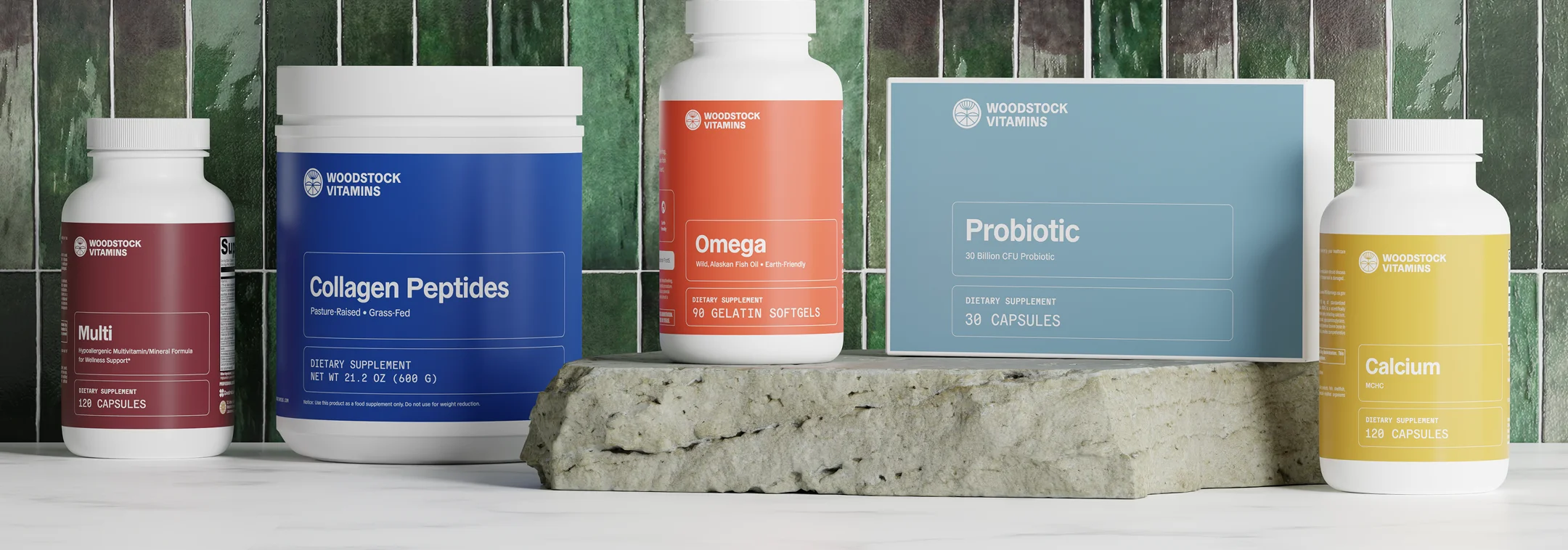


Supplement labels are written by companies to convince you that a product is worth buying. Legal teams approve supplement claims. Almost none of the language on the front of a bottle is written by anyone who understands what’s actually happening inside your body — and that’s not an accident. It’s the business model.
Our founder, Dr. Neal Smoller, has spent decades reading these labels the way he was trained to read a drug insert: skeptically, literally, and with the assumption that anything not backed by a specific number is just fluff. Most of what’s printed on a supplement bottle is designed to sound amazing without necessarily backing it up.
Here’s how to read the three phrases that do the most damage — plus a few honorable mentions — the way a pharmacist would read them.
“Clinically Studied”
What it sounds like: This exact product went through a clinical trial and the results were good.
What it usually means: An ingredient — maybe the one in this product, maybe a version of it, maybe just a molecule with the same name — showed up in a study somewhere. That’s it. “Clinically studied” doesn’t say which study, doesn’t say what dose was used, doesn’t say whether the dose in the study matches the dose in the bottle, and doesn’t say whether the outcome was meaningful or barely distinguishable from placebo.
It’s a true statement built to imply something the brand can’t actually say. “Clinically proven” is worse. It claims a level of certainty that a single study, or even a handful of them, rarely earns. Both phrases are doing the same job: borrowing the credibility of science without committing to any of its specifics.
The pharmacist’s read: Ask which study, what dose, and what population. If the brand can’t answer in one sentence, the phrase is decoration. A nutrient’s track record matters — the volume and quality of research behind it, the doses that were actually tested, the outcomes that actually held up. That’s worth knowing. A sticker that says “clinically studied” tells you none of it.
“Proprietary Blend”
What it sounds like: A specially engineered formula, expertly balanced, too sophisticated to spell out.
What it usually means: The label doesn’t have to disclose how much of each ingredient is in there. That’s the entire function of the phrase — it’s a legal workaround, not a formulation achievement. A “proprietary blend” can be 90% of the cheapest ingredient on the list and a trace amount of everything else that sounds impressive in the name.
If a formula actually worked because of a specific dose of a specific ingredient — which is how nutrients actually work — the brand would want you to see that dose. Hiding it isn’t sophistication. It’s the manipulation.
The pharmacist’s read: No exceptions here. If you can’t see the milligrams, you can’t evaluate the product. Full stop. This is one of the clearest signs in the entire category, and it’s why every Woodstock Vitamins label lists exact doses for every active ingredient — nothing blended, nothing hidden.
“Immune Boosting”
What it sounds like: This will ramp up your immune system and make you less likely to get sick.
What it usually means: Nothing specific, because your immune system isn’t a dial you can turn up. It’s a regulatory system that’s constantly adjusting itself up and down depending on what your body needs at that moment. “Boosting” it isn’t a real mechanism, and the FTC has flagged the phrase as misleading for exactly that reason. It’s a feeling, not a function.
What certain nutrients — Vitamin D, for example — actually do is help support your immune system’s normal function. That’s a real, defensible statement. It’s also a much smaller promise than “boosting,” which is precisely why most brands don’t use it.
The pharmacist’s read: Anytime a claim describes a body system as something you can supercharge, fight with, or battle your way through, that’s marketing language standing in for a mechanism nobody can point to. The honest version is almost always quieter: helps support, not boosts.
A Few More Worth Knowing
“Doctor recommended.” Recommended by which doctor, under what circumstances, and were they paid? This phrase implies an endorsement relationship the label almost never discloses. It’s meant to borrow authority, not demonstrate it.
“Detox” / “Detoxify.” Your liver and kidneys already do this continuously, without help. No supplement has been shown to meaningfully enhance that process. If a product claims to detoxify you, ask what, specifically, it’s removing that your organs weren’t already handling.
“Natural” / “Pure” / “Clean.” These words have no regulatory definition in the supplement industry. Anyone can put them on a bottle. They tell you nothing about sourcing, dosage, testing, or quality — which is exactly why they’re used so often. A specific claim about where an ingredient came from and how it was tested is worth something. “Natural” is worth nothing.
The Pattern Behind All of It
Every one of these phrases is doing the same job: replacing a specific, checkable fact with a vague, reassuring one. That’s not always malicious — sometimes it’s just how the category has always talked. But the effect is the same either way. It trains you to feel confident about a product without ever giving you a reason to be.
A pharmacist’s habit is simple: read past the adjective and look for the number. The dose. The form. The source. The study. If a claim can survive being rewritten with the vague word removed, it was probably true to begin with. If it collapses the moment you ask “compared to what, exactly?” — that’s the tell.
This is the same lens Neal applies to every product Woodstock Vitamins puts its name on. Not because we think the industry is full of bad people, but because we think the incentives are broken, and the language is where it shows first.
Next: see How to Read a Supplement Label Like a Pharmacist for what to look for once the marketing language is stripped away — or read more about What It Means to Have Neal in Your Corner.
Everyone says more is more when it comes to supplements. But is it? When a concern comes up, the instinct is to buy something new for it. Low energy? Add B vitamins to cart. Poor sleep? Grab magnesium. Joint discomfort? Try Collagen. Immune support? More vitamin C and zinc are needed. When you repeat that process enough times, the cabinet fills with bottles that each seem reasonable on their own. Months later, the routine is more complicated, more expensive, and often no more effective than when it started. This isn’t a willpower problem or a discipline problem. It’s a structural one. Adding supplements on top of a missing foundation doesn’t compound. It stalls your progress. Here’s why more isn’t more and what you should do instead.
The Assumption That Doesn’t Hold Up
The logic behind “more” feels sound on the surface: more nutrients, more coverage, more bases covered. But the body isn’t a checklist. Nutrients don’t work in isolation, nor in a vacuum. They depend on a baseline of foundational nutrients that impact nearly every body system and fill the gaps diet leaves behind.
When that nutritional baseline is missing, a newly added, more targeted product isn’t going to build upon your health goals. It’s operating without the groundwork that gives it a system to work within. The result is a routine that looks thorough on paper and doesn’t move the needle in practice.
Why Foundations Matter
A nutritional foundation isn’t about finding the “perfect” supplement. It’s about ensuring that the nutrients with the broadest impact—the ones many people don’t consistently get enough of through diet alone—are adequately covered before moving on to more targeted goals.
Foundational nutrients support processes that happen every day:
- Energy production
- Muscle function
- Bone health
- Immune function
- Nervous system signaling
- Cellular repair
- Protein synthesis
- Hormone production
When those systems are well supported, the body is generally in a better position to respond to more specific interventions. That doesn’t mean every targeted supplement suddenly becomes dramatically more effective. It means they’re no longer trying to compensate for a more basic nutritional gap.
What Happens Without a Foundation
Here’s how routines typically drift away from what’s actually useful.
Redundancy Without Coverage
One of the most common patterns is overlap. A multivitamin, greens powder, immune blend, and recovery formula may all contain some of the same vitamins and minerals, while still leaving genuinely under-consumed nutrients insufficient. In other words, you can end up taking multiple products that all emphasize similar ingredients while missing the nutrients that actually deserve priority. The cabinet looks complete. The nutritional foundation isn’t.
Chasing Symptoms Instead of Systems
Many supplements are marketed around individual concerns. One product promises better focus. Another promises better sleep. Another promises joint comfort. Another immunity. Each addresses a single outcome. But those outcomes don’t exist independently. Sleep influences recovery. Recovery influences exercise performance. Exercise affects energy. Energy affects cognitive function. Nutrition supports every one of those systems simultaneously. When the foundation isn’t covered, it’s easy to spend months treating individual symptoms without improving the broader physiological environment that supports them all.
Less Clarity on What Moved the Needle
The more products that enter a routine without a clear purpose, the harder it becomes to evaluate what’s actually helping. If energy improves, was it the new magnesium? Better sleep? More consistent vitamin D? The extra protein? Something unrelated entirely? Likewise, if nothing changes, it’s impossible to know whether the routine needs more time, fewer products, or a completely different approach. Every unnecessary addition makes the reasoning weaker. Simple routines create clearer feedback.
Cost Without Better Results
Supplement spending often grows much faster than benefit. It’s easy to spend hundreds of dollars each month assembling products aimed at increasingly narrow goals while overlooking the nutrients with the strongest evidence for broad, everyday health. A foundation-first approach does the opposite. It prioritizes nutrients that support multiple body systems, have substantial research behind them, and are commonly under-consumed. Only after that foundation is established does it make sense to ask whether something more specialized is likely to provide additional value.
Abandoning Supplements Too Early
Complex routines don’t usually fail because they’re ineffective. They fail because they’re difficult to maintain. You’ve got morning pills, evening pills, products that need food, products that need an empty stomach, products before workouts, products after workouts, and the list goes on. Even the most motivated people eventually miss days, then weeks, then stop altogether. Consistency matters more than complexity. A routine that someone follows for years will almost always outperform a theoretically perfect routine that lasts six weeks.
The Hidden Cost of Constantly Adding
There’s another downside that often goes unnoticed. Every new supplement changes expectations. Instead of asking, “Am I covering the basics?” people begin asking, “What’s the next thing I should add?” The routine gradually becomes centered around accumulation rather than evaluation. More bottles become a substitute for better decision-making. This creates an endless cycle of optimization without much actual progress. Sometimes the best next step isn’t another supplement. It’s simplifying the routine enough to identify what’s actually providing value.
The Case for Foundation-First
The nutrients that belong in a foundation share several characteristics. They’re commonly under-consumed, even among people who generally eat well. They support multiple physiological systems rather than one narrow function. They’ve been studied extensively and have evidence supporting long-term, daily use when intake is inadequate.
And they’re relevant to a broad portion of the population—not because everyone is deficient, but because dietary intake often falls short of recommended levels. That combination is what makes them worth prioritizing before anything else. Not because targeted supplements don’t have a place. Not because personalization doesn’t matter. But because specialization only makes sense once the fundamentals are in place.
Consistency Beats Constant Optimization
It’s tempting to think better results come from finding increasingly specialized solutions. In reality, many of the biggest gains come from consistently doing the basics well. A routine built on a solid nutritional foundation—and followed day after day—is usually more valuable than a larger collection of products taken inconsistently.
This isn’t the least ambitious approach. It’s the one most aligned with how long-term health behaviors actually succeed. Foundations aren’t meant to be exciting. They’re meant to be effective.
Where This Leaves You
None of this means additional, more targeted supplements are the wrong idea. For the right person, with the right goal, at the right time, they can absolutely make sense. But they’re rarely the right first step. Start with the nutrients that provide the broadest support, establish consistency, and then evaluate whether there’s a clear reason to add something more specific.
Foundation first. Everything else second. Not because more is inherently bad, but because more without a foundation underneath it rarely produces the results people are actually looking for. If you’re not sure whether your own routine has that foundation in place, start with the quiz. It’s the fastest way to identify what’s actually missing before adding anything else.
If your cabinet is full and your results still feel uneven, the problem usually isn’t willpower. It’s sequence. Most people don’t build a supplement routine on purpose. They add things as they hear about them — a recommendation from a friend, a claim from an ad, a new release that sounds promising. Nothing about that process is irrational. It’s just missing an order of operations.
A supplement strategy has three components, and they only work in order: What We All Need, What YOU Need, What You Want. Almost every supplement mistake we see traces back to skipping one of these, or taking them out of order. Here are the three that come up most.
Mistake 1: Skipping the Foundation
This is the most common mistake, and the most consequential one. Foundational nutrients — the ones broadly under-consumed even in strong diets, the ones that help support multiple body systems over years of consistent use — are easy to skip because they don’t feel urgent. There’s no dramatic before-and-after. There’s no single moment where you notice a gap in Omega-3s or Vitamin D closing.
So people go straight to the exciting part: the targeted product, the trending ingredient, the thing a podcast just mentioned. And when it doesn’t seem to do much, they assume it’s the product’s fault. Often, it’s the sequence’s fault. Adding a specific tool on top of a missing foundation is like renovating a room in a house with no plumbing. The renovation isn’t the problem. The order is.
What this looks like in practice: a cabinet full of targeted, symptom-chasing products and an empty space where the basics should be. Foundational nutrients aren’t the part of a routine you graduate from — they’re the part everything else depends on.
Mistake 2: Adding Wants Before Needs
Once the foundation is covered, most people still have a specific health picture — their own history, their own labs, their own lifestyle — that deserves its own set of evidence-based choices. That’s What YOU Need, and it’s real, individual work.
The second mistake happens when people skip straight past it to What You Want: the supplement that’s trending, the one with the compelling ad, the one a friend swears by. There’s nothing wrong with wanting to try something new — that’s a normal part of taking an interest in your own health. The mistake is reaching for it before the first two components are locked in.
A want-driven addition on top of an unaddressed need doesn’t just fail to help. It can crowd out the decision that would have actually mattered. If your personal health picture hasn’t been addressed, a trending ingredient is optimizing the wrong layer.
What this looks like in practice: a routine that reflects what’s exciting in the wellness conversation this month, rather than what your own health picture actually calls for.
Mistake 3: Mistaking Complexity for Strategy
The third mistake is the one that’s easiest to feel good about while you’re making it: assuming that more products, more categories, more ingredients on the label means a more serious approach to your health.
It doesn’t. A strategy is a framework for deciding what belongs in your routine and what doesn’t. A pile of products accumulated over time — a stack, in the loosest sense of the word — is the opposite of that. It’s not a decision. It’s an accumulation. And accumulation without a framework tends to produce redundancy, not results: multiple products doing overlapping jobs, doses that don’t add up to anything coherent, and a routine that’s genuinely hard to stick with.
Complexity feels like progress because it feels like effort. But consistency with the right few things beats a shelf of well-intentioned everything, every time.
What this looks like in practice: a routine that keeps growing but never gets evaluated — where the question is always “what should I add next” and never “does everything already here still belong?”
Why the Order Matters More Than the Products
None of these three mistakes are really about which products are on the shelf. They’re about sequence. What We All Need comes first because it’s the part almost everyone is missing and almost everyone benefits from. What YOU Need comes second because it’s where your specific picture belongs — not before the foundation, not skipped in favor of something newer. What You Want comes last, and that’s not a demotion. It’s what earns it: once the first two are handled, you’ve earned the freedom to explore.
Skip the order, and even good products end up working against each other instead of together.
If you’re not sure where your own routine stands, find your foundation with the quiz — it’s a faster way to see which of these three components actually needs your attention first.
Ask the internet how to improve your mood, and you’ll get a thousand answers. Most of them are contradictory, and the other half are selling something. Strip away the noise and the actual evidence points somewhere much less exciting: four unglamorous levers — sleep, movement, connection, and diet — do more for everyday mood and stress resilience than almost anything else available to you. No trend required.
This isn’t a substitute for professional care when it’s genuinely needed. It’s what’s true for the everyday stress and low mood most people carry around without ever addressing the root causes.
Sleep: The Lever Everything Else Depends On
Mood regulation is downstream of sleep, not the other way around. A single short night measurably shifts emotional reactivity — small frustrations register as bigger ones, and the mental bandwidth for handling stress shrinks along with the hours you got.
The fix isn’t complicated, but it is consistent: a stable wake time, a wind-down period free of screens, and treating sleep as non-negotiable rather than the first thing sacrificed when the schedule gets tight. If your mood has been off and your sleep has also been off, start there before you start anywhere else.
Movement: Not About the Workout You’re Skipping
Exercise doesn’t need to be intense to matter for mood. Regular, moderate movement — a daily walk, a bike ride, anything that gets the body working consistently — is associated with meaningfully better stress resilience and day-to-day mood stability. The mechanism isn’t mysterious: movement regulates the same stress-hormone systems that chronic sitting and chronic stress both push out of balance.
The threshold that matters most is consistency, not intensity. Fifteen minutes most days does more for mood than an hour once a week that you dread and eventually skip.
Connection: The Most Overlooked Lever of the Four
Isolation is a measurable stressor on the body, not just an emotional experience. Regular social contact — a standing coffee, a weekly call, showing up somewhere in person — supports the same nervous system regulation that sleep and movement do, and it’s the lever people neglect first when life gets busy, precisely because it feels optional. It isn’t. Treat a recurring connection point in your week with the same seriousness you’d give a workout or a bedtime.
Diet: Feeding the System That Runs Your Mood
Mood regulation runs on specific nutritional inputs — the same B vitamins, omega-3s, and gut-supportive nutrients that show up everywhere else in foundational health. A pattern heavy in ultra-processed food and light on whole foods doesn’t just affect energy and digestion; it removes raw material the nervous system depends on to regulate itself.
You don’t need a restrictive diet to fix this. You need consistent access to the nutrients that are already known to matter — protein, fiber, omega-3s, and a gut environment that’s actually functioning, since a meaningful share of the body’s mood-relevant neurotransmitter activity originates in the gut, not the brain.
Why None of These Work in Isolation
Here’s the part that gets lost in most “top tips” lists: these four levers reinforce each other. Poor sleep saps the motivation to move. Skipping movement makes sleep worse. Isolation removes the accountability that helps both. A diet leaning on convenience food is often what’s left when sleep and stress have already eaten into the time and energy for anything else.
That’s why chasing one lever in isolation — a single supplement, a single habit change — rarely moves the needle much on its own. The foundation has to be built, not patched.
Where Supplementation Fits — and Where It Doesn’t
Foundational nutrition supports this system; it doesn’t replace it. For everyday stress and mood, Omega is the Superstar — EPA specifically is among the more studied nutrients for supporting normal mood regulation. The complete foundation adds Probiotic, given the gut’s direct role in mood-relevant signaling, Calcium+D for the broader nutrient baseline tied to nervous system function, and Multi to close the B-vitamin and mineral gaps that feed into the same system.
None of these are a stand-in for sleep, movement, connection, or diet. They’re the nutritional floor that makes it easier for the other four levers to actually work — not a shortcut around them.
The Real Takeaway
If your mood has felt off and you’re looking for the one thing to fix it, the honest answer is that there isn’t one thing. There are four ordinary, unglamorous levers, and they compound. Start wherever feels most doable this week — sleep is usually the highest-leverage place to begin — and build from there.
Want to know where your foundation actually stands? Take our quiz to see what belongs in your foundation first, or check out the Stress & Mood Health foundation for the full picture.
When people think about bone health, calcium usually gets all the attention. Maybe Vitamin D gets a mention too, since it’s well known for helping the body absorb calcium. And while both are essential, they aren’t the entire story. One question often gets overlooked:
Once your body absorbs calcium, how does it know where to put it?
That’s where Vitamin K2 enters the conversation. K2 has become one of the most common nutrients people add to an established Calcium + Vitamin D routine. Not because it’s trendy, but because it supports an important step in the process that comes after absorption.
Here, we believe supplements work best when they’re built on the right foundation. Understanding where K2 fits—and where it doesn’t—is part of making informed decisions about your health.
Calcium Absorption Is Only Step One
Think of building a house. Delivering lumber to the job site doesn’t automatically build the walls. The materials still need to be put in the right place. Calcium works much the same way. Vitamin D helps your digestive system absorb calcium from the foods and supplements you consume. Without enough Vitamin D, your body simply can’t utilize calcium efficiently.
But after calcium enters your bloodstream, another process begins. Your body still needs to incorporate that calcium into healthy bone tissue while minimizing calcium deposition in places it isn’t intended to accumulate, such as soft tissues. Absorption and utilization are two different biological processes, and they rely on different nutrients.
The Important Role of Vitamin K2
Vitamin K2 doesn’t increase calcium absorption. Instead, it helps activate proteins that participate in calcium utilization throughout the body.
Researchers have identified two proteins that depend on Vitamin K2:
- Osteocalcin, a protein produced by bone-building cells that helps bind calcium within bone tissue after it has been activated.
- Matrix Gla Protein (MGP), which helps regulate calcium in soft tissues after activation.
Without sufficient Vitamin K2, these proteins remain undercarboxylated (inactive), meaning they cannot perform their intended functions efficiently. This is a well-studied biological mechanism that helps explain why K2 has become such a frequent topic in conversations about bone health.
Why Calcium, Vitamin D, and K2 Work Together
This trio contains the essential nutrients to provide truly rock-steady bone health. Each nutrient contributes something different:
- Calcium provides one of the primary minerals that support healthy bones.
- Vitamin D helps your body absorb calcium efficiently.
- Vitamin K2 helps activate proteins involved in directing calcium toward normal bone mineralization.
Rather than replacing one another, they perform complementary roles. It’s less about finding a “magic nutrient” and more about understanding that healthy physiology depends on multiple systems working together.
Not All Vitamin K2 Supplements Are the Same
One detail that often gets missed is that “Vitamin K2” isn’t a single ingredient.
The two most common supplemental forms are MK-4 and MK-7, and they behave differently in the body.
MK-4
MK-4 has a relatively short half-life, meaning blood levels decline fairly quickly after supplementation. Because of this, higher or more frequent dosing is often required to maintain consistent levels.
MK-7
MK-7 remains in circulation considerably longer. Its extended half-life allows it to provide more sustained activation of Vitamin K-dependent proteins between daily doses.
For many people looking to supplement with K2, this longer duration is one reason MK-7 is commonly chosen. While both forms have been studied, understanding the difference helps explain why supplement labels—and dosages—can vary significantly.
Who May Consider Adding Vitamin K2?
People often begin looking into K2 when they’ve already established consistent habits around bone health and want to take a more comprehensive approach.
That may include adults who:
- Already take Calcium and Vitamin D consistently.
- Want additional nutritional support for normal bone mineralization.
- Are becoming more proactive about maintaining bone health as they age.
- Prefer building a supplement routine step by step rather than taking everything at once.
Not everyone needs to begin with K2, and it isn’t intended to replace the basics. Instead, it fits naturally into a well-built routine after the nutritional foundation has already been established.
Food Sources of Vitamin K2
While supplements are one option, Vitamin K2 also occurs naturally in certain foods. Some of the richest dietary sources include:
- Natto (fermented soybeans)
- Certain aged cheeses
- Egg yolks
- Liver
- Some fermented dairy products
Because these foods aren’t staples in many Western diets, supplemental K2 has become increasingly popular among people looking to increase their intake.
Why K2 Isn’t Part of the First5 Foundation
This is where the Woodstock Vitamins philosophy becomes especially important. We don’t believe every beneficial supplement belongs in everyone’s routine from day one.
The First5 represents foundational nutrients that address common nutritional needs for a broad range of adults.
For bone health, Calcium + Vitamin D form that foundation because they address the basic requirements for calcium intake and absorption. Vitamin K2 is different.
It’s an excellent next-step nutrient, but only after the fundamentals are already in place.
Trying to optimize calcium utilization without first ensuring adequate calcium intake and Vitamin D status is a bit like installing premium tires on a car with an empty fuel tank. The upgrade may have value—but it isn’t the first priority. Order matters.
A Few Important Considerations
Although Vitamin K2 is appropriate for many adults, it isn’t right for everyone. Individuals taking anticoagulant medications such as warfarin should speak with their healthcare provider before taking Vitamin K supplements, since Vitamin K can affect how these medications work.
As with any supplement, it’s always a good idea to discuss changes to your routine with your healthcare professional, especially if you have an existing medical condition or take prescription medications.
The Woodstock Vitamins Takeaway
Bone health isn’t about finding one perfect nutrient. It’s about understanding how different nutrients work together. Calcium provides the building material. Vitamin D helps your body absorb it. Vitamin K2 helps activate the proteins involved in putting that calcium where it’s needed most.
That’s exactly why K2 has earned its reputation as one of the most common add-ons for people focused on bone health—but it’s also why we don’t put it ahead of the essentials. At Woodstock Vitamins, our philosophy is simple: build the foundation first, then layer in targeted support where it makes sense.
For most people, that means starting with Calcium + Vitamin D and considering Vitamin K2 as the next logical step once those basics are already part of a consistent daily routine.
We all want to feel more energized. Play with our kids, hike up a mountain, and have laser focus at work. The problem is, most of us are approaching it all wrong. Instead of doing the daily habits and consuming the foundational nutrients we need for natural energy, we find ourselves in the energy supplement aisle. There you’ll find hundreds of promises: more focus, more drive, more stamina — usually delivered by a bigger dose of caffeine than the last one. It works, for about an hour. Then you’re back where you started. That’s not an energy solution. It’s a trap. We’ll explain.
The Stimulant Trap
Caffeine and other stimulants don’t create energy. They block the signals that tell your brain you’re tired, which is a different thing entirely. Your body still did the work, used the resources, and built up the fatigue — you just stopped being able to feel it for a while.
Do that often enough and two things happen. First, tolerance builds, so the same dose stops doing much of anything, which is how a single afternoon coffee turns into a pre-workout, an energy drink, and a second coffee just to feel normal. Second, the crash that follows isn’t random — it’s the fatigue you postponed, arriving all at once with the stimulant’s exit.
This is the loop most “energy” products are built around: mask the symptom, sell the next dose. It’s a real category, and it has its place. It is not the same thing as addressing why you’re tired in the first place.
What Real Energy Actually Requires
Energy, in the physiological sense, isn’t a feeling you manufacture. It’s a process your body runs constantly, converting food into usable fuel at the cellular level. That process depends on a specific set of nutrients doing their jobs: B vitamins that support energy metabolism, iron that carries oxygen to the tissues that need it, magnesium involved in hundreds of the reactions that keep the process running.
When one of these inputs is running low — and for B vitamins, iron, and magnesium, that’s a common story, not a rare one — the whole system runs less efficiently. You feel it as low energy, poor focus, that “tired but wired” state that no amount of caffeine actually resolves, because caffeine was never addressing the input problem to begin with.
Why Stacking Stimulants Doesn’t Fix a Gap
Here’s what’s not said: if the fatigue is coming from a nutrient gap, a stimulant can’t close it. It can only override the signal telling you the gap exists. That’s why the pattern of “more caffeine, same tiredness” feels so familiar to so many people. The underlying cause was never addressed, just muted for a few hours at a time.
Foundational nutrition doesn’t work like a switch. It works by giving the system what it needs to run the way it’s supposed to, consistently, so the fatigue doesn’t build up, looking for an override in the first place.
The Foundation-First Approach
For Energy & Performance, Multi is the Superstar — it’s the most direct way to close the B vitamin, iron, and magnesium gaps that feed into normal energy metabolism. Built to our pharmacist-formulated standard, with activated forms and doses that reflect what the research actually supports, not what looks impressive on a label.
The complete foundation adds two more angles. Omega supports energy from a structural and cognitive-function standpoint — a different mechanism entirely from a B-vitamin gap. Collagen contributes amino acids that play a role in the body’s broader recovery and repair processes, which matters more to sustained energy than people usually assume.
None of these are a stimulant. None of them will make you feel “wired” in twenty minutes. That’s the point — they’re addressing the input, not overriding the signal.
What Else Actually Matters
No foundation fixes fatigue on its own if the basics aren’t in place. Sleep debt, dehydration, and a sedentary stretch of days will outweigh any supplement on the shelf. Foundational nutrition supports the energy system — it doesn’t replace the conditions that system needs to function.
If you’re consistently reaching for another cup of coffee just to feel normal, that’s worth paying attention to. It’s usually not a caffeine problem. It’s a foundation problem wearing a caffeine disguise.
Want to know where your foundation actually stands? Take the Woodstock Vitamins quiz to find out what belongs in your foundation first, or check out the Energy & Performance foundation for the full picture.
Everyone wants a sleep hack. The one supplement, gadget, or “secret” that finally delivers a full night’s sleep with little to no lifestyle changes. But here’s the uncomfortable truth: most sleep struggles aren’t caused by a lack of something. More often, they’re the result of habits that quietly work against your body’s natural sleep cycle every single day.
But there’s good news. This means improving your sleep doesn’t always require buying another product or completely overhauling your lifestyle. Sometimes, the biggest improvements come from removing the obstacles that are already standing in the way. Before you add anything to your nighttime routine, try subtracting these five habits first.
1. Stop Scrolling Right Up Until Lights Out
For many of us, checking our phones before bed has become automatic. A few emails turn into an hour of social media scrolling. Before you know it, it’s much later than you planned on going to bed, and your mind is completely wired.
The problem is the blue-enriched light from phones, tablets, and laptops tells your brain it’s still daytime. That signal can delay the natural release of melatonin, the hormone that helps regulate your sleep-wake cycle. When melatonin production is pushed back, falling asleep can become more difficult—even if you’re feeling tired.
There’s also the mental side of screen time. Reading work emails, scrolling through headlines, or engaging with stimulating content keeps your brain active at the exact moment you’re trying to wind it down.
Do this instead: Create a simple “screen sunset”. Put your phone away 30 to 60 minutes before bed, dim the lights, and give your brain permission to shift into nighttime mode. If you use your phone as an alarm clock, consider charging it across the room or outside the bedroom altogether.
2. Stop Pretending Your 3 p.m. Coffee Doesn’t Count
Coffee gets all the attention, but caffeine shows up in more places than you might expect—including tea, soda, energy drinks, chocolate, and even some pre-workout supplements.
What surprises many people is how long caffeine sticks around. While everyone metabolizes it a little differently, caffeine can remain in your system for several hours after you drink it. That afternoon pick-me-up may still be affecting your nervous system well into the evening, making it harder to fall asleep or stay asleep through the night. You may not even notice the connection because you’ve become accustomed to it.
Do this instead: Experiment with setting a caffeine cutoff in the early afternoon. Give it a week or two before deciding whether it makes a difference. Sleep improvements often happen gradually, and consistency is what allows your body to respond.
3. Stop Napping Like It’s a Second Job
Naps aren’t the enemy. In fact, a brief daytime nap can improve alertness, mood, and concentration when used intentionally. The challenge comes when naps become long, late, or unpredictable.
Your body naturally builds “sleep pressure” throughout the day—the biological drive that helps you feel ready for bed at night. A long afternoon nap can reduce that pressure, making bedtime feel less appealing and leaving you lying awake wondering why you’re suddenly wide awake. It’s an easy cycle to fall into: poor sleep leads to long naps, which lead to poorer sleep the next night.
Do this instead: If you need a nap, aim for about 20 to 30 minutes earlier in the day. Think of it as a quick recharge, not a substitute for a full night’s sleep.
4. Stop Treating the Weekend Like a Sleep Reset Button
After a busy week, sleeping in on Saturday feels earned. Unfortunately, your internal clock doesn’t always agree.
Our bodies thrive on consistency. Going to bed and waking up at dramatically different times from one day to the next can confuse your circadian rhythm, making Sunday night feel strangely restless and Monday morning especially difficult.
It’s sometimes called “social jet lag” because your body experiences a similar kind of disruption—even though you never left home. While one late night won’t undo your progress, regularly shifting your schedule by several hours can make it much harder to establish healthy sleep patterns.
Do this instead: Try to keep your wake-up time within about an hour of your usual schedule, even on weekends. If you need extra rest, consider going to bed a little earlier instead of sleeping far later.
5. Stop Reaching for the Supplement Aisle Before You’ve Handled the Basics
This may sound surprising coming from a supplement company, but it’s worth saying anyway. No supplement can consistently outwork habits that undermine sleep every night.
If you’re exposing yourself to bright light before bed, drinking caffeine late in the day, taking lengthy evening naps, and changing your sleep schedule every weekend, adding a capsule to your routine probably won’t address the root cause. That’s not to say supplements don’t have a place.
Once you’ve built a solid sleep routine, nutritional support may help fill genuine gaps or complement healthy habits. But supplements work best as part of a strong foundation—not as a replacement for one.
Do this instead: Focus on the fundamentals first. Create a consistent bedtime routine. Limit evening screen time. Watch your caffeine intake. Keep your schedule steady. Once those habits are in place, you’ll have a much clearer picture of whether additional nutritional support makes sense.
Small Changes Add Up
Better sleep rarely comes from one dramatic change. More often, it’s the result of small decisions repeated day after day. Turning off your phone a little earlier. Choosing water instead of another cup of coffee. Keeping your wake-up time consistent. Letting your body follow the rhythm it was designed to follow. None of these habits are flashy, but together they can have a meaningful impact on how rested you feel.
The best place to start isn’t by asking, “What should I add?”
It’s by asking, “What’s getting in the way?”
That’s the philosophy behind the First5 approach: build your health from the foundation up. Once the basics are in place, every other healthy choice has a better chance to work.
Curious about where your own foundation stands? Take our quiz to discover which foundational areas may deserve your attention first—and build from there.
Most people think about their gut only when something feels off. Maybe it’s occasional bloating after a meal, inconsistent digestion, or that heavy, sluggish feeling that seems to arrive every afternoon. But your digestive system does much more than process food.
Every day, your gut is engaged in a constant conversation with your brain. Through an intricate communication network known as the gut-brain axis, these two systems exchange millions of signals that influence digestion, immune function, energy, mood, and how your body responds to everyday stress.
This isn’t a wellness trend or the latest health buzzword—it’s well-established physiology. Scientists continue to uncover just how closely the gut microbiome, nervous system, and brain work together to help maintain overall health.
That’s one of the reasons we consider Probiotic the Superstar of our Digestive Resilience Pillar. Supporting a balanced microbiome isn’t just about digestive comfort—it’s about helping build a stronger foundation for your entire body.
Your Gut Has Its Own Nervous System
Inside the walls of your digestive tract lives an incredibly sophisticated network of approximately 100 million neurons, known as the enteric nervous system (ENS).
Often called the body’s “second brain,” the ENS can regulate many digestive functions independently, coordinating everything from muscle contractions that move food through the intestines to the release of digestive enzymes. While your gut isn’t literally thinking, it is constantly processing information.
Even more fascinating is how closely it’s connected to your brain through the vagus nerve—one of the body’s largest communication pathways. Rather than acting as a one-way street, the vagus nerve carries information in both directions. In fact, much of the traffic actually travels from the gut to the brain.
That means what’s happening inside your digestive system doesn’t stay there. Your gut microbiome is continually sending signals that help inform how your nervous system responds to the world around you.
Where Mood Chemistry Actually Starts
Your digestive tract is home to trillions of microorganisms, collectively called the gut microbiome. Far from being unwanted guests, many of these bacteria perform jobs your body can’t do alone.
A balanced microbiome helps:
- Break down certain fibers and nutrients
- Produce beneficial short-chain fatty acids that nourish cells lining the colon
- Support normal immune function
- Help maintain the integrity of the intestinal barrier
- Interact with the nervous system through chemical signaling
Scientists now recognize that many of these microbial activities have ripple effects throughout the body—including the brain.
Why Strain Matters More Than the Number on the Label
One of the most surprising discoveries in gut-brain research is that approximately 90–95% of the body’s serotonin is produced in the digestive tract. Serotonin is widely known for its role in supporting mood, but it also helps regulate normal digestion, appetite, and communication throughout the nervous system.
While serotonin produced in the gut doesn’t simply travel into the brain, the gut and its resident bacteria influence many of the building blocks and signaling pathways involved in healthy nervous system function.
Gut microbes also interact with compounds involved in the production of neurotransmitters like GABA and dopamine precursors, while producing metabolites that communicate with immune cells, endocrine cells, and nerve tissue. The result is an ongoing conversation between your microbiome and your nervous system that researchers are still working to fully understand.
This doesn’t mean probiotics replace therapy, medication, quality sleep, or other evidence-based approaches when those are needed. It does mean that maintaining a healthy gut is one meaningful piece of the larger puzzle that supports normal mood regulation and resilience to everyday stress.
The Stress Loop Runs Both Ways
The gut-brain axis works both ways. Just as your gut influences your nervous system, chronic everyday stress can change the environment inside your digestive tract.
Elevated stress hormones may affect digestion, alter intestinal motility, influence the balance of beneficial bacteria, and impact the intestinal barrier. Over time, those changes may influence the very signals traveling back to the brain.
It’s a feedback loop. Stress can affect the microbiome. The microbiome can influence nervous system signaling. That altered signaling may make it harder for the body to adapt to ongoing stress. Breaking that cycle isn’t about finding one miracle supplement. It’s about strengthening the foundation that supports both systems every day.
Why the Right Strains Matter More Than a Huge CFU Number
Walk down the supplement aisle, and you’ll see probiotics boasting 50 billion, 100 billion, or even 200 billion CFUs. It sounds impressive. But bigger numbers don’t automatically translate into better results. A probiotic is defined by its strains, not simply its bacterial count.
Different strains perform different functions. Some are better studied for digestive balance, others for immune support, and others for maintaining a healthy microbial ecosystem. That’s why our formula focuses on four well-researched strains instead of chasing the biggest number on the label:
- Bifidobacterium lactis
- Bifidobacterium longum
- Lactobacillus acidophilus
- Lactobacillus plantarum
Together, these strains provide 30 billion CFUs per serving in a formula designed for shelf stability and acid resistance, helping more beneficial bacteria survive the journey through the stomach and reach the intestines where they’re intended to work.
Because even the highest CFU count doesn’t matter if the bacteria don’t make it to the gut.
Building the Foundation, Not Chasing a Fix
While Probiotic is the Superstar of our Digestive Resilience Pillar, lasting wellness rarely comes from a single product.
The First5 philosophy is built around complementary systems that work together.
Probiotic supports a balanced microbiome—the foundation of healthy gut-brain communication.
Omega provides EPA and DHA, essential fatty acids that contribute to normal brain function and support healthy nervous system structure.
Collagen provides important amino acids that support connective tissues, including those that help maintain the integrity of the digestive tract.
Multi helps fill nutritional gaps with vitamins and minerals—including B vitamins that support normal energy metabolism and healthy nervous system function.
Each addresses a different piece of the same foundation.
Together, they create a more complete approach than any one supplement could deliver on its own.
What Else Actually Moves the Needle
Supplementation supports a practice — it doesn’t replace one. Sleep, movement, and what’s actually on your plate matter just as much for gut health and stress resilience as anything in a capsule. If those basics are missing, no formula fixes that gap. If they’re in place, the First5 foundation gives the gut-brain relationship what it needs to function the way it’s supposed to.
Not sure where your foundation is missing something? Take our quiz to find out which of the First5 belongs in your foundation first.
Most multivitamin labels are built to impress you, not to inform you. Twenty-three ingredients in bold type, a “Daily Value” percentage that sounds reassuring, a front-of-bottle claim in a font size doing a lot of heavy lifting. None of that tells you whether the product will actually do anything.
Here’s the thing nobody on the shelf wants to say out loud: most multivitamins are formulated to sell, not to work. That’s not an accusation — it’s just what happens when a category competes on ingredient count instead of ingredient quality. More looks better in a listing. It rarely performs better in your body.
If you’re standing in front of a wall of options — or scrolling through one — here’s what actually matters, and what’s mostly noise.
What the Label Doesn’t Tell You
A supplement bottle has to say what’s in the product. It doesn’t have to say whether any of it matters, whether it’s good quality, or in the right doses.
The ingredient quantity doesn’t always mean quality. A multivitamin with 40 ingredients isn’t twice as effective as one with 20. Often it means the formulators added trendy extras at doses too small to move the needle, just so the label reads longer. More vitamins doesn’t mean it’s going to help you get healthier.
“100% Daily Value” and “Daily Value” are not the same claim — read it closely. Some products load up on a handful of nutrients at levels far beyond what the research supports, then quietly underdose the ones that actually matter, or skip them completely. A multivitamin’s job is to close gaps, not to hit dramatic numbers on a few flashy ones.
The Supplement Facts panel matters more than the front of the bottle. That’s where the actual doses and forms live. Front-of-package language is written by companies. The back panel is written by regulators. Pay attention to the back panel more.
Inactive ingredients are still ingredients. Fillers, binders, coatings, artificial dyes, and other agents don’t do anything for you. And some are worth avoiding altogether. If a label doesn’t disclose them clearly, that’s information too.
What Forms to Look For
This is the part most people skip, and it’s the part that determines whether your multivitamin actually gets absorbed.
Not all forms of a nutrient behave the same way in your body. Two multivitamins can list “500mg of calcium” and deliver completely different amounts to your bloodstream, depending on the chemical form used. This is true across almost every mineral and several vitamins.
A few specifics worth knowing:
- Minerals are often listed in cheap, poorly absorbed forms — oxides and carbonates are common because they’re inexpensive to manufacture, not because they work well. Chelated forms (minerals bound to amino acids) are generally better absorbed. If you see “TRAACS” on a label, that’s a specific, patented chelated mineral technology with published absorption data behind it. It’s worth knowing and looking for.
- B vitamins are frequently included in synthetic forms that a meaningful portion of the population doesn’t process efficiently. “Activated” or “methylated” B vitamin forms (like methylcobalamin instead of cyanocobalamin) are already in the form your body uses, rather than one it has to convert first.
- Vitamin D3 (cholecalciferol) is the form your body produces from sunlight and the one the research is built around. D2 is technically vitamin D, but it isn’t the same thing metabolically.
The takeaway: don’t just check whether a nutrient is on the list. Check what form it’s in.
What Dose Actually Means
This is where the real gap between “looks good” and “does something” shows up.
A dose is only meaningful in context — relative to what the research actually showed, and what your body can use.
Megadoses aren’t a bonus. Some multivitamins load certain vitamins at 500% or 1,000% of the Daily Value, betting that bigger numbers read as more generous. For fat-soluble vitamins in particular, more isn’t simply wasted — it can accumulate. A well-formulated multivitamin is dosed to close a gap, not to win an arms race on the label.
Underdosing is the quieter problem. It’s common for a multivitamin to include a nutrient at a particular amount — enough to legally list it, not enough to matter. This is especially common with nutrients that are expensive to dose properly. If a formula includes 30 ingredients but half of them are there in name only, you’re paying for a longer list, not a better product.
The right target, for most foundational nutrients, is closing the gap between what you eat and what you need — not maximizing every number on the panel. That’s a different design goal than most of the category is working toward, and it’s why dose has to be read alongside form and purpose, not in isolation.
The Three-Question Filter
Next time you’re evaluating a multivitamin — ours or anyone else’s — three questions cut through most of the noise:
- Is the dose based on what the research actually studied, or on what makes the label look generous?
- Is the form one your body can actually use, or the cheapest one available to the manufacturer?
- Does the ingredient list reflect real nutritional gaps, or is it just good marketing?
If you can’t answer those three questions from the label, that’s the answer.
Where a Multivitamin Fits into a Foundation
A multivitamin isn’t meant to replace a diet, and it isn’t meant to treat anything on its own. Its job is narrow and specific: fill the nutritional gaps that a typical diet leaves behind, consistently, in forms your body can use. That’s the whole job. Judged against that standard, most of what’s on the shelf is working harder to look complete than to be useful.
Our Multi is built to that standard — activated B vitamins, TRAACS chelated minerals, and doses set at 100% Daily Value rather than inflated megadoses, with no unnecessary fillers. Want the full formulation story, including what we left out and why? Read Multivitamins: Why Most Are Built Backwards for the complete picture.
Most calcium supplements are chosen for their bone-building benefits. Calcium has long been marketed as a solution for bone and joint resilience — and most people are right. Calcium, with the addition of vitamin D, has been shown in studies to support bone remineralization and keep them going strong. But not all forms of calcium are created equal and have the same bone-building effect.
The form of calcium you choose determines how much of it your body can actually use — and on that measure. That’s why looking at a bottle with 1200mg, 1500mg or even bigger sounds great. But it’s not the quantity that moves the needle; it’s the form. This is the case for why we use Calcium Hydroxyapatite in our Calcium+D. And the two forms that didn’t make the cut.
The Three Forms of Calcium You’ll Actually See
Walk down any supplement aisle, and you’ll find calcium in one of three forms. Each behaves differently once it’s in your body.
Calcium Carbonate is a mined mineral salt. It’s high in elemental calcium (about 40%), but it needs stomach acid to be absorbed, so it’s best taken with food, and it can cause bloating or constipation at higher doses.
Calcium Citrate is calcium bound to citric acid. It’s lower in elemental calcium (about 21%), but it doesn’t need stomach acid to absorb, so it can be taken on an empty stomach. Its main downside is that it requires a larger pill to hit the same elemental dose as carbonate.
Calcium Hydroxyapatite is a naturally occurring calcium-phosphate complex, structurally similar to bone mineral itself. Elemental calcium runs moderate (roughly 20–39%, depending on the formulation); it doesn’t require stomach acid to absorb, and it comes with phosphorus and trace bone-supportive minerals rather than just calcium alone. The main thing to watch for with this form is sourcing quality, which varies significantly by supplier.
Carbonate is cheap to produce, which is why it’s everywhere. Citrate solved the absorption problem carbonate has, which is why it became the “upgrade” most brands reach for next. Hydroxyapatite solves a different problem — one most labels don’t even mention.
The Problem Neither Calcium Carbonate Nor Citrate Solves
Bone isn’t just calcium. It’s a matrix. Calcium and phosphorus are arranged together with trace amounts of other minerals, in roughly the same ratio your skeleton is already built from. Carbonate and citrate deliver calcium in isolation. Hydroxyapatite delivers it in something closer to the form your body is actually working with.
That distinction matters because calcium doesn’t do much on its own. Supplementing calcium without the cofactors your body uses to deposit it is like sending building material to a job site with no plan for how it gets used. Hydroxyapatite is derived from bone mineral itself, which means the calcium arrives already in relationship with phosphorus and the two minerals bone structure depends on together, not separately.
This is also why we never recommend calcium without Vitamin D. Calcium absorption is D-dependent — without adequate D, a meaningful share of the calcium you take never gets where it’s going. Pairing them isn’t a formulation flourish. It’s the whole point.
What This Looks Like in Calcium+D
Calcium+D pairs 700mg of Calcium Hydroxyapatite with 2000 IU of Vitamin D3, sustainably and ethically sourced. There were a few specific decisions behind that formula:
We opted for 700mg, not 1200mg. Megadosing calcium doesn’t build stronger bones. It just increases the odds of the GI issues carbonate is known for, with no added benefit. 700mg reflects what the research on daily calcium intake actually supports, not what looks most impressive on a label.
Hydroxyapatite, not carbonate. We chose the form that mirrors bone’s own mineral structure over the form that’s cheapest to source. D3 in the same capsule. Not sold separately, not positioned as optional. Calcium without D is an incomplete formula.
Calcium and Vitamin D help support bone strength and density over time — that’s the claim, and it’s the only one we’ll make. We won’t tell you this reverses anything or promises a timeline. Bone is slow-changing tissue. What you can control is whether you’re giving it the right inputs, consistently, for as long as it takes.
The Takeaway
If a calcium supplement’s whole pitch is bone-building with a big number on the bottle, that’s a sign the form wasn’t the priority. Form determines what your body can actually do with what you’re taking — and Calcium Hydroxyapatite, paired with the D3 that makes it usable, is the version of calcium we were willing to put our name on. Calcium+D is one of the First5 — the foundational nutrients most people are missing, and the first place to start before adding anything else.
We all know probiotics are great for brain, gut, and digestive health. But the lingering question is: which one? It’s not obvious which probiotic will do the trick for your health goals because every probiotic bottle looks the same. They’re all playing the same numbers game. 30 billion colony-forming units (CFUs) here. 50 billion CFUs there. 100 billion CFUs, right there on the front, in the biggest font on the bottle. Probiotics use CFU count like it’s a competition, and bigger automatically wins.
The truth is, CFU count is the number the industry wants you looking at, because it’s the easiest number to make big. It is not the number that tells you whether a probiotic will actually do anything once it’s in you. Instead of guessing, here are other components — beyond CFU count — that actually matter in your probiotic decision.
Strain Specificity: What, Exactly, Is In There?
A probiotic is not a monolith. It’s a category name for thousands of different bacterial strains, and each strain behaves differently in the body. A formula that just says “probiotic blend” or lists a genus without a specific strain (Lactobacillus, on its own, tells you almost nothing) is a formula that’s asking you to trust a category instead of an ingredient. The gold standard for probiotics is: Bifidobacterium Lactis, Lactobacillus Acidophilus, Lactobacillus Plantarum, Bifidobacterium Longum. They’re the most researched strains and have the most evidence for their efficacy behind them. Finding a probiotic with these strains is a good first step towards finding the right probiotic for you. But there’s more to check for.
Check for:
- Specific strains listed by full name — genus, species, and strain designation (for example, Lactobacillus rhamnosus GG, not just “Lactobacillus”)
- A small number of targeted strains rather than a long list of unnamed ones — strain specificity beats strain count
- Some indication of why each strain is included, not just that it’s included
Red flag: A CFU number in giant type and a strain list in tiny type, if it’s listed at all. That’s a label built to be looked at, not read.
CFU Reality: The Number That Matters Isn’t the Number on the Front
What’s inside is what counts. CFU (colony-forming units) measures how many live organisms were in the product at the time of manufacturing — not how many are alive when you take it, and not how many survive long enough to matter. CFUs can be misleading. A 100-billion-CFU product that’s mostly dead by the time it reaches you is worse than a well-formulated 30-billion-CFU product that survives the trip. That’s why there are other questions to ask beyond how much bacteria is in the bottle to determine whether a probiotic is worth your time and will work for you.
Check for:
- CFU count guaranteed through the end of shelf life — not just at manufacturing
- CFU count tied to specific, named strains — an unattributed total CFU number across an unnamed blend tells you nothing about what’s actually surviving
- A brand that explains its CFU number rather than just displaying it
Red flag: “Up to” language (“up to 50 billion CFU”) without a guaranteed minimum. That phrasing exists to let a brand claim a number it isn’t required to deliver.
Shelf Stability: Does It Survive the Time Between Manufacturing and Your Cabinet?
It’s simple: live bacteria die. That’s not a flaw in probiotics; it’s just biology. When evaluating a probiotic, the question is whether a product is formulated to slow that die-off, or whether it’s counting on you taking it fast and storing it perfectly. Don’t put your eggs in the latter basket. You want a probiotic that stays potent as long as it can — without refrigeration if possible. Most probiotic-rich foods and supplements need a fridge to stay fresh, but the no-refrigeration-required formulas often have more advanced formulations and can often be more potent because of it. With that, there are a few things to check for to ensure you’re choosing a good formula.
Check for:
- Shelf-stable formulation that doesn’t require refrigeration — refrigeration-dependent products are more vulnerable to breaks in the cold chain between the manufacturer, the shelf, and your kitchen
- Manufacturing processes designed for bacterial survival (moisture control, packaging that limits oxygen exposure)
- A stated shelf-life CFU guarantee, not just a “best by” date on the box
Red flag: No mention of stability testing at all. If a brand can’t tell you how it keeps the bacteria alive between the factory and your first dose, assume it hasn’t solved that problem.
pH Resistance: Does It Survive You?
Now this is the step most labels skip entirely, and it might be the most important one. Even a probiotic with the right strains, a real CFU guarantee, and solid shelf stability still has to survive stomach acid to reach the gut, where it actually has a job to do. A lot of live bacteria never make it that far. That’s where pH resistance capsules and coatings can make a big difference. Choosing a probiotic that can withstand your stomach acid and not go rancid before it gets to the right place is crucial. But here are some other elements to keep in mind.
Check for:
- Delivery formulated for acid resistance — delayed-release capsules, acid-resistant coatings, or strains with documented ability to survive gastric transit
- Evidence that this specific product’s delivery method has been evaluated for survival, not just the strain in isolation
- No assumption that “probiotic” alone means it’s built to get where it needs to go
Red flag: A standard capsule with no delivery technology mentioned, paired with a big CFU claim. Impressive number, uncertain odds it arrives intact.
Run this Checklist Before You Buy
When it comes to probiotics, not all are created equal. Strain specificity and which bacteria are actually in your supplement mean a lot. The CFU reality that more doesn’t always mean better is something to check. Shelf stability and whether the probiotic can hang when you need it is an underrated element. And finally, pH resistance and whether the good bacteria will ever make it to your gut and digestion is imperative. The order is important, because each one is a gate the last one has to pass through first — the right strain that doesn’t survive shelf life doesn’t matter, and the CFU count that doesn’t survive your stomach doesn’t matter either. A probiotic is a formulation problem wearing a marketing number. Judge it by the formulation.
If you’d rather start from a probiotic that’s already been built to clear all four, that’s what ours is for. See Why We Recommend Our Probiotic.
Buying supplements has become a national sport. Thousands of people stand in the supplement aisle or scroll online and scan every bottle that promises miraculous results overnight. They add to cart, try it out, and after a few weeks, feel let down by the lack of results.
From the outside, one bottle of fish oil looks about as trustworthy as the next, but it isn’t. The supplement category has limited oversight, unchecked marketing claims, and enormous variation in quality within the exact same product type. Two bottles of the same nutrient, sitting next to each other on the same shelf, can be built to completely different standards — and nothing on the label will tell you that at a glance.
That’s the problem this guide solves. Not by telling you which brand to trust, but by giving you the actual questions to ask before anything goes in your cart or your body.
We evaluate every product we sell against four dimensions: Science, Compliance, Virtue, and Value, the main components of our Supplement Quality Standard (SQS). You don’t need to work here to use this framework. Here’s how to run it yourself, on anything.
Science: Is this backed by evidence, or just a study citation?
A lot of labels lean on the word “studied” like it settles the question. The real questions are about what was studied, at what dose, and whether that has anything to do with what’s actually in the bottle. When it comes to science, different studies point to different conclusions. We’re not asking you to be an expert in supplement science, but there are a few things to check for to ensure you’re reading evidence for a supplement’s efficacy that makes sense.
Check for:
- The dose on the label matches doses used in published research — not a fraction of it
- The ingredient itself (not just the broader category) has evidence behind it — “omega-3” isn’t specific enough; you want EPA and DHA amounts called out
- The product isn’t relying on a single small study to justify a big claim
- Claims describe what a nutrient does in the body — not what it does to a diagnosed condition. If a claim requires naming a disease to make sense, that’s a sign to look elsewhere
Red flag: A “proprietary blend” with no individual ingredient amounts listed. If a brand won’t tell you how much of something is actually in there, assume it’s less than you’d want.
Compliance: Is this made the way it says it’s made?
This is the part most people skip entirely, because it isn’t visible on the label. It’s visible in what the brand is willing to show you. Compliance ensures that the supplement was made in a safe, clean, and certified facility and that it’s tested for quality and effectiveness. Many brands skip this step, and without explicit mention of where they manufacture their supplement and how it’s made, you could be ingesting something that’s incredibly unsafe. Here are a few things to check for before you buy.
Check for:
- Manufactured in a cGMP-compliant facility (this should be stated, not implied)
- Third-party tested for potency and contaminants — and the brand can point to how, not just claim it
- Label accuracy — what’s on the label matches what’s in the capsule, in the amounts stated
- Sourcing is traceable. If you ask where an ingredient comes from, there’s a real answer
Red flag: Vague language like “pure” or “natural” standing in for actual testing information. Neither word has a regulatory definition in this category. They describe nothing. Ask what a brand actually tests for instead of what it calls itself.
Virtue: What does a brand do when nobody is watching?
Quality isn’t only about what’s in the formula. It’s the decisions a brand makes when a shortcut wouldn’t have shown up anywhere a customer could see it. It matters where a brand gets its ingredients and whether they were ethically sourced. If they’re using animal ingredients, were they fished or farmed in a way that benefits people and the planet? Most brands don’t want to reveal the dark underbelly of their sourcing and ingredients. But you can do your due diligence by checking for some key components.
Check for:
- Ethical sourcing that holds up under a specific question, not a general claim
- Ingredient amounts that reflect what the research supports — not what’s cheapest to include
- No filler ingredients added just to bulk out a capsule
- A brand that will tell you what it turned down, not just what it sells
Red flag: A brand whose entire quality pitch is a single word on the front of the bottle — “clean,” “premium,” “pure” — with nothing underneath it. Real virtue is specific. It survives a follow-up question.
Value: Is the price connected to anything real?
Value isn’t the lowest number on the shelf. An underdosed product isn’t a bargain — it’s a product that doesn’t do the job, priced to look like it does. Value is about being honest. Does the price of the supplement match the quality, or is it overpriced and overrated? You should be able to check for a few things to ensure that you’re being charged a fair rate for a supplement and not getting ripped off in the process.
Check for:
- The dose is high enough to matter and move the needle
- The price reflects the ingredient quality and testing — not just the packaging
- There’s no unnecessary ingredient inflation — a longer label isn’t a better one
- You’re not paying extra for a claim that has no science behind it
Red flag: A “22-in-1” formula priced like a specialty product. More ingredients at fractional doses usually means less of what actually matters, spread thinner.
Run the Checklist Before You Buy
Remember the four components of the Supplement Quality Standard: science, compliance. Virtue and value. In that order. A product that’s all bark and no bite on any one of these four components isn’t a deal — it’s a decision you’ll probably regret in three months, when the bottle’s still two-thirds full, and nothing’s changed.
This isn’t a checklist you run once and forget. It’s how we think about every product before it ever reaches our shelves, and it’s worth thinking the same way before anything reaches yours.
If you’d rather skip the aisle-by-aisle audit and start from a foundation that’s already been through this process, that’s what the First5 is for. All of the First5 are run through the SQS to ensure you’re getting simpler, more effective supplements that are sustainably sourced and a good value. But not every part of the First5 might be right for you. Get your own personalized supplement recommendations by finding your foundation here.
You may have heard of collagen somewhere on the internet. Maybe a YouTube video explained how to keep your skin looking young with collagen supplements. An influencer on social media created a delicious-looking collagen protein shake in their morning routine. Or perhaps some news article highlighted the benefits of collagen for your joint and digestive health. All of the above are true, but which type and source of collagen you choose makes a big difference in the benefits you’ll get. In this article, we’re going to break down what collagen is, how it works, and which form will give you many of the health benefits you’re looking for.
What Collagen Actually Is
Collagen is a structural protein — the most abundant protein in the human body. It’s the framework material: the scaffolding that gives skin its structure, joints their cushioning, bones their matrix, and connective tissue its integrity.
Most people don’t get enough protein quality overall. But even people who do are almost certainly not getting enough collagen specifically. Modern diets have largely eliminated the foods that used to supply it — bone broth, organ meats, skin-on cuts — in favor of the lean, trimmed cuts that dominate a typical plate.
A chicken breast and a cup of bone broth can both hit the same gram count on a protein tracker. Only one of them contains the amino acid profile your body uses to maintain collagen-dependent structures. Closing the collagen gap isn’t about eating more protein; it’s about restoring a specific input that most conventional protein sources don’t carry.
Why Whole Collagen Doesn’t Work as a Supplement
Here’s the problem: collagen, in its natural form, is a large, tightly wound triple-helix molecule. It’s built to be strong and stable, which is exactly what makes it useless to swallow as-is. Whole collagen is too large to cross the gut lining intact. Eaten on its own, it’s broken down into individual amino acids before absorption, the same as any other protein, and loses the specific peptide structure that makes it useful for connective tissue support.
This is the piece most collagen supplement brands don’t talk about. A supplement can list “collagen” on the label and still deliver almost none of what made collagen worth taking in the first place.
What Hydrolyzation Actually Does
Hydrolyzation solves the problem of making collagen more digestible. It’s an enzymatic process that breaks the collagen molecule down before it ever gets to you. This cuts the long protein chain into much smaller fragments called peptides, including short chains known as di- and tri-peptides.
This matters for one reason: size determines whether something can be absorbed intact. Smaller peptide chains are able to pass through the gut lining largely whole, rather than being fully broken down into individual amino acids first. That means a meaningful share of what you take reaches circulation still carrying the specific peptide sequences your body recognizes and uses for collagen-dependent structures — not just a generic amino acid pool.
This is what “hydrolyzed” means on a label, and it’s the difference between a collagen supplement that does something specific and one that behaves like any other protein source once it’s been digested.
The Amino Acid Profile That Makes It Work
Collagen peptides help support healthy skin, joints, and connective tissue because of what they’re made of, not just because they’re protein. Three amino acids define the profile: glycine, proline, and hydroxyproline. Together, they make up a significant share of the collagen molecule and are the specific building blocks your body draws on to maintain skin, joint, bone, and connective tissue structure.
Conventional protein sources — chicken, eggs, whey, plant proteins — don’t carry this profile in meaningful amounts. You can eat plenty of high-quality protein and still be missing the specific inputs collagen peptides supply. That’s the distinction worth holding onto: this isn’t about adding more protein to your day. It’s about supplying an input that a well-rounded diet still tends to miss.
What This Looks Like in Our Collagen
A few formulation decisions follow directly from the science above:
Bovine, not marine. Bovine collagen peptides offer a well-studied amino acid profile suited to skin, joint, and connective tissue support, with a formulation that’s easier to source consistently at scale.
Pasture-raised, grass-fed sourcing. Sourcing affects quality. We chose pasture-raised, grass-fed cows over conventional sourcing.
Unflavored, single ingredient. No added sugars, fillers, or flavor systems — nothing standing between the peptides and the amino acid profile that makes them work.
18g per serving. A dose sized to matter, not to make a label look generous.
The Takeaway
Not all collagen supplements are doing the same thing once they’re in your body. Hydrolyzation — the process that breaks collagen down into smaller, absorbable peptides — is what determines whether a supplement delivers a meaningful amount of the amino acid profile your connective tissue actually depends on, or just another source of generic protein you’ve already got covered. Collagen is one of the First5 — the foundational nutrients most people are missing, and the first place to start before adding anything else.
Listen, we know you don’t have time to become a supplement expert. You have a job, a family, a to-do list that never actually clears, and about four minutes of quiet before the day starts again. Good news: you don’t need to become an expert. You need a strategy.
A supplement strategy is different from a stack. A stack is what happens when you add products one at a time — a new bottle here, a trending ingredient there — until your cabinet is full and you’re still not sure any of it is working. A strategy is a filter. You build it once, and it tells you what belongs in your routine and what doesn’t. No more guessing every time a new product shows up in your feed.
Here’s the whole framework, in three simple, busy-person-friendly parts.
1. What We ALL Need
These are your foundational nutrients, a.k.a. the First5. These are the five nutrients that most people don’t get enough of, even with a solid diet, and that help support multiple systems in the body over time: brain, gut, bones, joints, and the everyday gaps a busy diet leaves behind.
This is where everyone starts. Not because it’s simple marketing but because it’s the highest-leverage place to put your attention when your attention is limited. Foundation before optimization.
Your move: Start with what foundational nutrients. If you only do one thing from this guide, it’s this.
2. What YOU Need
Once your foundation is in place, the next layer is more personal. This is where your specific health picture comes in — your health history, your personal goals, your lifestyle, and what you’re actually dealing with day to day.
This is not a second round of guessing. It’s where a real recommendation, built around your foundation, replaces the generic “everyone should take this” advice. You can get personalized recommendations on what you need by taking our quiz. It only takes a couple of minutes, but you’ll get a A LOT more clarity on what’s needed — and what’s missing — after you take it.
Your move: This is what Your Practice and a quick quiz are for — matching your foundation to what your picture actually calls for, without you having to research it yourself.
3. What You WANT
Last comes the fun part: the supplements with newer or more limited evidence that you’re curious about. Maybe it’s something you saw discussed somewhere; maybe it’s just interesting to you.
This tier is fine. It’s allowed. The rule is simply this: it comes last. Adding a “want” before your “need” is covered is how people end up with a cabinet full of half-used bottles and no foundation underneath any of it.
Your move: Explore here only after the first two layers are locked in. Not a second before.
Why the Order Is the Whole Strategy
Skipping ahead like jumping straight to what’s trending without a foundation underneath it is the single most common and most expensive mistake in this category. It’s also exactly what the supplement industry is built to encourage, because confusion keeps people buying without ever feeling settled.
The order isn’t a suggestion. It’s the strategy. Foundation, then personal, then curiosity — in that sequence, every time.
The Two-Minute Takeaway
If you remember nothing else from this guide, remember this:
- Need comes first — the First5, your foundation.
- You come second — your specific picture, personalized.
- Want comes last — and only after the first two are handled.
That’s the whole system. No spreadsheets, no research rabbit holes, no twelve-step protocol to memorize before bed. Just a filter you build once and reuse for every new product, trend, or claim that crosses your path from here on out.
Not sure where your foundation stands right now? Find your foundation — it takes less time than reading this guide did.
When you’re fishing for a new omega-3 supplement, let’s be honest: most look roughly the same. A fish photo on the label, a big number on the front, a promise of brain and heart support. But what’s inside those bottles is nowhere near as uniform.
Most of what separates a good omega-3 from a mediocre one isn’t on the front of the label. It’s in four specific details: form, dose, sourcing, and freshness. Here’s how to check each one, so you’re deciding with information instead of guessing from packaging.
Check the Form
Not all fish oil is absorbed the same way, and the form it comes in is the reason.
- Ethyl ester is a more concentrated, more stable form. Generally more absorbable than older, cheaper alternatives.
- Triglyceride form is the form fish oil naturally exists in. Also well absorbed, though typically at lower concentrations per capsule.
- Free fatty acid is the most absorbable form, but rare and usually far more expensive.
What to look for: the label should state the form outright. If it doesn’t, that’s a sign the product wasn’t built with absorption as a priority.
Check the Dose
This is where label math matters most. A bottle can say “1000mg Fish Oil” in bold — and still contain very little of what actually does anything. Fish oil is mostly filler oil. EPA and DHA are the two components with the research behind them, and they need to be called out separately, in milligrams, per serving.
What to look for:
- The EPA + DHA amount listed specifically — not just “fish oil” or “omega-3” as a vague total
- A combined EPA + DHA dose that’s meaningful, not a fraction of the total fish oil weight
- A serving size you’d actually take daily — if it takes four capsules to hit a reasonable dose, that’s a compliance problem waiting to happen, not a convenience
If the front of the label makes a big claim and the back of the label makes a small one, trust the back.
Check the Sourcing
Where the fish came from — and how it was caught — affects both quality and the toxin load in the final oil.
What to look for:
- Wild-caught over farm-raised, where possible
- Cold-water species (like the ones found off Alaska), which tend to carry a cleaner fat profile
- Sustainability certification — a real, named standard, not just the word “sustainable” on the label
- Third-party testing for heavy metals and contaminants — this should be stated, not implied
If a brand can’t tell you where the fish came from or how it was tested, that’s the answer to whether it’s worth trusting.
Check for Oxidation
This is the detail almost nobody checks — and the one that quietly determines whether a fish oil is worth taking at all.
Fish oil oxidizes. It’s a fat, and fats go rancid over time, with heat, and with exposure to light and air. Rancid fish oil isn’t just less useful — it smells and tastes the part, and that “fishy burp” people complain about is often a sign of oxidation, not a normal side effect of taking omega-3.
What to look for:
- Third-party oxidation testing (sometimes shown as a TOTOX score) — the lower, the better
- A product that doesn’t leave a strong fishy aftertaste, which usually signals a fresher, better-preserved oil
- Dark or opaque packaging, which protects the oil from light exposure before it ever reaches you
The Four-Point Checklist
Before you buy any fish oil, run it through this:
- Form — Does the label state ethyl ester, triglyceride, or free fatty acid?
- Dose — Is EPA + DHA broken out specifically, and is the amount meaningful?
- Sourcing — Is it wild-caught, traceable, and third-party tested for contaminants?
- Freshness — Is there oxidation testing, and does it avoid a strong fishy aftertaste?
If a product can answer all four clearly, it’s a fish oil worth considering. If a label dodges any of them, that’s the point where you start asking why. Omega-3s help support brain, heart, and joint health over the long term — but only the dose you’re actually absorbing does any of that work. The rest is packaging.
Curious how a specific formula stacks up against this checklist? See how our Omega measures up and if it belongs in your foundation.
For decades, the supplement industry has sold a comforting idea: one bottle, one pill, one habit, and you’re covered. Multivitamin in the morning, box checked, done thinking about it. It’s a tidy story. It’s also the wrong question. No single supplement can provide a person’s complete nutrition — even if they want it to. Building an intentional supplement stack where a few good supplements support multiple systems in the body.
The Multi-As-Everything Fallacy
A multivitamin is built to do one job well: fill small, broad gaps across a wide range of vitamins and minerals at modest doses that meet your daily value. That’s a legitimate and important job. It is not the same job as closing five distinct, well-documented nutrient gaps that most people’s diets leave wide open.
Here’s the math problem hiding inside the one-a-day mindset. A multivitamin formulated to cover 23 nutrients at sensible doses simply doesn’t have room — physically, in a capsule someone will actually swallow — for a gram of EPA and DHA, or 30 billion CFU from targeted probiotic strains, or 700mg of calcium paired with real Vitamin D3, or a meaningful dose of collagen peptides. Trying to cram all of that into one pill doesn’t produce a better multivitamin. It produces an enormous pill nobody takes consistently, at doses too small to matter for any single nutrient.
That’s the fallacy in one sentence: a single pill can’t replace five distinct nutrient priorities, because it was never designed to carry the dose any one of them requires.
Why the First5 Are Separated on Purpose
Woodstock Vitamins built the First5 — Omega, Probiotic, Calcium+D, Collagen, and Multi — around a simple rule: each nutrient earned its place because it’s broadly under-consumed, backed by strong evidence, relevant to multiple body systems, and meant for long-term daily use. Those five criteria are also why they can’t be flattened into one formula.
Each of the First5 works through a different mechanism, at a different dose, often needing a different delivery format entirely:
- Omega needs enough EPA and DHA — real gram-level amounts — to matter, in a form the body can actually absorb.
- Probiotic needs live, targeted strains that survive stomach acid to reach the gut. That’s a delivery problem a standard tablet doesn’t solve.
- Calcium+D needs a calcium dose large enough to matter, paired with Vitamin D3, because calcium absorption depends on it.
- Collagen isn’t a vitamin or mineral at all — it’s a structural protein, and it needs to be dosed in grams, not milligrams, to supply the amino acid profile connective tissue actually uses.
- Multi does what a multivitamin does best: covers the broad vitamin and mineral gaps at sensible, Daily-Value doses.
None of these substitute for each other. A well-formulated Multi helps support baseline nutritional gaps. It was never built to also help support cardiovascular health, a balanced gut microbiome, and connective tissue in the same swallow.
The Category Illusion
The “all-in-one” pitch is appealing precisely because it promises to make a decision disappear. One choice, made once, and you’re finished. That’s a comforting story — and it’s exactly the kind of story the supplement industry tells to keep things simple to sell, not simple to actually work.
The honest version is less tidy but more useful: most people aren’t under-supplemented because they’re missing one magic formula. They’re under-supplemented because a handful of specific, well-evidenced nutrients are missing from a typical diet, and no single pill is built to close all of those gaps in workable amounts.
That’s not a reason to feel behind. It’s a reason to stop looking for the one pill and start looking at the handful of specific gaps that are actually there.
Foundation, Not Accumulation, is Key
To be clear, the answer to “a multivitamin isn’t everything” is not “add more supplements.” The First5 exists precisely to prevent that spiral — five nutrients, chosen because the evidence says they matter broadly, not an invitation to start collecting bottles.
A Multi is a reasonable place to start. It’s a poor place to stop, if the goal is actually closing the gaps that most affect how people feel and function over time. The right question was never “which one pill does everything?” It’s “which of the specific nutrient gaps do I actually need to close?”
That’s the question the First5 was built to answer. Find your foundation with the Woodstock Vitamins quiz, or read more about the reasoning behind the First5.
If you’ve ever wondered what the difference is between a cabinet full of supplements and an intentional supplement stack, it’s this: a stack is a collection, and the First5 is a foundation. Let us explain.
That distinction sounds small but isn’t. Anyone can collect bottles of supplements for hair, skin, gut, and digestion, but a stack is a select group of supplements that have specific intentions that work together in unison. It’s the difference between adding a new supplement versus choosing an intentional product. This distinction is the reason the First5 was never meant to be read as a bundle of five products sitting next to each other on a shelf. But instead, as a stackable, cohesive group of products that work with nearly every major body system to bring out longer-lasting, total body health.
What a Stack Actually Is
Ask anyone you know to describe their “stack,” and you’ll get a list. A greens powder here, a nootropic there, and whatever a friend swore by. Each item earned its place for its own reason, on its own timeline, usually with its own separate story about why it got added.
That’s not a criticism of the people building their supplement regimen this way. It’s a description of how the category trains people to think. More products means more combinations, and even more personalization dressed up as precision. The underlying logic isn’t “what does the evidence say I’m missing” — it’s “what haven’t I tried yet.”
A stack can be extensive and still be directionless. Nothing about having twelve bottles on the counter tells you whether any of them are the right place to start.
The First5 Asks a Different Question
The First5 didn’t begin with a list of products. It began with a question: which nutrients are broadly under-consumed, well-supported by real evidence, relevant to multiple body systems, and worth taking consistently over the long term?
Run every nutrient in the category through that filter, honestly, and the field narrows fast. Most ingredients fail at least one of those four tests — they’re niche, they’re trendy, they’re single-system, or the evidence doesn’t hold up outside of a press release. What’s left is a short list. Not because five is a tidy marketing number, but because five is what the evidence actually supports as foundational.
That’s the reordering that matters. A stack starts with the product and works backward to a justification. The First5 starts with the criteria and works forward to whichever nutrients survive them.
Order Isn’t Arbitrary Here
In a stack, order is usually whatever you added most recently, or whatever’s cheapest to swap out. In the First5, the order reflects the weight of the evidence behind each nutrient — it’s fixed because the reasoning behind it doesn’t change from one marketing cycle to the next.
That’s a meaningful difference in how the two ideas function. A stack can be rearranged on a whim because nothing was holding it together in the first place. The First5 holds its shape because the criteria that built it haven’t moved.
A Framework Tells You What to Do With New Information
This is where the difference matters most in practice. A stack has no mechanism for handling something new. A trending ingredient shows up, and the only available response is to add it because adding is the whole operating model.
A framework responds differently. When something new comes along, the question isn’t “should I add this too?” It’s “does this meet the same bar the First5 already meets?” Most of the time, it doesn’t — and that’s fine. Not making the cut doesn’t mean a nutrient is useless. It means it isn’t foundational, which is a different and much narrower decision.
That’s also why the First5 is described as a living model rather than a fixed list. The model can evolve if the evidence genuinely shifts. What it won’t do is expand just because something new showed up and asked nicely.
Fewer Moving Parts, Not Fewer Standards
None of this is an argument that five is a magic number, or that nothing outside the First5 has value. It’s an argument about where to start and what to trust as the base of a routine. Foundational nutrients earn that role by clearing a high bar consistently — not by being new, not by being trendy, not by being marketed as personalized.
Once that foundation is in place, there’s room for a more individual layer — supplements that make sense for a specific health picture — and beyond that, room for the things a person simply wants to try. But that ordering only holds if the foundation was built on a framework in the first place. Skip that step, and what looks like a personalized plan is really just a stack with better branding.
Start With the Foundation, Not the List
The First5 isn’t asking anyone to memorize five products. It’s asking a simpler question first: are you building on a foundation, or are you just accumulating? Answer that honestly, and the rest of the decision gets a lot easier. Not sure where your own foundation stands? Take the quiz to see which of the First5 nutrients matter most for you
There’s a moment almost everyone hits eventually: nothing feels like it’s working, so you add something. A new bottle. A new blend. Something with a bolder label than the last one. It feels like progress, but it rarely is. “More” is the industry’s default answer to almost every problem. It’s also, most of the time, the wrong one. Let us explain.
The “More” Reflex and Why It Doesn’t Compound
Adding a product on top of a shaky nutritional foundation doesn’t create momentum or lead to good results. It creates noise. If your baseline nutrient gaps are still open, a new supplement or product isn’t building on anything. Your progress ends up being imaginary.
This is the quiet failure behind most crowded supplement cabinets. It’s not laziness or a lack of effort. It’s a structural mistake. It’s treating supplementation like a collection to have instead of a foundation to build up. Ten half-used bottles rarely outperform two or three thoughtfully taken ones with consistency. That’s because the ten were never really working together in the first place. They were working around each other. Remember, results don’t compound when the thing underneath them keeps shifting.
What Compounding Actually Looks Like
Compounding requires two things: the right starting points and time spent not disrupting them.
In nutrition, that means closing the gaps that are broadly under-consumed and are foundational to total body health. These are the nutrients most diets miss regardless of how careful someone is, and then giving the body a consistent baseline to work from. Omega-3s help support brain and cardiovascular health. Calcium and Vitamin D help support bone strength and density over time. A balanced gut microbiome, supported by the right probiotic strains, plays a role in digestion and broader system function. None of that shows up as a single dramatic before-and-after. It shows up as a baseline that holds month after month, instead of resetting every time a routine changes.
That’s the part the industry rarely tells you: benefits compound. They don’t spike and then crash. A formula that promises a fast, singular turnaround is, by definition, promising something a nutrient can’t deliver on its own. The honest version is slower and less exciting to put on a label — and it’s the one that actually holds up over time.
Why the Foundation Has to Come First
This is the reasoning behind the First5: five nutrients that are broadly under-consumed even in strong diets, backed by a meaningful body of evidence, relevant across multiple body systems, and appropriate for long-term daily use. Everything else — however well-formulated and interesting from a research perspective — is secondary until that baseline is in place.
Layering something promising on top of an open gap doesn’t get you further ahead. It just means you’re optimizing on top of a hole. Foundation first isn’t a slogan. It’s the only sequence that lets anything after it actually work.
Restraint Is Part of the Strategy
We say no to more products more often than we say yes to them — on purpose. A well-marketed add-on that isn’t yet earned doesn’t belong in a starting recommendation, no matter how good the story behind it sounds. Situational supplements have a place, but only after consistency with the foundation is already established. Not before. Not instead of.
This is a different posture than most of the category takes, and it’s a deliberate one. A crowded cabinet isn’t a sign of a serious wellness practice. A short list, taken consistently, usually is.
What This Looks Like in Practice
Start with the foundation, not the newest thing on the shelf. If you’re not sure where your own gaps are, Find Your Foundation walks you through it. It’s built to identify which of the First5 belong in your starting point, not to hand you a shopping list. From there, the work is mostly about showing up: the same handful of things, taken the same way, for long enough that they can actually do what they’re formulated to do.
This is what turns supplementation from a stack of purchases into an actual practice — one you commit to because the foundation is right, not because you found one more thing to add to the pile. Fewer supplements. Better decisions. Results that build instead of fade.
Most supplement routines aren’t built — they’re accumulated. A bottle here because a friend recommended it. A powder there because an ad found you at the right moment. A few months later, the cabinet is full, and half of it goes untouched. Not because any single product was wrong, but because nothing was ever put in order.
A sustainable routine isn’t about which products you own. It’s about the sequence you add them in and the role they play. Get the order right, and a supplement routine becomes something you barely think about — a few minutes a day sets the foundation for months of intentional supplementation. Get the order wrong, and even good products turn into unused bottles collecting dust in your cabinet. Here’s how to build it the right way, one layer at a time.

Start With What We All Need: The First5
Every sustainable routine starts in the same place — not with your specific goals, your labs, or your latest curiosity, but with the foundation nearly everyone is missing regardless of any of that. This is Component 1 of a real supplement strategy: what we ALL need.
That foundation is the First5 — five nutrients that are broadly under-consumed even in strong diets, backed by a deep body of evidence, and built for long-term, daily use rather than a quick fix:
- Omega — helps support brain, heart, and joint health
- Probiotic — helps support a balanced gut microbiome
- Calcium+D — helps support bone strength and structure
- Collagen — helps support skin, joints, bones, and connective tissue
- Multi — helps support the nutrient gaps most diets leave behind
Not everyone needs all five. The First5 isn’t a checklist to complete — it’s a set of gaps to check against your own life. If you’re not sure which of the five actually apply to you, that’s exactly what Find Your Foundation is for. It won’t hand you a personalized health plan, and it isn’t meant to. Its one job is to tell you where your foundation has real gaps, so you’re not guessing.
This is the step people are most tempted to skip, usually because it feels too basic to matter. It’s also the step that determines whether everything you add later actually works. A supplement that targets a specific concern can’t do much if the foundation underneath it is missing. Foundation first, always — not because it’s exciting, but because it’s what everything else depends on.
Turn the Foundation Into a Daily Habit
A foundation only works if it’s actually taken. This is where most routines quietly fail — not from a bad product, but from a routine that never became automatic.
A few things make it stick:
- Anchor it to something you already do. Keep your First5 next to your coffee maker, your toothbrush, or wherever your morning already lands. The goal isn’t a new ritual; it’s attaching the new habit to one that’s already unbreakable.
- Same time, same place. Consistency beats precision. Taking your foundation at roughly the same time every day matters more than taking it at the “optimal” time.
- Keep it visible. Out of sight is out of routine. A cabinet is where good intentions go to be forgotten.
- Give it weeks, not days. Foundational nutrients work by closing gaps that built up over years. Expecting an overnight shift sets you up to quit right before it starts working. Let the habit run before you judge the results.
If this is the only layer you ever build, that’s a complete, defensible routine. For a lot of people, a solid foundation is enough. The layers below are for those whose picture is a little more specific.
Layer In What YOU Need
Once your foundation is steady — not perfect, just consistent — some people have a health picture that calls for more. This is Component 2 of a real supplement strategy: what YOU need.
This layer is personal by design. It’s shaped by your health history, your labs, your lifestyle — the kind of picture a quiz can’t responsibly capture and shouldn’t try to. This is where Dr. Neal’s guidance on DrNealSmoller.com comes in. His role is to help you understand your own picture and what, if anything, belongs beyond the foundation. Woodstock Vitamins’ role is to make sure that foundation is solid enough to build on when you get there.
The mistake to avoid here is skipping to this layer before the first one is locked in. A targeted addition can’t compensate for a missing foundation; it just adds a second thing to be inconsistent about.
Add What You Want Once the First Two Are Earned
The last layer is Component 3: what you want. This is where situational add-ons and newer, less-established supplements belong — the ones you’re curious about, want to try, or have read about somewhere.
This layer isn’t off-limits. It’s just last, and for a reason: it’s the layer with the least evidence behind it, so it should never be competing for space with the layers that have the most. A few ground rules keep it from undoing everything above it:
- Never first. If your foundation isn’t consistent yet, this layer waits.
- One at a time. Adding a single new product lets you actually notice how it fits your routine. Adding three at once just recreates the cabinet problem you were trying to avoid.
- Earned, not automatic. This layer exists for real situations, not because a product showed up in your feed. If you can’t say what gap it’s closing, it doesn’t belong yet.
Getting to this layer isn’t a failure of the first two — it’s what the first two were built to support.
The Order Is the Strategy
None of this is complicated on its own. What makes a routine sustainable is doing these three things in order, and not letting excitement about layer three pull you past layers one and two.
Build your foundation. Then your needs. Then your wants. In that order, every time, because a strategy isn’t a list of products. It’s a filter for deciding what earns a place in your routine, and when. If you haven’t found your foundation yet, that’s the only place to start: Find Your Foundation.