







Why We Don’t Chase Trends

Every few months, a new, trendy ingredient shows up seemingly everywhere at once. A podcast mentions it as the new miracle in the market. Then a wellness influencer swears by it for curing their persistent health issue. Then it suddenly appears in six different formulas at your local supplement shop, in three different doses, with three different stories convincing you why you suddenly need it.
Does this sound familiar? That’s not a coincidence — it’s a very strategic business model that the supplement industry has used with millions of people.
If there’s one thing you should know about us, it’s this: we’re not interested in chasing trends. We know that could be an unpopular thing to say. But here’s why we’re so anti-trend, and here’s what we do instead.
The Supplement Industry Runs on Novelty. We Don’t.
Most of the supplement industry isn’t built to help you get results. It’s built to get you to buy something with hardly any research behind it. The truth is nothing sells like something new. New ingredients create new reasons to reformulate, new claims to make, new urgency to manufacture. A trending ingredient doesn’t have to work particularly well — it just has to be unfamiliar enough to seem like the missing piece.
That’s a good strategy for moving product. It’s a bad strategy for your health.
We’re not here to agitate that cycle. We’re here to end it for the people who trust us. Dr. Neal Smoller built Woodstock Vitamins to help people take fewer supplements with more confidence, not more supplements with better marketing. A brand that chases every trend can’t also be the brand that helps you stop guessing. We had to pick one. We picked restraint.
Novelty Isn’t Evidence. It’s Just Noise That Hasn’t Been Around Long Enough to Get Questioned.
Here’s the thing about a brand-new ingredient: nobody’s had time to find its limits yet. Early studies are usually small, often industry-funded, and rarely built to hold up over years of daily use. Excitement moves faster than evidence, and by the time the evidence catches up, the ingredient has usually already been replaced by whatever’s trending next.
We’d rather be slow and right than fast and forgotten. If an ingredient can’t show us real, repeatable, independently reproduced evidence — not a single flashy study, not a supplier’s sell sheet, not a headline — it doesn’t belong in any formula we make. Not because we’re against new things. Because we’re for things that work.
What We Actually Run Every Ingredient Through
We evaluate every ingredient — trending or not — through the same three filters, in the same order, every time.
First, the pharmacist lens. Should this exist in a formula at all? We’re asking the same questions Dr. Neal was trained to ask about medications: What does the evidence actually show? What’s the real bioavailability? Does this duplicate something already doing the job? A pharmacist’s default assumption is that a claim is overstated until proven otherwise. We hold every new ingredient to that same starting line — trending or not.
Second, product integrity. If an ingredient clears the science, we still have to ask whether it can be sourced, manufactured, and tested to the standard we hold everything else to. By that we mean the Supplement Quality Standard. A set of rigorous guidelines that ensure every supplement we make is safely manufactured, ethically sourced, tested for quality, and a good value for the customer. Trending ingredients are often the least traceable — new supply chains, unproven manufacturers, sourcing that hasn’t been vetted at scale. A promising ingredient made carelessly still fails.
Third, the First5 filter. Even an ingredient that’s well-studied and well-made still has to answer the harder question: is this foundational? Is it broadly under-consumed, does it support multiple systems, does it hold up for daily, long-term use — or does it only work in isolation, short-term, or as part of a bigger stack? Most trending ingredients fail here even when they pass the first two. They’re built to solve one narrow thing, not to be a foundation people can build a practice on.
An ingredient has to clear all three, in order, before it earns a place in what we make. Most trending ingredients don’t make it past the first.
What This Actually Means for You
It means we say no more than we say yes. It means the First5 hasn’t changed because something new got popular — it’s changed only when the evidence itself changed enough to earn it. It means we’d rather tell you a trending ingredient isn’t ready than sell it to you and let you find out later.
It also means we’re comfortable being out of step. Woodstock, New York has never been the place that follows the crowd, and neither are we. Being right has always mattered more to us than being first.
Foundations Don’t Go Out of Style
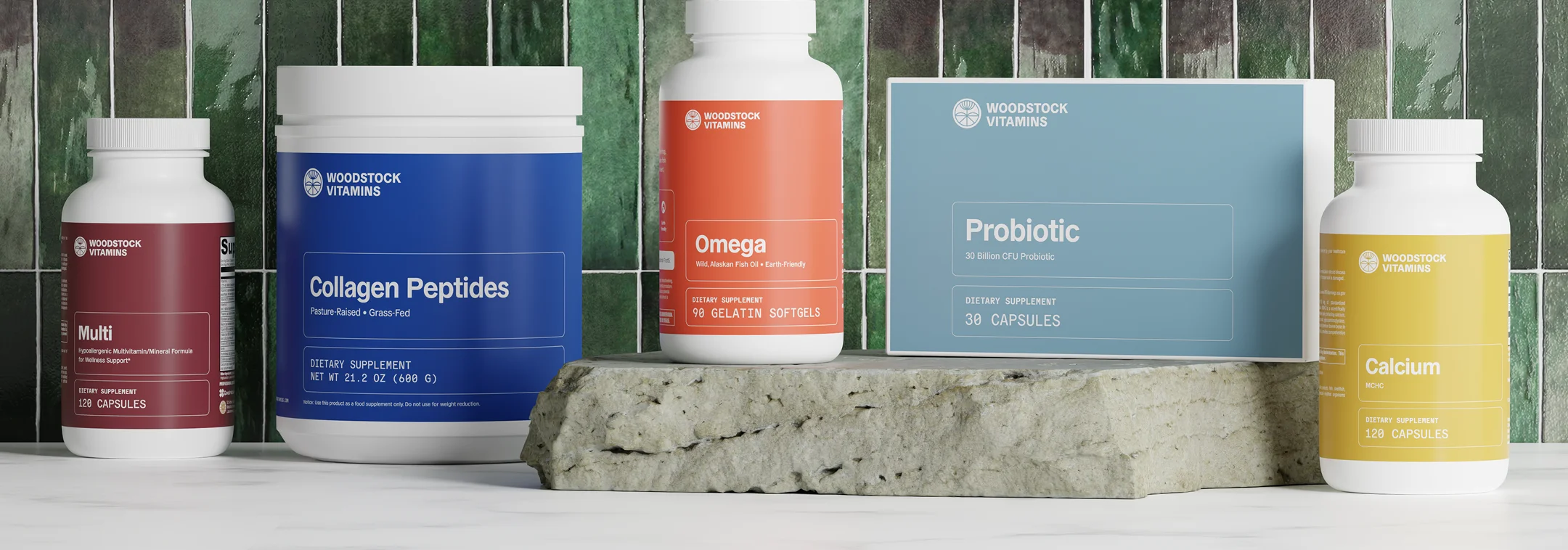
The First5 — Omega, Probiotic, Calcium+D, Collagen, Multi — didn’t get chosen because they were interesting. They got chosen because the evidence behind them is deep, repeatable, and holds up daily, for years, in real people’s routines. That’s a much higher bar than trending, and it’s the only bar we care about.
If a nutrient clears it someday, the model will evolve — the First5 is a living framework, not a fixed list frozen in time. But it evolves because the science moved, not because a headline did.
Trends come and go. Foundations are what you come back to. First things first: take the quiz to find your foundation.
You don't need more products. You need a clear place to start.
You don't need to rush. You don't need to figure it out alone. Two minutes with the quiz and you'll know exactly where your foundation has gaps — and what to do about it.