






Digestive Enzymes: When They Help (and When They Don’t)

Most people who start looking into digestive enzymes are really asking a different question: why does my stomach feel off after certain meals, and what’s actually going to help? Enzymes are one possible answer. For most people, they’re not the first one.
Here’s an honest look at what digestive enzymes actually do, the specific situations where they can genuinely add value, and why — for most people, most of the time — Probiotic is the better place to start.
What Digestive Enzymes Actually Do
Digestive enzymes are proteins your body already produces — in the stomach, pancreas, and small intestine — to break food down into what it can absorb. They handle three main jobs: breaking down proteins (proteases), fats (lipases), and carbohydrates (amylases). Your body makes these continuously, in amounts generally matched to what you eat.
An enzyme supplement is built to add extra enzyme activity around a specific meal or a specific type of food. It isn’t formulated to change the composition of your gut microbiome or provide the kind of ongoing, foundational support the First5 nutrients are built for.
That distinction matters. Enzymes act on a single meal. Probiotics work over time, helping support the balance of bacteria your gut relies on continuously. Different mechanisms, different jobs, different timelines.
When Enzymes Can Genuinely Help
Enzymes earn a place in a routine in a fairly narrow set of situations — not as a general digestion product, but as a targeted response to a specific, identifiable pattern:
- Rich or fat-heavy meals feel harder to sit with than they used to. Lipase-focused enzyme blends are built for exactly this — larger or richer meals where the body’s own enzyme output may be outpaced in the moment.
- Dairy is a known trigger. Lactase supplements target one specific, well-defined gap — lactose digestion — not digestion broadly.
- Enzyme production has slowed with age. Natural enzyme output tends to decline over the years, which is one reason occasional post-meal discomfort becomes more common later in life.
- A specific meal or ingredient reliably causes discomfort, and the pattern is consistent enough to actually name.
In each case, the enzyme is solving a narrow, identifiable problem tied to a particular food or moment. That’s the honest use case — not a general-purpose digestion aid taken with every meal “just in case.”
If digestive discomfort is frequent, unpredictable, or significant, that’s a conversation for a doctor, not a supplement aisle decision.
Why Enzymes Aren’t the Foundation
Here at Woodstock Vitamins, we think of digestive enzymes as a situational add-on — something that may earn a place in a routine later, for a specific reason, once the foundation is already in place. Not something we lead with, not something we recommend by default, and never something we auto-add.
That’s not a knock on enzymes. It’s how we think about anything outside the First5: we say no more than we say yes. A supplement that solves a narrow, occasional problem doesn’t belong at the front of the conversation. It belongs later, after the basics are handled.
Where Probiotic Fits Instead
For most people asking about digestion, the more useful starting question isn’t “which enzyme do I need?” It’s “is my gut microbiome supported at all?”
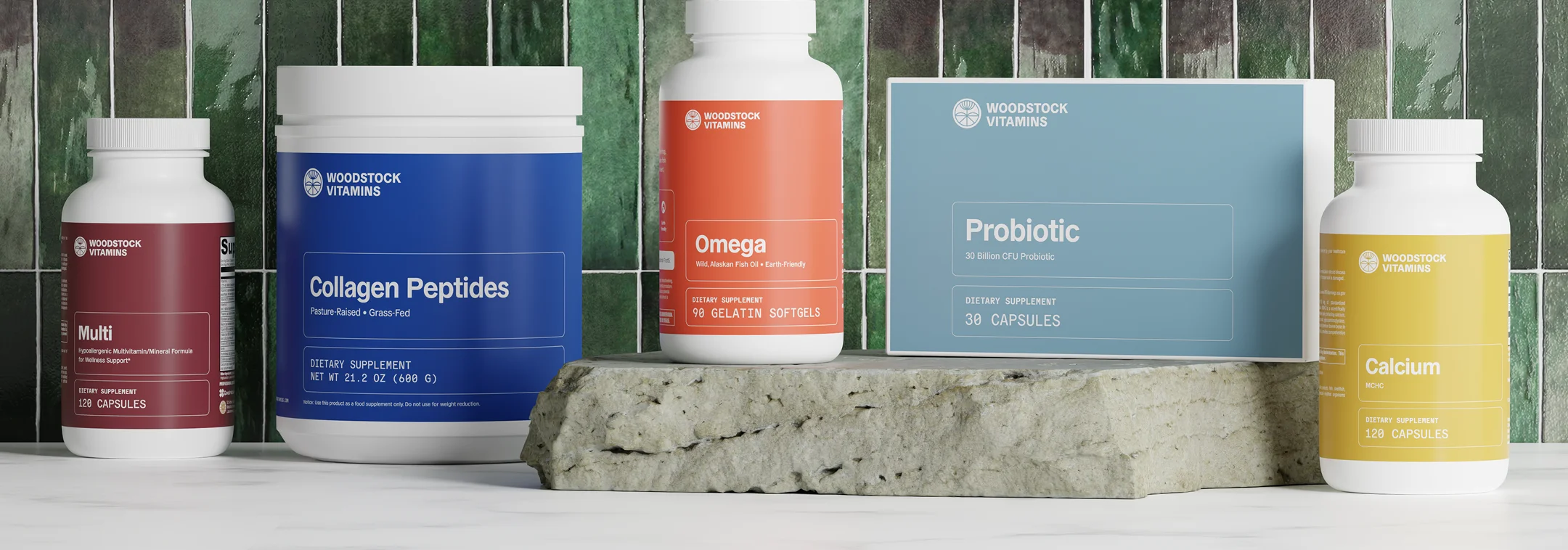
That’s the job Probiotic is built for. Rather than acting on a single meal, it’s formulated with four targeted strains to help support a balanced gut microbiome over time — the kind of ongoing, foundational support a single-meal enzyme dose isn’t designed to provide. It’s also why Probiotic, not an enzyme, is one of the First5: broadly relevant, evidence-backed, and built for daily, long-term use.
For the everyday version of this question — occasional bloating, general unevenness, wanting a steadier baseline — Probiotic is the right place to start. It’s foundational. Enzymes are situational.
The Order That Actually Works
First things first. Start with the foundation: a daily probiotic that helps support the gut microbiome as a whole. Give it time to work the way foundational nutrients do — gradually, with consistency, not overnight. If a specific, nameable pattern shows up after that — a particular meal, a particular ingredient — that’s the moment an enzyme might make sense, added deliberately for that pattern rather than as a blanket fix.
That’s the same logic behind the whole First5 model: get the foundation right before adding anything on top of it. Not because enzymes don’t do what they’re built to do — but because most everyday digestive discomfort isn’t an enzyme problem. It’s a foundation problem.
You don't need more products. You need a clear place to start.
You don't need to rush. You don't need to figure it out alone. Two minutes with the quiz and you'll know exactly where your foundation has gaps — and what to do about it.