







Restorative Sleep: Why Foundational Nutrition Matters More Than Sleep Supplements

If you search “best supplements for sleep,” here’s what you’ll find: melatonin. Valerian root. Magnesium gummies in five flavors. Herbal blends with fourteen ingredients and a dream-cloud on the label. What you won’t find. at least not easily, is the honest answer.
Most sleep supplements are built backwards. They target the symptom while ignoring the system. And the system, it turns out, depends heavily on something the sleep supplement category rarely talks about: what you’re already taking, or not taking, every day.
Sleep is not a switch. It is a biological process. One that relies on nutritional inputs, hormonal signaling, and a nervous system that has been supported (or undersupported) for months. Fix the inputs, and sleep tends to follow. Chase the symptom without addressing the inputs, and the gummies help on Tuesday and nothing on Friday, and you’re back to searching again.
This is the article the sleep supplement category doesn’t want you to read.
Why Sleep Is a Biological Process, Not a Product Problem
Here is what happens when you sleep well: your body cycles through multiple stages — light sleep, deep slow-wave sleep, and REM — in predictable 90-minute windows. During deep sleep, your body repairs tissue, consolidates memory, and regulates hormones. During REM, your brain processes emotion and cements learning. These stages require a nervous system that can downshift, a gut that is functioning well, and a body that has the raw materials it needs to produce the signaling molecules — serotonin, melatonin, GABA — that drive the process.
Those raw materials come from nutrients. Specific nutrients. And most people aren’t getting enough of them.
The sleep supplement category has decided that the answer is to add more products. The problem with that logic is the same problem with most supplement logic: it skips the foundation entirely. It goes straight to optimization before anyone has checked whether the baseline is covered.
The baseline is where sleep is often quietly broken, and the baseline is where the First5 comes in.
The Foundational Nutrients That Support Sleep Quality
Before you add a sleep supplement to your cabinet, the honest question is whether your foundation is actually in place. Several of the First5—the nutrients most people miss and that affect multiple body systems—have a direct, meaningful relationship with how you sleep.

Probiotic: The Superstar for Sleep
This one surprises people. A probiotic is not what most people reach for when they can’t sleep. But it should be one of the first things they consider.
The gut-sleep connection is one of the most underappreciated relationships in the body. Your gut microbiome plays a direct role in producing serotonin, the precursor to melatonin, the hormone that governs your sleep-wake cycle. Research into the microbiome-melatonin pathway continues to develop, but what is already clear is this: gut health and sleep quality are not separate systems. They are deeply intertwined.
A disrupted gut microbiome can compromise serotonin production, which can compromise melatonin signaling, which makes quality sleep harder to achieve and harder to sustain. A well-formulated probiotic — one built around strain specificity rather than raw CFU numbers — helps support a balanced gut microbiome. That foundation supports the gut-brain connection, which supports sleep.
This is not a sleep supplement. It is a foundational supplement with meaningful sleep implications. That distinction matters.
Calcium + D: The Often-Overlooked Connection
Calcium is associated with bones. What most people don’t know is that calcium also plays a role in muscle relaxation and nerve signaling — two things that matter considerably when your body is trying to downshift into sleep. And Vitamin D, which is required for calcium absorption, has its own separate relationship with sleep quality through its role in immune modulation and overall systemic balance.
Vitamin D insufficiency is common — even in people with otherwise strong diets and reasonable sun exposure. Closing that gap helps support bone health, immune function, and the kind of systemic stability that sleep depends on.
Omega-3: The Long-Game Nutrient
EPA and DHA — the omega-3 fatty acids in a well-formulated fish oil — help support brain health and the body’s normal regulatory processes. Quality sleep is, at its core, a brain health practice. The long-term consistency of omega-3 supplementation supports the same systems that, over time, support more stable sleep.
This is not “take omega-3 tonight and sleep better.” It is “a body that is better nourished at the foundational level tends to function better across system and sleep is one of them.” That is a slower, less marketable story. It is also the true one.
Why Most Sleep Supplements Miss the Mark
The sleep supplement category has a specific problem: it sells the feeling of doing something without fixing the underlying thing.
Melatonin is the most instructive example. It is not a sleep aid in the traditional sense; it is a hormonal signal. It tells your body what time it is. For jet lag, for shift workers, for specific circadian disruptions, it has real utility. As a nightly sleep supplement for someone who is simply struggling to sleep, the question is rarely “am I short on melatonin?” The question is “why is my melatonin not signaling correctly?” — and that question leads back to the gut, to nutritional gaps, to light exposure and cortisol rhythms.
Herbal blends have a similar pattern. Valerian, passionflower, and lemon balm have some evidence for relaxation support, though the evidence base is modest and the quality variance in products is enormous. They can be worth exploring. But they belong in Component 3 of a supplement strategy: they are what you want, after what you need is locked in.
Taking a 14-ingredient sleep blend while your foundational nutrition is incomplete is the supplement equivalent of renovating the guest room before fixing the foundation. It might make things temporarily more comfortable. It does not fix the structure.
Magnesium: The Most Common Add-On for Sleep and How to Think About It
Magnesium deserves its own honest treatment, because unlike most sleep supplements, the evidence for it is real.
Magnesium plays a role in over 300 enzymatic reactions in the body. It is involved in muscle relaxation, nerve function, and the regulation of the nervous system’s stress response. Magnesium glycinate, in particular, has been studied for its relationship with sleep quality, specifically its role in supporting the GABA pathway, which is the inhibitory signaling system that helps the nervous system calm down.
Intake of magnesium is low across populations. For people who are already doing the foundational work, magnesium is a legitimate next step for sleep support.
But the form matters. Magnesium oxide — the cheapest and most common form — is not the right answer here. Magnesium glycinate is the form with the most relevant evidence for sleep and relaxation support, and it is better tolerated by most people.
The one thing to be aware of: Magnesium is an add-on, not a foundation. It is not in the First5 because it does not meet the threshold for a foundational-first recommendation. But for someone who has the First5 in place and is looking for additional sleep support, it is the most evidence-grounded next step in this category.
The right order is: foundation first, then magnesium. Not the other way around.
What Else Actually Matters
Supplements — even the right ones, taken consistently — support a practice. They do not replace one. And for sleep specifically, the lifestyle inputs are substantial enough that ignoring them while focusing on supplements is a real mistake.
Light
Your circadian rhythm is governed by light. Bright light in the morning, ideally natural light within an hour of waking, helps anchor your sleep-wake cycle. Blue light from screens in the two hours before bed disrupts melatonin signaling in a way that no supplement fully counteracts.
Timing
Your body sleeps better on a consistent schedule. Going to bed and waking at the same time, including weekends, is one of the most consistently supported interventions in sleep research. The supplement industry will not sell you this because it is free.
Temperature
Core body temperature drops during sleep onset. A cool room, around 65–68°F for most people, facilitates that drop. Warmth before bed (a shower, a bath) followed by a cooler environment can help accelerate the transition.
Consistency over intervention
The supplement industry trains people to think in terms of products they take when they have a problem. Sleep doesn’t work that way. The body responds to sustained inputs over time: consistent nutrition, sleep timing, and light exposure. The people who sleep best are usually not the people with the most elaborate supplement protocol. They are the people who have done the boring foundational work and kept doing it.
The Honest Starting Point for Better Sleep
If you are struggling with sleep, the most useful question is not “which sleep supplement should I add?” It is “is my foundation in place?”
That means: are you getting the nutrients that most people are missing — the ones that help support the nervous system, the gut, the brain, and the hormonal signaling that sleep depends on? If not, that is the starting point.
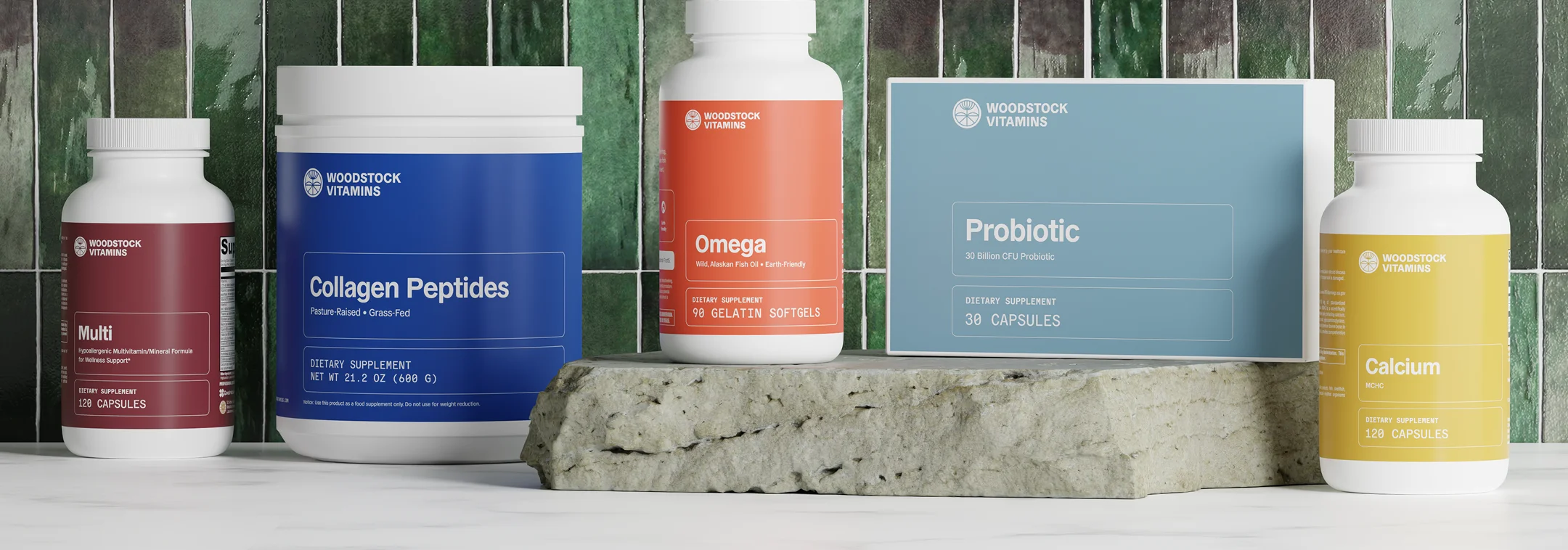
The First5 is that starting point. A well-formulated probiotic — built around strain specificity, not CFU marketing — is the most relevant piece for sleep specifically. Calcium+D and Omega round out the foundation in ways that matter for the systems sleep depends on. Once the foundation is genuinely in place, magnesium glycinate is the most evidence-grounded add-on for sleep support. Not before.
This is not the answer the sleep supplement aisle wants you to hear. But it is the answer that actually moves the needle. Start with the foundations, and good sleep will follow.
You don't need more products. You need a clear place to start.
You don't need to rush. You don't need to figure it out alone. Two minutes with the quiz and you'll know exactly where your foundation has gaps — and what to do about it.